
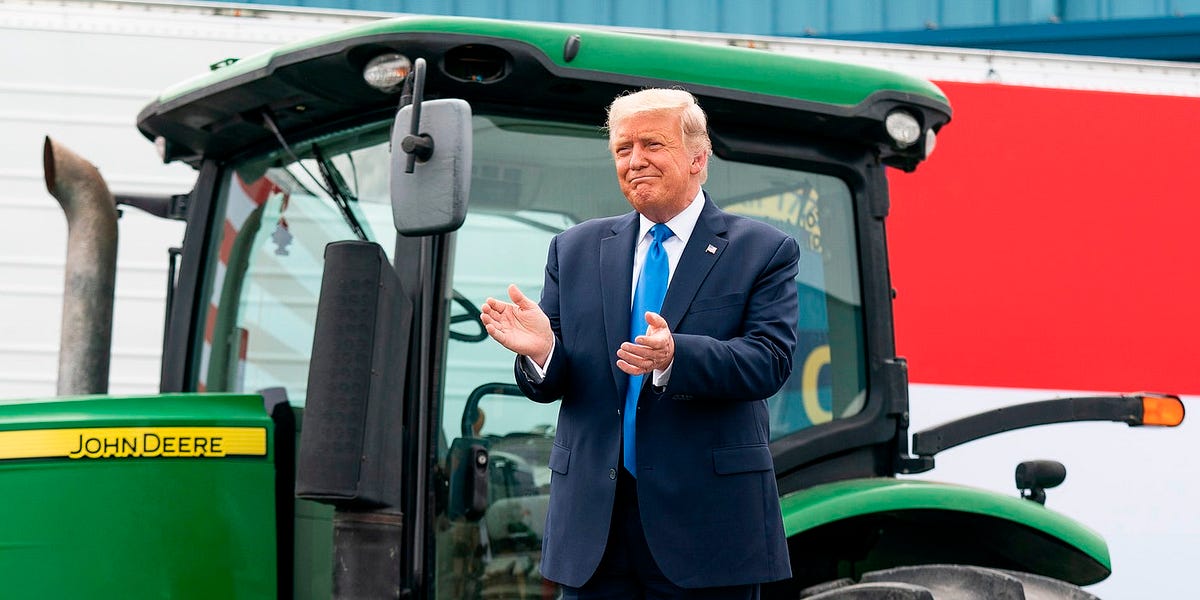
 President Trump, about to get into a tractor and make “Vroom! Vroom!” sounds (Official White House Photo by Shealah Craighead)
One of the key through-lines of conservative social policy is that the average person who receives a direct government benefit like Medicaid or food stamps is a contemptible parasite, one whose need for government support is evidence of their poor character. If they must be given any help at all, it should be accompanied with stern lectures and rituals of humiliation like drug tests and endless paperwork, so they have an incentive to change their malingering ways.
But not all who come to the government with palms outstretched receive this treatment. To wit: President Trump just announced a $12 billion bailout for farmers, who have seen their livelihoods upended by his mindless trade war. In case you haven’t followed this story, Trump imposed tariffs on China, which then retaliated by cutting off its imports of US agricultural goods, especially soybeans. The taxpayer will be now be paying those farmers to cover their losses, or at least some of them. Trump says he has now received assurances from Xi Jinping that China will be importing more of our soybeans, which might or might not happen to the degree Trump claims.
Everyone knew this would happen, because it’s an almost note-for-note replay of what occurred in Trump’s first term: He imposed tariffs on Chinese goods, the Chinese retaliated by cutting off agricultural imports, and Trump gave a total of $61 billion in bailouts to farmers, almost all the tariff revenue assessed on Chinese goods. His trade war accomplished nothing other than forcing American importers and consumers to pay for a farm bailout. And we’re going to do it all again. Not only that, we’ll probably have to keep giving farmers more bailouts for the next three years, because Trump isn’t going to negotiate “deals” that return exports to where they were before he started this trade war.
But isn’t it unfair to call the farm bailouts welfare? It isn’t the farmers’ fault that they need this money! They’re noble custodians of the land, not layabouts! Well, sure. But maybe the problem is that conservatives want everyone to believe that a cashier who needs Medicaid is undeserving of support, while a farmer who needs a bailout is a virtuous person who deserves our help. What if it’s all welfare, and welfare is fine?
One thing you hear a lot from farmers commenting on the trade war/bailout cycle Trump subjects them to is that this isn’t what they want; they’d much rather sell their wares on the open market and succeed on the sweat of their brows. Even Trump said something like this in his ridiculous White House event announcing the bailout, in which he also talked a great deal about “love”:
Yeah, we’re going to make the farmers so strong, and I’m not even talking about financially, because they just want to be able to produce what they can produce. We’re going to make them so strong that it will be indeed a golden age for farmers.
You know, we had it going in the first administration, and then Biden came in and ruined everything. They had no idea what they were… They did. I mean, I think they wanted, they hated the farmer. I love the farmer. That’s why I got 94% of the vote from the farmers, but they hated the farmers. I love the farmers.
That 94% number is of course completely made up (there isn’t any reliable polling I’ve seen of farmers, who are a tiny portion of the population and thus difficult to poll), and of course Trump only “loves” farmers in the sense that as a lifetime con man he loves every mark gullible enough to let themselves be suckered by him.
But Trump is basically right when he says “they just want to be able to produce what they can produce,” although it’s more accurate to say they want to be able to sell what they can produce. Which they haven’t been able to do, because of Donald Trump.
So while this particular bailout is maddening because of how unnecessary it was, we can grant that farmers would prefer to be self-reliant, and in some ways, they are. Farmers pride themselves, for instance, on having the knowledge and skills to repair a variety of processes and machinery they use on their farms. But that doesn’t mean they’re as independent and self-sufficient as so many of them would like to believe.
That’s because farmers are embedded in a system that is designed to ensure that they can continue to produce food for everyone to eat. They are propped up by a web of government supports — price supports and loan programs and government-funded agricultural research and much more. So are the communities in which they live: There are over 400 federal programs focused on promoting economic and community development in rural areas.
And you know what? That’s fine. I don’t begrudge farmers all that help, funded with my tax money. What they do is important, and we all want them to have financial stability and fair treatment. But we ought to feel the same way about everyone in our society.
Because none of us are truly independent, and we all rely on the government. Your life has been supported by government help in a hundred ways, whether it was direct or indirect. We drive on roads the government built, those of us who aren’t rich go to government schools, we have reliable electricity and water and sewage systems thanks to the government, and you can be reasonably sure that when you buy a chicken sandwich it isn’t glazed in E.coli, because we have food inspectors. We live in a society with basic rules and laws that allow modern life to exist, because of the government. We’re all participants, and we all rely on systems that are created and maintained by each other.
When you realize that, you can’t help but notice that some of the people who shout the loudest about how independent they are and how much they despise the government meddling in their lives are the people who have benefited the most from it. Like farmers, yes, but also techno-libertarian billionaire douchebags complaining about the gentlest regulation, when it was the government that created the internet in the first place and made everything they do possible.
So yes, farm country is full of welfare queens, and so is Silicon Valley. So are cities and suburbs and small towns. I’m a welfare queen, and so are you. And there’s nothing wrong with that.
Thank you for reading The Cross Section. This site has no paywall, so I depend on the generosity of readers to sustain the work I present here. If you find what you read valuable and would like it to continue, consider becoming a paid subscriber.