
Later, we made our way to Schmuck, an East Village cocktail bar where the furniture includes vintage Togo seats, Eames chairs, a hype-y silver floor-to-ceiling tension rod bubble lamp, and, among it all, Westman’s round baby blue dining table. Whether he’s designing custom furniture or big-box store plates, Westman’s work is so childlike-joy-filled that it can seem deceptively simple. But simple doesn’t mean effortless. “It’s easy to underestimate the task of creating a collection,” he says. Plus, “it’s hard to deal with people’s expectations when they don’t know how the process works. It’s so much to design these things, and I have to reset afterward.” Despite the effort, the IKEA collab proved to be more than worth it for Westman. “I’ve said no to all the collabs,” he says. “But now I’m gonna start saying yes.”
While the designing is one thing, the rollout of a collaboration is more fraught—even for the happiest man in design. “I have to accept that social media has been important for me. I couldn’t show my stuff without it. It’s very democratic in that sense,” says Westman. Still, he learned the truth to the poet’s immortal warning, “Haters gonna hate.”
In a digital-first world, giving feedback is as easy as pressing an anonymous few buttons. “I get a lot of comments like, ‘You know, this is just adding more waste to the world, an unnecessary object,’” says Westman. “And I’m like, yeah, obviously, but it’s like, so is everything else,” he says. “Plates are super functional, and those already exist.” Westman is more concerned with the context of a design: “What’s interesting for me is how you connect with the time we’re living in, and the shapes. Obviously, someone has made it before, but that’s not the important thing.”
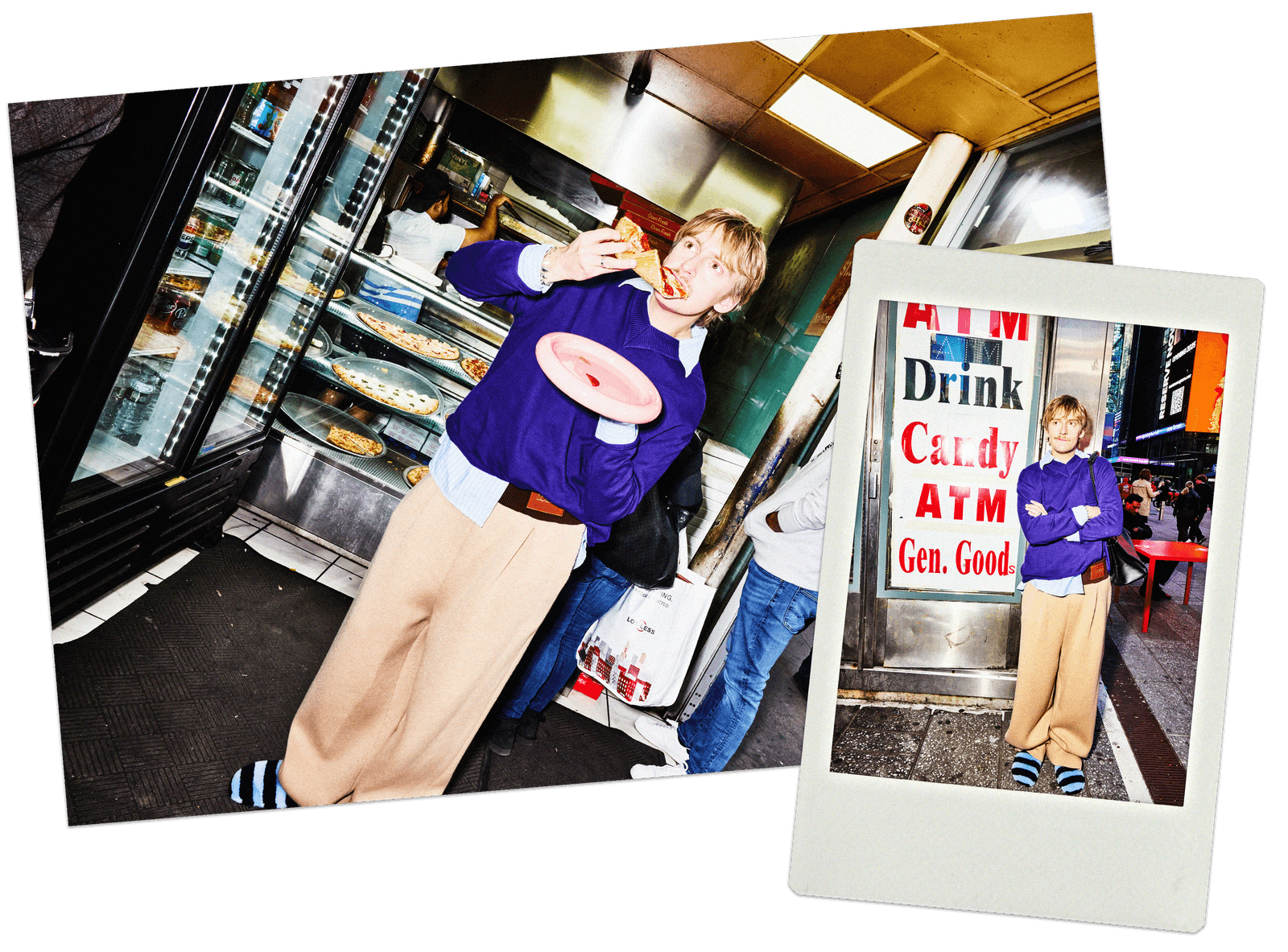
Westman (in an Ouer sweater and Loewe pants and shoes) stops for a slice.