
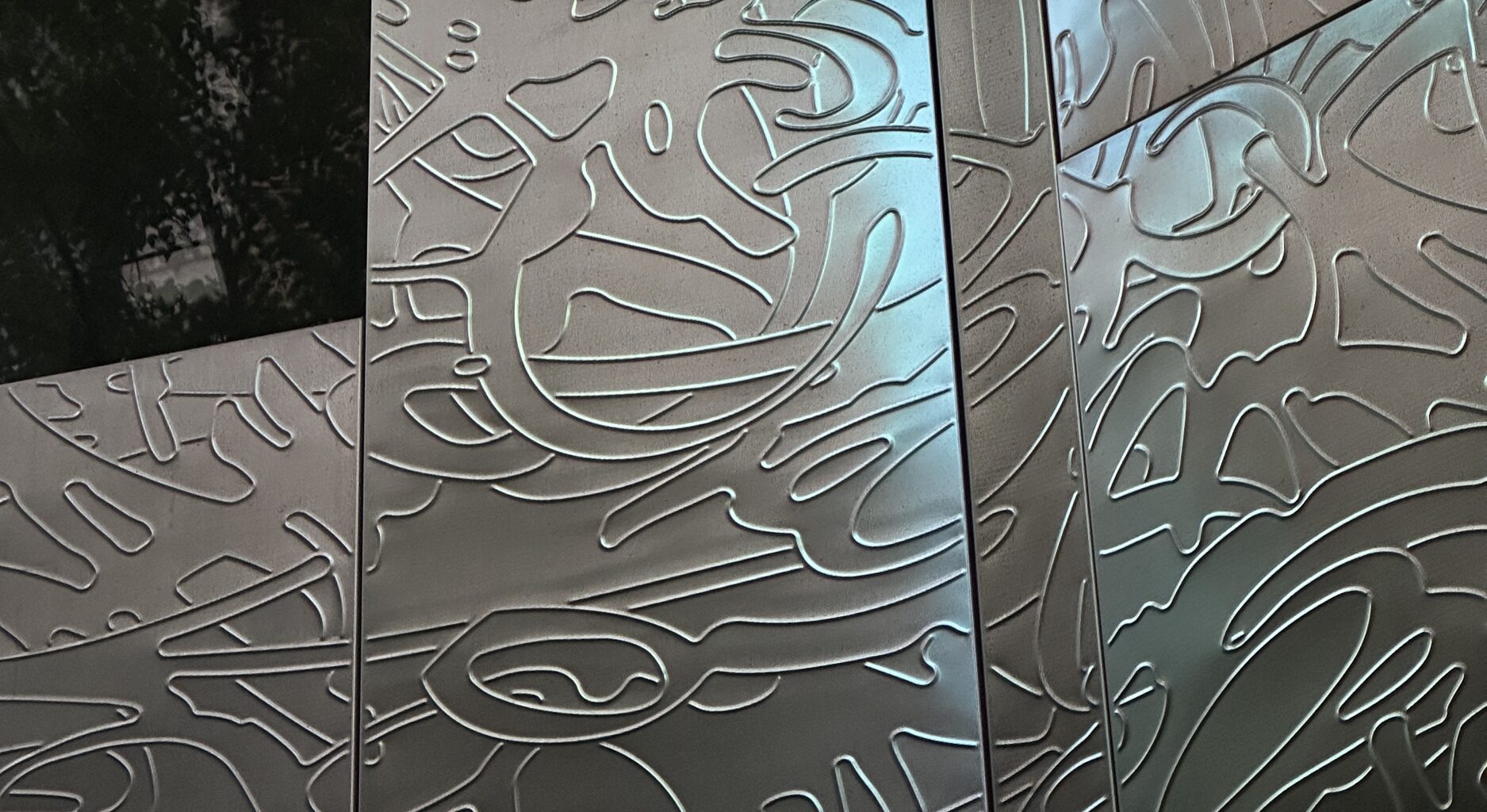
This anonymous building provides a sound background against which to read Entramados Materiales.7 Like our case study, the installation produced by the architecture practice salazarsequeromedina for this year’s Architectural League Prize exhibition resists an easy description.8 Both structures evade the formal clarity or symbolic content necessary to convey specificity—they comfortably retreat one step short, inhabiting a state of almost somethingness. If the wedge building in NoHo is a causal object formed by the city’s infrastructural, economic, and regulatory forces, then Entramados Materiales is its speculative twin: an idiosyncratic simulacrum portraying contingency, redundancy, and misalignment as a formal language. Installed across three identical, white-walled cubicles at Pratt Institute’s MFA studios in Brooklyn, the piece consists of three structures built from a combination of off-the-shelf materials and bespoke elements arranged in three—intentionally ambiguously labeled—archetypes: Shelf/Tower, Table/Canopy, and Bench/Bridge. These assemblages combine drywall steel studs, clamps, aluminum profiles, live-edge wood slabs, and galvanized HVAC fittings, along with small elements designed and built by the architects, in three uneasy compositions that lack a singular dominant form, logic, or identifiable gesture. Yet, some of these elements and the relationships between them suggest familiar architectural elements, such as ramps, awnings, columns, slabs, roofs, or guardrails—but never quite stabilize into recognition. As such, the installation can be considered a study on insufficiency—a refusal to resolve into legibility.
My goal here is to offer the notion of Almost Something as a lens through which to reconsider both Entramados Materiales and buildings like the one at the corner of Lafayette and Mulberry. Fundamentally, these structures resist completion, occupying a space between being and not being. They recall Giorgio Agamben’s ideas on potentiality—by not only having the ability to become something but also the capacity to remain unactualized. In that suspension, architectural form is held open, refusing finality and, from a Heideggerian perspective, existing in time through its entanglements with the world around it. This understanding shifts architecture away from the static, autonomous object and toward being-in-the-world, where meaning and definition emerge through context and perception, thus challenging the conventional authorial relationship between the architect and their work. On a more prosaic level, Almost Something allows us to reevaluate what might otherwise appear as automatic, unintentional, or banal. It invites us to see makeshift or mundane structures—those often overlooked by the discipline—as conceptually rich, not as resolved forms, but as lingering possibilities.
For a young practice whose previous work is characterized by formal rigor, legibility, and precision, Entramados Materiales signals an exciting and meaningful shift. Where salazarsequeromedina usually works through clear and definitive formal strategies, this installation embraces indeterminacy and hesitation. It relinquishes control in favor of something less ordered, more open, more poetic. In doing so, it quietly resists architecture’s long-standing tradition to be read—whether through classical form, a modernist diagram, or even graffiti—and instead offers a phenomenon that is content with being noticed, potentially misread, and hopefully revisited. Just like the odd wedge in NoHo, Entramados Materiales stands as a record of accumulated decisions, constraints, and improvisations. However, unlike the wedge, it does so knowingly, performing its ontological ambiguity as a proposition for reconsidering architecture. To disregard structures that are almost something as simply “unfinished” would be to miss the point entirely. Almost Something is not awaiting completion but intentionally remains in progress, occupying the moment just before resolution. Structures built and evaluated from this vantage point stand in opposition to architectures of total clarity—where every millimeter has been considered, and every detail asserts control—affirming instead their architectural value by remaining fragile, strange, and full of possibility.