
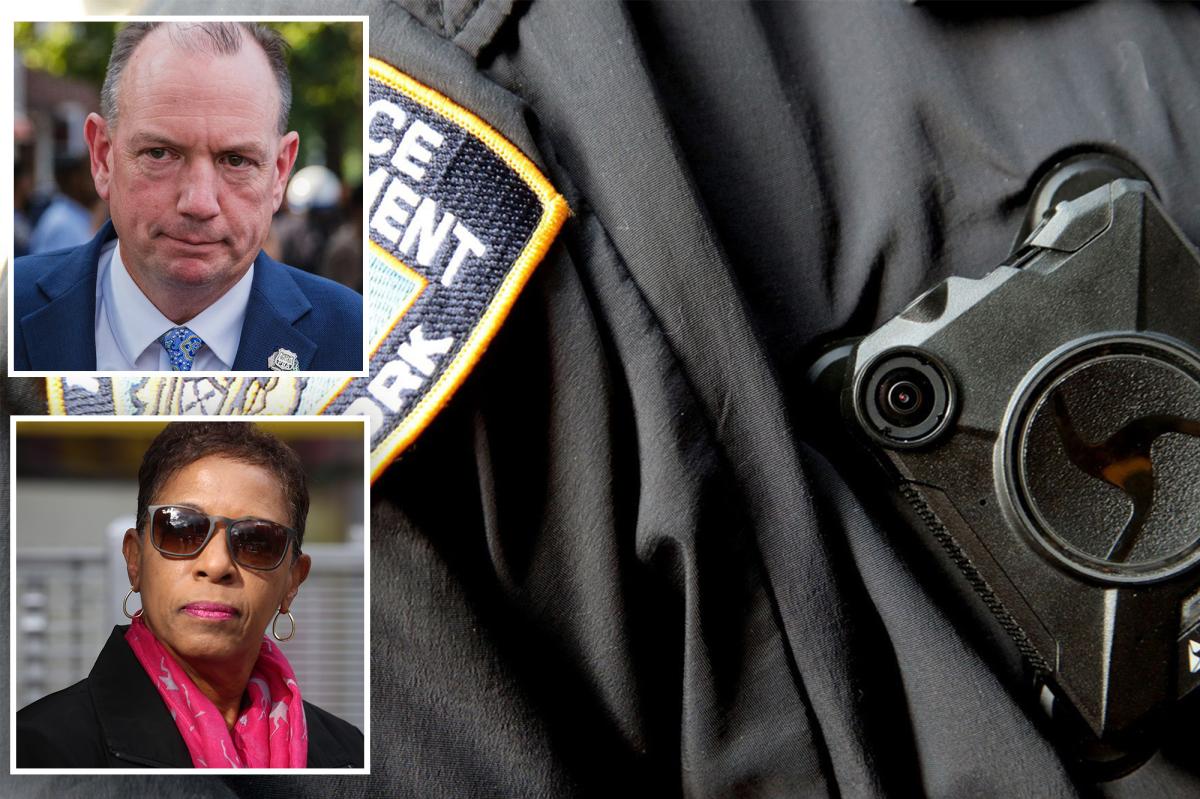
The City Council plans to ram through a controversial bill giving the NYPD’s civilian watchdog direct access to body-worn camera footage — despite cops ripping it as an “unnecessary” power grab, The Post has learned.
Outgoing Council Speaker Adrienne Adams will be putting the first-of-its-kind law up for a vote by the full 51-member body next week, while privately boasting to members that it will be part of her “legacy,” insiders said.
The bill — introduced by Adams and co-sponsored by a slate of leftie lawmakers, including Democratic Socialists of America council members Tiffany Caban and Shahana Hanif — would give the Civilian Complaint Review Board real-time access to the NYPD servers storing police videos.
City Council Speaker Adrienne Adams is term-limited and set to leave office at the end of the year. James Messerschmidt
The police department’s largest union railed that the law would continue to force cops off the job by putting officers in the crosshairs of a CCRB emboldened by the new expanded powers.
“Council members need to understand the message they’re sending to the cops in their neighborhood,” Police Benevolent Association President Patrick Hendry said Wednesday.
“The unfairness at CCRB is already a major factor driving police officers away from this job,” he said. “By pushing this unnecessary and legally unfeasible bill to grant CCRB even more power, the Council is actually pushing more dedicated, talented cops out the door.”
The PBA and the council members opposed to the bill argue it could actually violate state law, citing the Clean Slate Act, which bars authorities from handing over troves of criminal case evidence after a certain period of time or if the charges were dismissed.
Start your day with all you need to know
Morning Report delivers the latest news, videos, photos and more.
Thanks for signing up!
“This dangerous CCRB bill would force the NYPD to hand over sealed body-cam footage in clear violation of state law, blowing up privacy protections and due process,” railed moderate Democratic Councilman Bob Holden (Queens-District 30).
“Instead of backing our cops, the Council is pandering to an anti-police board and putting public safety at risk,” said Holden, who is term-limited and will leave office at the end of the year.
Investigators at the independent oversight agency currently have to request footage from the police department, and the NYPD reviews the video before handing it over.
Patrick Hendry, president of the PBA, the NYPD’s largest union, railed against the proposed bill. Stephen Yang
The CCRB has long griped that the NYPD has dragged its feet on a number of these requests, particularly when the agency was probing complaints against cops during the George Floyd protests in 2020.
The average turnaround time for bodycam footage in 2025 was eight days, the agency said.
Supporters of the bill argue it will boost police transparency and speed up investigation times for the CCRB, which can bring disciplinary cases against cops accused of wrongdoing.
Roughly a dozen council members, including the six Republicans, are opposed to the measure, per The Post’s count.
But it is still expected to pass when members vote on it Dec. 18, sources said.
The law would give the CCRB real-time access to NYPD servers. TNS
Mayor Eric Adams, no relation to the council speaker, didn’t say whether he would try to veto the bill should it pass before he leaves office at the end of the year.
Even if it was nixed by the mayor, the incoming council next year could still move to override the veto.
Mayor-elect Zohran Mamdani, who takes office Jan. 1, 2026, hasn’t said whether he backs the bill, but has previously argued for expanded powers for the CCRB.
The city’s Office of Management and Budget said the measure would come with a $10 million price tag for the software and hardware necessary to set the watchdog agency up with real time access to the footage.
The cost could balloon even higher, with OMB expecting a new unit will be needed to manage the data being collected. The council, however, wrote in a fiscal impact summary that it believes the NYPD’s existing unit could handle such duties.
A council spokesperson said that “all bills will comply with state law” and that there would be a two-year runway to create the necessary software systems.
“These wildly exaggerated doom-and-gloom predictions to oppose transparency have become far too routine, but the vast majority of police officers will not be impacted by this technical change,” a council rep added.
“In reality, it is the management decisions made within the department that most affect rank-and-file officers’ job quality of life.”