
Folk Songs
Gagosian
November 6–December 20, 2025
New York
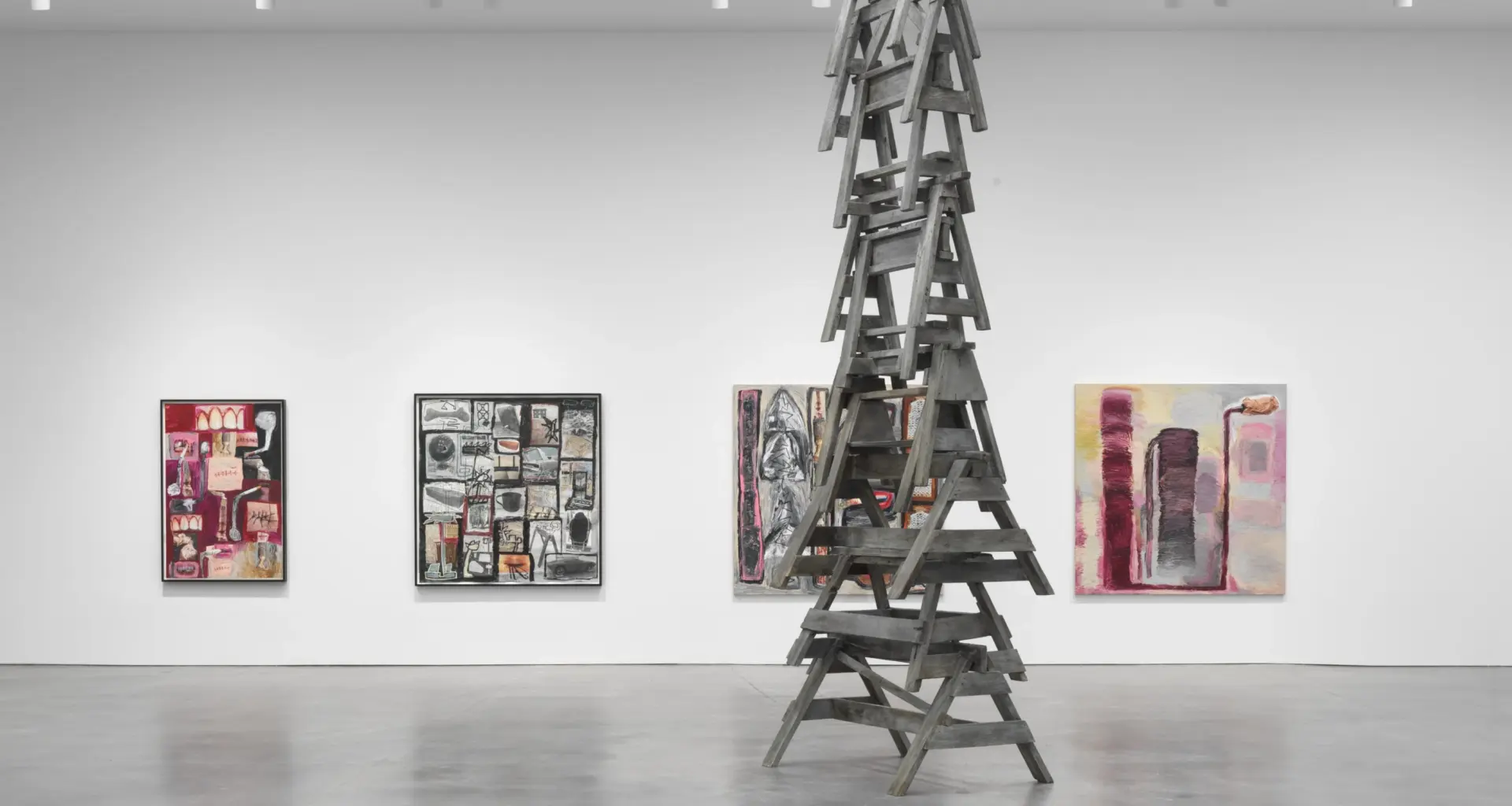
Gagosian Gallery’s Richard Prince: Folk Songs deploys a suite of leitmotifs—scrawled ajar hexagon coffins, rephotographed bleeding blunted teeth, tessellated steel microphones, polygon-fuming impastoed cigarette butts, austere and unpainted picket fences, closed eyes with antenna lashes scraped, sutured, extended, and wooden sawhorse trestles (to name but a few)—into a concatenation. The source imagery is sometimes anchored in a photograph by Prince, but is often a rephotographed appropriation. Elsewhere it originates from a hastily drawn pen-on-paper flat delineation, evidenced by approximately twenty outlines executed in 2019 and 2020 that introduce us to the imagery we find repeated throughout the show’s canvases. Blearily dashed and traced on photographic surfaces, the ladders, flame-bursting cigarettes, and clanged teeth broadly hew to ruby-rouge flesh tones flanked by metallic grays. Often, the various nodes are collated into gridded, matrix-like collages. The points of conceptual closure, however, do not much reveal themselves, should they even exist. Prince’s connotative bridges consist in visceral reception: sheer sense data. That is, the system that webs Prince’s vectors into a chain of possible meaning has little to do with that which he and his “Picture Generation” colleagues are best known for: second-order and post-authorial selection, of a piece with coeval, epochal, technological affordances and media habits. The exhibition’s title, Folk Songs, already indicates that Prince’s concern is far from digitality, new media, and the internet; this is compounded by revelations that both the reiterated cabin motif is representative of his childhood, and that the purple pants adorning the painted bronze Untitled (Hippie Pants) (2019–20) are his own. However personal they are, however, the images are hardly intimate. Their relative “extimacy” is due to their comparable ineffability and meaningless for those who do enjoy nostalgic attachment to them. Paradoxically, were these images selected from recognizable fashion, advertising, or social media platforms, they would allow for conceptual entry. By instrumentalizing motifs forlorn but not wholly objective, Prince denies viewers such cognitive entry.
The images are not particularly optically pleasing and one can hardly imagine Prince intended them to be, given how crudely he has painted and overpainted his already repellent motifs. Uneven teeth pool a wine-blood admixture at their edges. Cigarettes spill hazy gray microphones and hoary brush-blocks. None of this is executed with much care for verisimilitude or verism, distancing Prince from the Surrealist tradition of Salvador Dalí, Yves Tanguy, and Max Ernst. The closest Prince approaches the latter convention is in a burnt orange 2022 canvas, where he minimizes his overwrought imagery into a tripartite progression: an almost entirely smoked cigarette butt sits inside a hazy pair of misshapen cherry lips bereft of teeth. The shimmering, crusted block does not quite plume or smoke; rather, it pulleys out from the cigarette (and, curiously, not the mouth) like a rectilinear speech bubble. Such simple compositions appear infrequently in this series, though they are welcome reprieves, allowing the viewer to home in on and appreciate the compounded oddities.
When presented in maximalist collage fashion—as Prince is wont to do in his larger collages—what might otherwise be uncanny is neutralized. In a rectangular 2022 canvas, the faintly delineated outline of a basketball backboard (which features as a black-and-white photograph in another collage) is multiplied into hurried carmine and plastery square segments. These raw silhouettes are occasionally broken by finely contoured ink drawings and photographs of sawhorses, a suburban home, racecars on cinderblocks and, as is the case in a 2021 iteration, a sculpture of a cartoon dog.
The fleshly pink-red palette, sustained across the show, is Philip Guston’s. But Guston judiciously contained his bursts of coral red within hooded men’s cloaks, figuring it into bloodshed stains. Without oblique figuration, Prince’s ichor is but bloody paint unto itself—sickly paint that licenses phenomenology equally depurated of critique and of subject as it is of a form. What Prince produces, then, is often free-floating and unconnected phenomenology, a series of would-be concepts received via sensoria. Prince has rejected Guston’s lesson, imparted in the latter’s “Faith, Hope, and Impossibility” (1965–66). Guston writes:
The canvas you are working on modifies the previous ones in an unending, baffling chain which never seems to finish. … For me the most relevant question and perhaps the only one is, “When are you finished?”
Guston then settles on an answer: to finish is to “compromise,” which is conditioned by a “decision.” Although “[d]ecisions to settle anywhere are intolerable” for the artist, “painting proves its right to exist” by enforcing and imposing the decision. In Prince’s case, he has—with the exception of those sparse paintings in which he has exercised restraint, such as in the aforementioned orange canvas—broadly refused to settle anywhere. Prince admits as much, telling his Vanity Fair interviewer, “I’ve always liked the idea of taking as much subjectivity out of the image—or interpretation, which is what usually is associated with art. … You sort of remove the umpire, the critic, the opinion.” Shirking interpretability can, nevertheless, at times reveal operative concepts; if the images belong to a common kind, they betray previously unrecognized shared features within a genre or phenomenon. With Folk Songs, this is not the case, as the images are too varied—in source, media, and application. By not deciding upon a conceptual system, Prince also abdicates the viewer’s ability to understand or judge his painting vis-à-vis an appeal to artistic intentions. Where in the past, Prince’s collecting images remained attuned to a medium or platform (e.g., magazines, movie stills, Instagram), these new collages remain unanchored.