
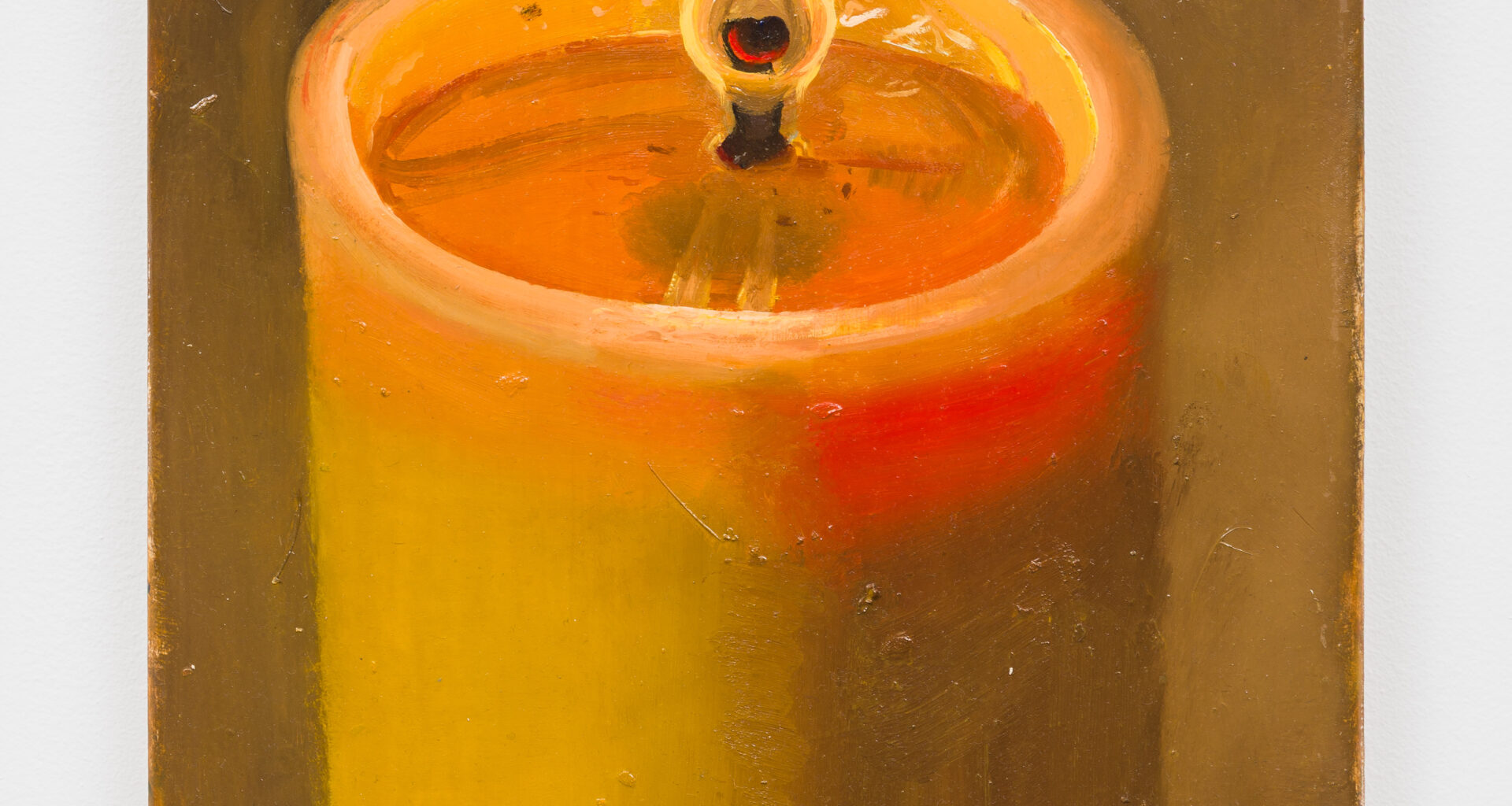
Paintings from the Orange Room
P·P·O·W
October 31–December 20, 2025
New York
Phoebe Helander’s first solo exhibition in New York City, Paintings from the Orange Room at P·P·O·W, is an auspicious debut consisting of nearly fifty intimate still lifes that make legible her attention to objects over time. On imperfect wood panels approximately the size of a book spread, Helander paints various flowers, burning candles, and quotidian possessions—a folding mirror, a packet of matches, a stack of dollar bills, a halved lemon—deploying subtle formal strategies to convey her observations. Helander made each of the works on view in a single session lasting between four and ten hours, continually describing the item at hand according to the shifting conditions of light and form.
This endeavor becomes particularly dramatic when Helander takes burning candles as her subject. As she paints these self-destructing objects, the beeswax melts and congeals in new shapes, the wick grows tiny burls, and the flame alternatively flares and diminishes to a smolder. In a recent talk at the New York Studio School, the artist likened the pursuit of these transient features to chasing a runaway train. “My goal,” she said, “is to stay with the flame.” From this process, Helander creates images that simultaneously contain a duration of time (metaphorized as the accretion of wax) and articulate a decisive moment (the flame). Of the eighteen candles in the show, the most recently ignited are Candle Burning III (2024) and Candle Burning XIII (for Ines) (2025), which maintain their original shapes even as their rims begin to blush with heat. Both Candle Burning IX and X (both 2025) portray a wide, stubby candle cupping a pool of melted wax, blazing hot as it nears the end of its life. In Candle Burning XIV (for Aaron & Jacob) (2025), Helander zooms in on the blackened wick, its burls enveloped by roiling strokes of orange, blue, and brown.
The most poignant of the Paintings from the Orange Room are self-evident in their condensation of time, even if the ephemerality of the subject matter is not quite as obvious as that of a melting candle. For starters, there is the monolithic Unlit Candle (2025), whose pristine wick functions as a sundial, casting a fanned-out shadow on the undisturbed plateau of wax below. Encircling the candlestick are gradations of shadow applied in short, meticulous strokes, in which Helander has managed to inscribe the slow passage of hours.
In her paintings of bowls of liquid, the artist conjures an atmosphere of enduring stasis. Branch with surface tension (2025) shows a leafy green plant in a bowl of cool water, surrounded by fallen leaves. The order of operations is key: she painted the tabletop and bowl, abraded large swaths of the painting’s surface, and then added the water and plant. The bowl and the tabletop it rests upon are partly erased from the scene, conflating these elements in their mutual degeneracy. Vitalized by contrast, the motionless water assumes a spiritual peace—the kind only found in spaces long left dormant.