
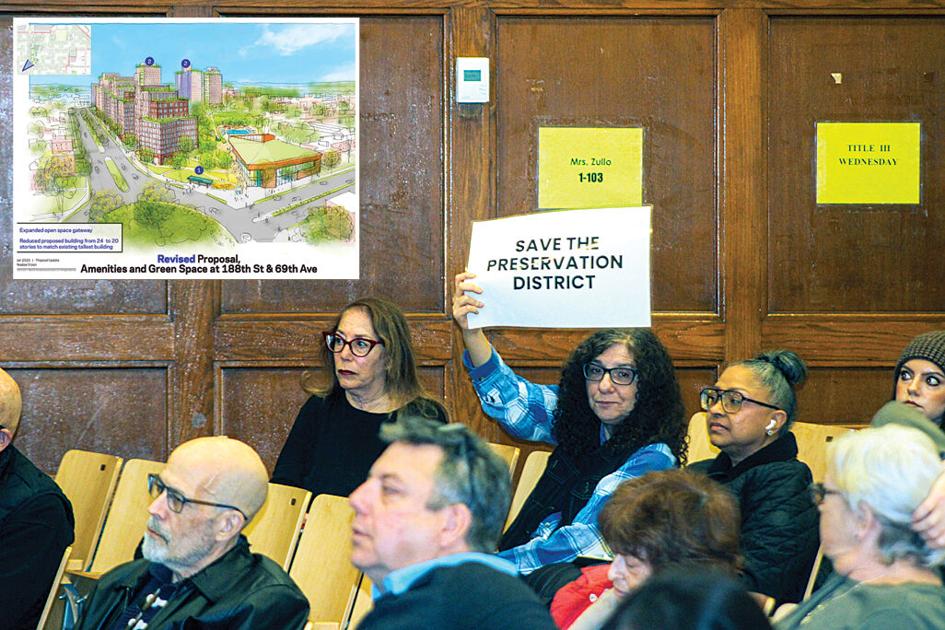
Promises to reduce the height, size and number of newly proposed high-rises in Fresh Meadows did little to sway the hundred or so residents who showed up last week on a cold night for the unveiling of the latest plans to build more housing in their Queens neighborhood.
Inside the auditorium of the Rufus King School in Fresh Meadows on Dec. 3, the development’s owners laid out their latest plans for building and selling more apartments in the area. Built in various stages, initially in the 1940s by New York Life Insurance Co., the Fresh Meadows Apartments now include nearly 3,200 units in 140 buildings, and is owned by New York residential real estate kingpin Rubin Schron, who bought the buildings in 2001.
Schron’s company set up the meeting. Back in May representatives started making rounds to present plans to build 2,000 new apartments. “Fresh Meadows Vision intends to build upon the history of Fresh Meadows as a family-friendly and welcoming home to many generations of New Yorkers,” his company said in a press release.
Concerned residents in the complex and the surrounding neighborhood responded by reviving a dormant local group called the Committee for the Preservation of Fresh Meadows, with the idea of opposing such plans.
In October, the group convened some 50 to 100 people at 188th Street on a chilly weekend afternoon, and, in the cold, they chanted lines like “When they come back and offer us less apartments, what do we say?”
“We say no!”
A little over a month later, that’s just what the buildings’ owner did.
The newest plans would “reduce the overall number of new units from 2,000 to 1,200, reduce the total number of [new] buildings from 14 to 8, reduce the number of units that would need to be relocated from 102 to 22, increase the parking ratio and lower the tallest buildings so they’re the same number of stories as the existing tallest buildings,” said Jack Robbins, one of the architects hired for the development.
“Take 1,200 apartments and multiply it by three or four people,” said longtime resident Gary Miller, a retiree, shaking his head. “It’s an unworkable and unredeemable plan.”
“One Hundred Eighty-Eighth Street is so jammed now,” added in his wife, Sharron.
The complex’s newer residents were no more excited at the prospect of over a thousand new neighbors.
“My thoughts on the plans still remain the same,” said Taylor Randi Lee, who works for the city and moved to Fresh Meadows two years ago.
“I think the gestures were a respectable attempt to compromise, but I don’t think there’s a compromise here,” Lee told the Chronicle. She’s also against any new apartments.
After making it to Fresh Meadows herself, she doesn’t want to see the rest of the city show up, too. That would be “gentrification,” she says.
“I moved here for a reason. I moved to Fresh Meadows because it gave that New York city vibe, but was residential. Most importantly, it’s a community. Their plan makes it as if the community is going to be more copy-and-paste, 20-somethings in tech; that’s what the vibe is giving.”
Many at the meeting echoed the refrain that the area had been designated as a preservation district, in order to prevent the kinds of high-rises that are on the table. They were not swayed by the presentation.
“I thought it was horrible,” said Tammy Osherov, an opponent of the development who sits on Community Board 8, lives in the area and brought with her a sign reading “Save The Preservation District.”
“I thought they were not listening to the tenants. They have not been good neighbors or landlords and they shouldn’t be rewarded when they can’t even handle what they got,” Osherov told the Chronicle.
When asked if there is any amount of new housing Osherov would tolerate in the neighborhood, she said there was none.
“No, we have a suburban feel. It was a planned community, from back in the day,” she said.
Osherov and other members of the Committee for the Preservation of Fresh Meadows used the notice of the new plans to start circulating a petition reading “We stand united in saying No to changing the preservation district.”
By next Monday, another member of the committee, Rebecca Montalbano, told the Chronicle that “at present count we have 105 in our paper petitions and 257 on the online petition.”
Many who showed up used the specter of the development plans as an invitation to complain about their landlord.
“I would say there’s a sense of outrage that there’s these new elaborate plans in place when real quality-of-life issues have been ignored for a long time,” said Edita Birnkrant, director of a nonprofit who has lived in the development for the past 20 years.
The locks were broken, she said. The garbage was overflowing. From her phone, in front of the auditorium, Birnkrant started playing a series of loud, ominous noises she had recorded from a building half a block away from her.
“It’s like we live in a garbage dump on a windy day,” she said.
“We’re doing our best to keep up with it, rest assured,” retorted Ari Polinsky, a representative for the building’s management. “If there was a magic wand to fix it, I swear we would.”