
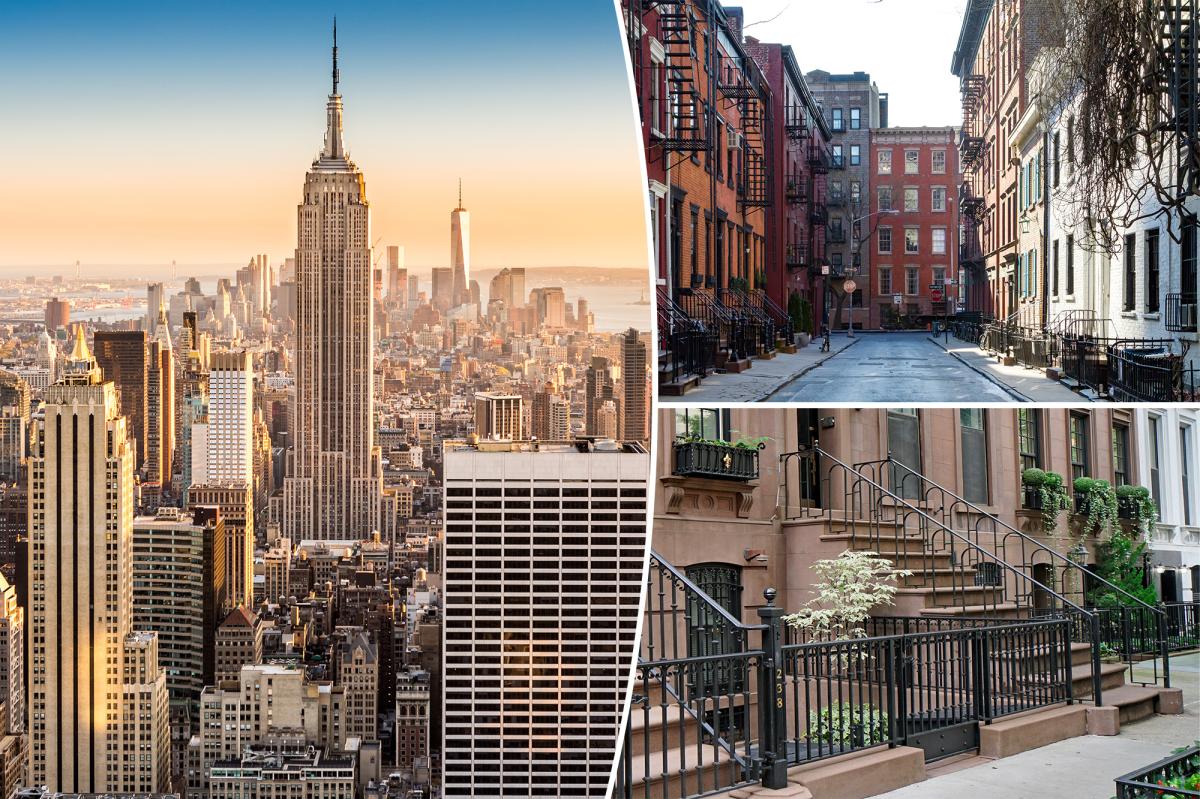
I want to be part of it, New York, New York — but does that mean it’s easy?
According to the latest Douglas Elliman and Miller Samuel numbers, it certainly isn’t — at least when it comes to affording rent.
Average and median rents once again hit record new highs in Manhattan in November — signaling that affordability in the borough is slipping farther and farther out of reach.
Living in Manhattan, in particular, is proving to be an affordability nightmare. deberarr – stock.adobe.com
Average rent is now at a jaw-dropping $5,686, up 13% from a year ago. In November 2024, average rents were at $5,047. In October 2025, average rents were at $5,651.
Meanwhile, median rent climbed to $4,750, also up 13.1% from $4,200 last November. In October 2025, median rent was roughly $100 cheaper — at $4,600. And the price per square foot edged toward the once-unthinkable threshold of $100. The previous November, it stood at $86.
It’s the latest sign that affordability, already stretched, is reaching a breaking point.
But the bigger story, brokers say, is why the numbers are moving so dramatically.
Keyan Sanai, one of Douglas Elliman’s top rental agents, points squarely to the city’s Fairness in Apartment Rental Expenses Act, which took full effect in June. The law bars landlords and listing agents from charging tenants the broker fee if the tenant did not hire them. In practice, the fee is now routinely shifted to landlords — and in turn, folded into the rent.
“When you see 13%, you have to take into consideration that with the FARE Act, the rent went up almost 8% overnight,” Sanai said. “So really we’re looking at a 5% increase. Once again, it’s a way to manipulate numbers.”
November’s average rent climbed to $5,686, up nearly 13% year-over-year, while the median reached $4,750. deberarr – stock.adobe.com
Sanai describes what happened next as a cascading repricing across the market.
A $3,000 Chelsea studio with an elevator and laundry that previously carried a one-month broker fee suddenly rose to $3,400. But the no-fee luxury rental down the block, which had been $3,600, did not sit still.
“Do you think that the luxury unit stayed at the price they were at? Nope. They went up to $4,200,” he said. “They created the same amount of separation.”
The sky-high rental prices are driven by a mix of constrained supply, tenants delaying home purchases and the ripple effects of the city’s new FARE Act, which shifted broker fees to landlords and quickly translated into higher asking rents. Nick Starichenko – stock.adobe.com
Elliman broker Keyan Sanai argued that the law effectively raised some rents “almost 8% overnight” and intensified pricing across both luxury and non-luxury buildings, while deeper issues — from warehoused rent-stabilized units to well-funded newcomers with guarantors — continue to prop up demand. James Steidl – stock.adobe.com
Renters’ competition is particularly fierce downtown, according to Corcoran agent Taylor Durland, who sees them choosing flexibility at a time when interest rates remain high for mortgages.
“One or more people are choosing to rent over buy,” Durland said. “The world feels a bit uncertain right now, I think psychologically renting feels like less of a commitment than buying.”
Prime neighborhoods — West Village, Tribeca, West Chelsea — are absorbing that demand the fastest.
“We’ve had an anemic supply of new housing units coming online,” he said. “When you just don’t have more supply, prices go up — the age-old supply and demand relationship.”
The return-to-office push is also making for an overall scramble.
“Instagram, for example, is the latest large tech company to come back and take five days in the office,” Durland added. Workers who moved upstate when required to commute only occasionally “are now feeling like, ‘Okay, wow, I need to be close. I need to be back in Manhattan.’”
Corcoran agent Taylor Durland noted that renters who might otherwise buy are opting for flexibility instead, intensifying competition downtown. Marcantonio – stock.adobe.com
But even for well-paid newcomers, expectations need adjusting. Durland recently worked with Sonam Singh, a tech professional in her mid 30s relocating from London.
“The biggest thing is having to downsize the expectations of space,” he said. Singh began her search hoping for a two-bedroom downtown. The math didn’t work. Singh ultimately chose a one-bedroom with amenities in her preferred Flatiron area. She moved there in October after a six-month search.
“The rent in New York City is significantly higher than anticipated, but seems to be the standard based on all of the viewings,” she told The Post. “A typical one-bed in a good area with amenities seems to be at the bare minimum $6,500 to $7,000. For comparison, what I pay for a one-bed apartment in New York City per month could get me a two- to three-bedroom house in an affluent area in London.”
“London is competitive,” she added, “however New York City is a different league.”
Of course, a huge move brought some other big headaches.
Appraiser Jonathan Miller added that high mortgage rates have kept would-be buyers in the rental pool, further inflating prices. James – stock.adobe.com
“It is disappointing because if you are budgeting, especially when you’re moving from one country to another, you’re always going to have unexpected costs,” Singh said. “One of the things that you can probably rely on at the bare minimum is what your rental and your bills would be. And if that’s higher than what you initially anticipated, then that’s already going to start you off thinking of different ways to save.”
Appraiser Jonathan Miller, who authors the Elliman report, sees the broader affordability crunch flowing from the frozen sales market.
“A lot of the affordability issues with rent coming out of COVID has more to do with mortgage rates or interest rates,” he said. “The people that were intending to buy remained in the rental market.”
And that has reduced supply.
After all, if rents were to fall, that would raise red flags. Even if prices remain high, Durland believes New York’s gravitational pull will keep demand steady.
“It’s an amazing testament to how attractive it is to still live in New York,” he said.