
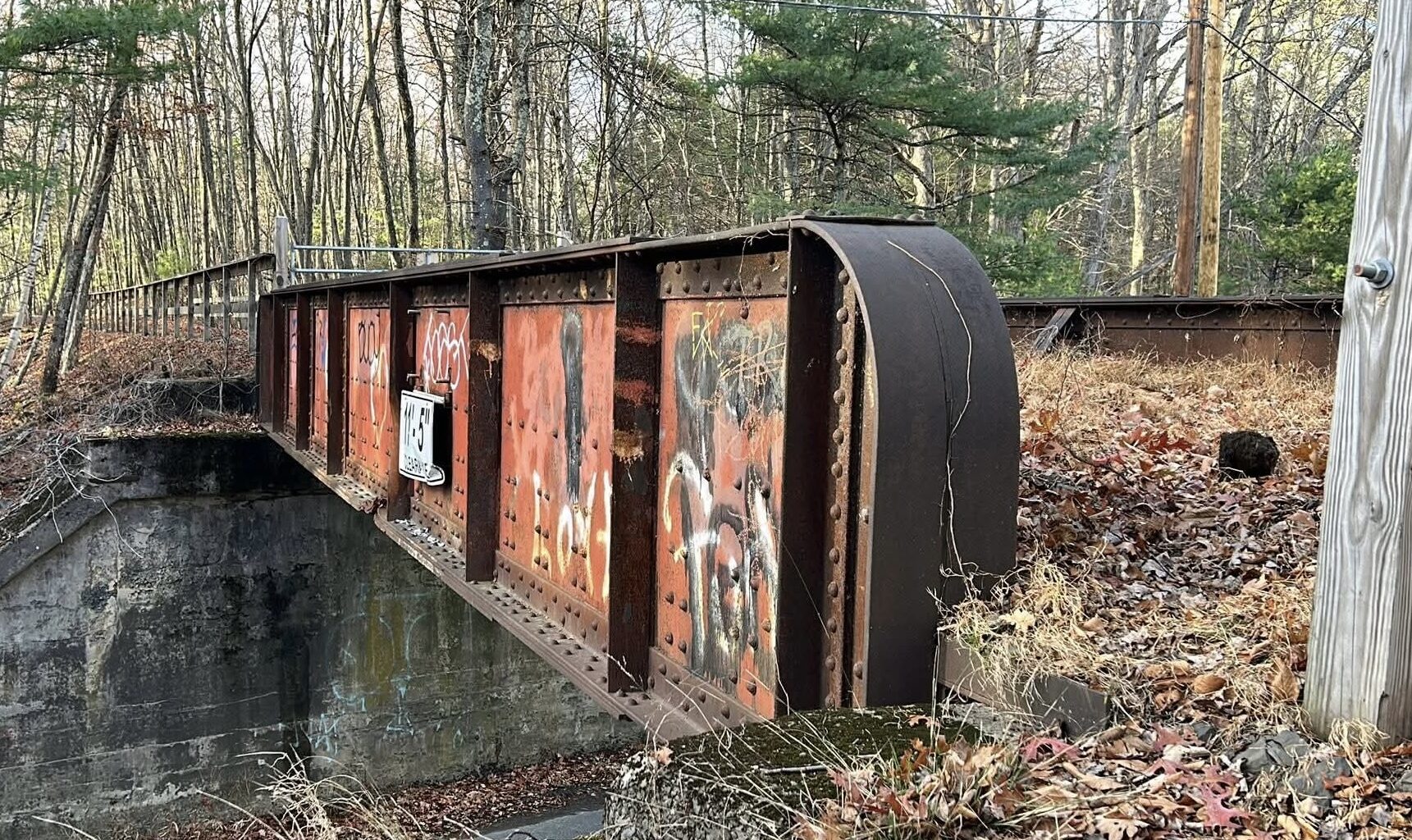
A proposal to replace the railroad bridge above Basin Road is causing tensions to flare between the Ulster County Legislature and the Catskill Mountain Railroad.
Courtesy of Matthew Lundy
KINGSTON — Bridges have helped communities overcome obstacles for centuries — from rivers, valleys and gorges to roads and railways. But one bridge in Ulster County seems to be tearing the community apart.

The Basin Road railway bridge in Woodstock sits between a 1.8-mile undesignated section of the Ulster & Delaware Corridor and the Ashokan Rail Trail. Ulster County lawmakers want to replace it with a new, taller pedestrian bridge that will alleviate construction concerns for the Ashokan Century Project, while still ensuring pedestrians have access to the rail trail. The project would be funded by the New York City Department of Environmental Protection.
Article continues below this ad
But removing the existing bridge could negatively impact the expansion plans of Catskill Mountain Railroad, which operates a tourist train from Kingston Plaza toward the Catskill Mountains. Instead, the railroad is proposing to raise the bridge on its own dime in the hopes that it can be reconverted to rail use in the future.
On Tuesday, Ulster County lawmakers will review the resolution for a second time. At the Legislature’s Nov. 18 meeting, 17 residents spoke about the plan — four in favor — and the board sent it back to the Housing and Transportation Committee for further review. On Dec. 4, the committee unanimously passed an amended version of the resolution specifying that the bridge would be replaced, not simply removed.
Even with these adjustments, the Catskill Mountain Railroad remains opposed to the resolution.
Make the Times Union a Preferred Source on Google to see more of our journalism when you search.
Add Preferred Source
“We are still worried the bridge will be removed and the replacement may never happen because the abutments on either side aren’t owned by the county,” President Ernest Hunt said.
Article continues below this ad
One side of the bridge is owned by the DEP and the other side is owned by a private landowner. Without a formal agreement in place, the corridor could be permanently severed, Hunt said.
The removal of the Basin Road bridge could impact the expansion plans of the Catskill Mountain Railroad, pictured in this file photo.
Roger Hannigan Gilson/Times Union
The proposal to replace the bridge comes just one month after county lawmakers authorized a study on the best use of a 1.8-mile section of the corridor between the railroad’s current route and the Ashokan Rail Trail. Known as the “undesignated section,” this portion of the corridor has been a point of contention between the railroad and the county for more than a decade.
“Whatever the resolution of the study is for the undesignated corridor, we still need a bridge to go from the undesignated corridor to the Ashokan Rail Trail, whether that’s to support the plans of CMRR, or whether that’s to support a trail,” Housing and Transportation Committee Chair Jeff Collins said. “They both need a bridge and that bridge must be (American Association of State Highway and Transportation Officials) compliant.”
Article continues below this ad
The Ashokan Century Program
The Ashokan Century Program is a $750 million plan to upgrade water supply infrastructure at the Ashokan Reservoir. The comprehensive, multiyear capital program includes upgrades to the dam, dikes, chambers and other facilities at the reservoir, a key node in the DEP’s upstate water system, which provides drinking water to nearly 10 million people in New York City and the lower Hudson Valley.
It is the largest public works project in the Catskills in more than 50 years. But the Basin Road bridge, due to its height, poses a problem for construction vehicles going to and from the work site. Catskill Mountain Railroad has offered to raise the bridge and proposed that DEP build a pedestrian bridge parallel to it, but county lawmakers appear to be moving forward with plans to replace it altogether.
“The Ashokan Century Program is the largest capital construction project seen in the Catskill mountains in generations, and ensuring safe and efficient access for construction and delivery vehicles is essential — which is why the county is working with DEP to replace the Basin Road bridge with a modern active transportation structure that supports the established trail use in this area,” Ulster County Executive Jen Metzger said in a statement.
Article continues below this ad
Collins, the transportation committee chair, said the current bridge does not comply with certain national standards because it is not wide enough and does not have the proper railings. Simply raising the bridge would not meet those requirements, he said.
The bridge debate is the latest in a series of disagreements between the railroad and the county. In 2024, the state Department of Transportation suspended $667,000 in grant funding to the railroad because the organization submitted its application without the required signature from the county.
Putting the cart before the horse
Several critics, including both lawmakers and residents, have asked the legislature to put the resolution on hold until the county’s rail corridor study is complete.
Article continues below this ad
County lawmakers just awarded the $77,440 contract to Barton & Lojuidice, an Albany-based engineering firm, in October. The study will include a full cost comparison of trail-only, rail-only, and rail-with-trail options; an analysis of critical corridor features, including wetlands and the Route 28A crossing; environmental and sound impact assessments; land-use considerations, including zoning, parcel size and land swap potential; preliminary depot concept planning, including parking and acreage needs; and an analysis of public input and stakeholder perspectives.
As a result of a 2013 lawsuit filed by the railroad, the legislature adopted a policy in 2015 where certain parts of the corridor would be rail-only, certain parts would be trail-only, and the county would investigate if other parts could be converted into “rail with trail.”
The section running along the Ashokan Reservoir was designated as trail-only, according to the resolution. This section opened as the Ashokan Rail Trail in 2019.
The Ashokan Rail Trail in West Hurley overlooking the Ashokan Reservoir on Oct. 8, 2023.
Maria M. Silva/Times Union
The section running west from Kingston, where the railroad company has been running tourist trains, would be “co-located with public trail wherever feasible,” according to the resolution. The section from this point to the beginning of the Ashokan Reservoir “will require further investigation on the future feasibility of rail with trail.” The study by Barton & Loguidice will focus on this 1.8-mile section; the firm will deliver a final report to the legislature by July 1, 2026.
Article continues below this ad
“I don’t know why they are so adamant on pushing this through,” Hunt said, adding that he felt the decision should wait until after the study is completed.
The bridge is not part of the study because it is not part of the undesignated section, Collins said at the Dec. 4 committee meeting. This means that whether the new bridge can support rail is irrelevant.
“That section is designated entirely trail,” he said, referring to the west side of the bridge. “We’re not ever going to get a train across Basin Road. So it does not need to be a train bridge; it needs to be a pedestrian bridge.”
In a Nov. 25 letter to the Housing and Transportation Committee, Hunt requested that the railroad be allowed to raise the bridge so that it can be “returned to rail use” and allow “additional room for longer trains at the future Basin Road terminal.”
Article continues below this ad
Proposed by the railroad in 2024, the terminal would be built at the end of the undesignated section near the Ashokan Reservoir. In other words, to connect to the new terminal from its existing route, the railroad would need rights to the 1.8-mile undesignated section that is currently under debate. Removing the bridge without a formal agreement between the abutting landowners could “sabotage” the railroad’s expansion plans, Hunt said.
“The rush to remove the bridge is just to block our progress and not rational,” he said.
In the letter, Hunt went on to say that keeping the bridge and rail alignment “preserves the option for rail-with-trail west of Basin Road” — something that would go against the county’s existing policy of trail-only use for that section.
“If the county implements and constructs rail-with-trail from Basin Road to Kingston, the thought of taking this combination west would certainly be viewed much more favorably if the NYC DEP consents,” Hunt wrote, adding that the railroad has “no current plans” to expand west of the bridge.
Article continues below this ad
Both Collins and Legislator Eric Stewart indicated at the Dec. 4 meeting that the DEP is unlikely to permit rail use west of the bridge at any point in the future.
The legislature’s vote comes during one of the railroad’s busiest times of the year. About 3,000 people had ridden the railroad’s “Polar Express” ride by the Nov. 18 meeting, railroad employee Harrison Balduf said.
“It brings joy to my heart to see these children smiling ear to ear,” Sherret Chase of Olive told the board. “You take away the bridge, you take away the railroad, you take away the joy from children. You’re a bunch of scrooges.”
In addition to attracting tourists, the railroad also serves as one of Kingston’s largest youth employers. High school student Matthew Lundy described the decision to remove the bridge as “rushed, unnecessary and a disservice to the people of Ulster County.”
Article continues below this ad
“The railroad is consistently one of the biggest assets to the local economy,” he said. “I am one of 50 students per year employed by the Polar Express … In 2024, the railroad brought 60,000 riders to Ulster County.”
But Betsy Blair, of Hurley, doesn’t see removing the bridge as the end of the railroad.
“It’s presented as a disaster, but I don’t believe it is,” she said. “We can have both a railroad and a useful, safe trail connection.”
Article continues below this ad