
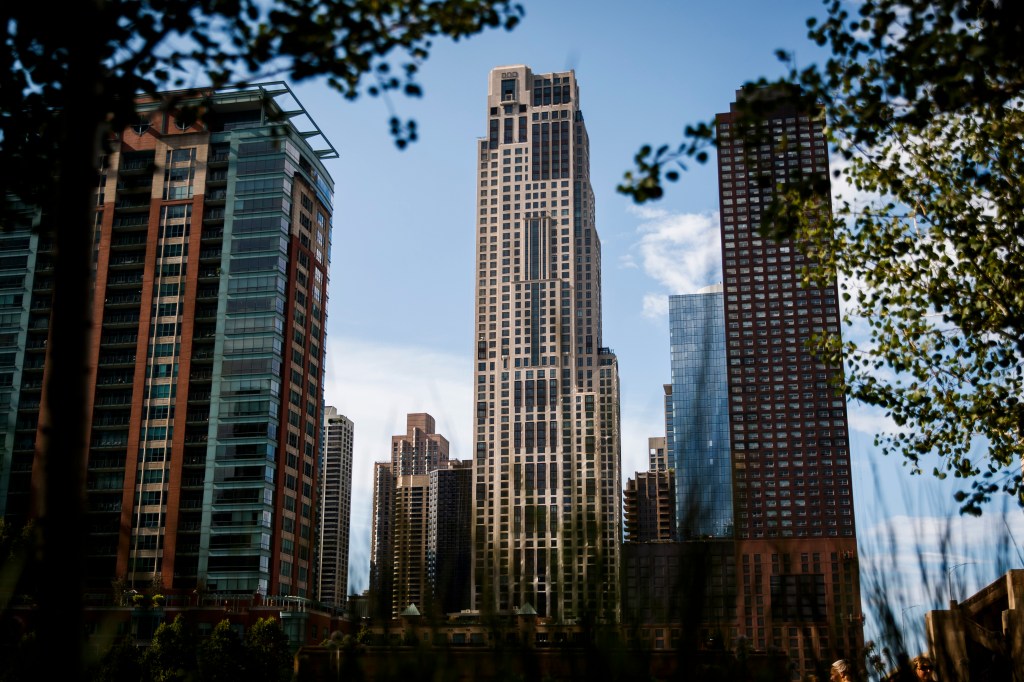
Chicagoans know Robert A.M. Stern better than they might realize; his ubiquitous designs for bus stop shelters and other street furniture for JC Decaux have graced streets throughout the city since 2002.
The noted New York-based architect passed away on Thanksgiving at the age of 86.
The bus shelters are an amalgam of varied historical influences and reveal a bit of the contradictory forces that shaped Stern’s most intriguing work. The structures deploy largely traditional columns that support shallow arched roofs above glass partitions — save for a single wall that always holds the ever-changing supersized advertisements that financially supported the wholesale replication of the structures at most CTA stops. They are memorable while being quiet and discreet, becoming thoughtful background players in the larger Chicago story.
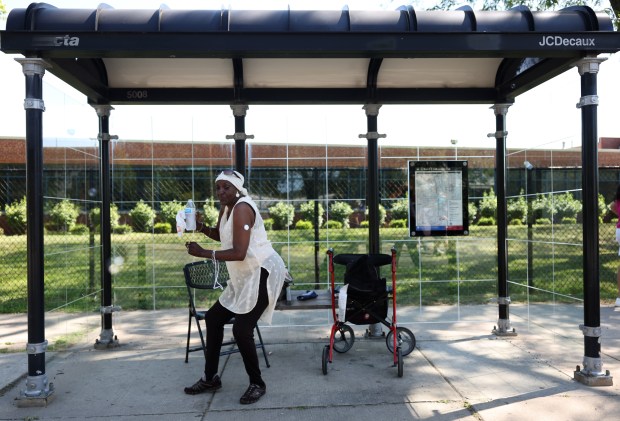 Vivian Loving dances under the shade of a Robert A.M. Stern bus shelter while viewing the Chicago Labor Day parade along South Cottage Grove Avenue in the Pullman neighborhood Sept. 2, 2023. (John J. Kim/Chicago Tribune)
Stern was no stranger to Chicago. His father was raised here and attended the Dwight Perkins-designed Carl Schurz High School — a building that a young Stern visited with his dad. Beyond the bus shelters, he designed a handful of notable buildings here including the old Banana Republic on North Michigan Avenue (now demolished), the One Bennett Park residential tower in Streeterville and a new south portico for the Griffin Museum of Science and Industry that’s slated to be completed in 2027. In the early 1980s, Stern produced a memorable “late entry” to the Chicago Tribune Tower competition and was among a group of architects and planners who worked on the proposed 1992 World’s Fair on Northerly Island. In 2011, Stern won the Chicago-based Richard H. Driehaus Prize — the Pritzker Prize alternate conceived by the Chicago businessman and philanthropist with the University of Notre Dame to recognize practitioners in traditional and classical architecture.
Stern built throughout the country and around the world, but his connection to his home city of New York was paramount. Perhaps no single architect since Stanford White during the Gilded Age symbolized New York City as well as Stern, who always spoke of his enchantment with the city starting during his childhood in the 1940s and 1950s.
The architect would complete four dozen or so buildings in the city during his career, but his magnum opus is an epic six-volume, almost 7,000-page series of books that form the definitive history of New York’s architecture and urbanism. It was a collaborative effort with an evolving cast of contributors and Stern at the helm that saw the books released sporadically starting in 1983. The series was built around specific dates: 1880, 1900, 1930, 1960, 2000 and 2020. The final volume, titled “New York 2020: Architecture and Urbanism at the Beginning of a New Century,” appeared just weeks before his death.
Initially conceived as a three-part series that would span from the Civil War to the start of World War II, the scope was broadened to reach the end of the 20th century and later extended to 2020. The final volume spans the period from 9/11 to COVID. It’s not something you’ll ever contemplate reading from cover to cover, but it’s sensibly written much like a city — you can jump in anyplace, look around a bit, learn and enjoy the scenery. It is a remarkably pleasurable read that packs tons of information about individual projects while setting each into its particular architectural and social contexts through copious primary source material. A difference from earlier volumes is the exclusion of floor plans in lieu of more photography. It seems to reflect Stern’s personal agenda; he could mine the more historically oriented material for his own architecture, but the more contemporary work had less to offer him.
Until just a few days before his passing, Stern and I had planned to chat about this column. I had planned to ask him why Chicago — where we consider ourselves superior to New York in architectural matters — doesn’t have a similar series of historical record. Alas, that conversation never happened, but I turned to others for their insights.
John Zukowsky was the Art Institute of Chicago’s first curator of architecture from 1978 to 2004. He says that Stern’s books “are absolutely amazing surveys — something that no one else has done for any American city” and notes that “the early ones inspired the two large volumes that I organized … for the Art Institute.” Those books, “Chicago Architecture 1872-1922: Birth of a Metropolis” and “Chicago Architecture 1923-1993: Reconfiguration of an American Metropolis” remain the closest analogue we have.
 Architect Robert A.M. Stern at his office in New York on Oct. 31, 2007. He died Nov. 27, 2025, at his home in Manhattan. He was 86. (Richard Perry/The New York Times )
New York-based architect John Hill began his career in Chicago and has written seven books, including a “Guide to Chicago’s Twenty-First-Century Architecture” and “Guide to Contemporary New York City Architecture”. When asked who might play a similar role in creating a Chicago version of Stern’s series, Hill suggests Chicago former cultural historian Tim Samuelson or MAS Context Editor In Chief Iker Gil. “Perhaps it’s up to organizations like the Chicago Architecture Center or Society for Architectural Historians to take the reins and put a team together with the goal of creating an expansive and exhaustive reference on a city deserving of such a series,” Hill says.
“It should be a collaborative effort,” Chicago-based architectural historian and preservationist Elizabeth Blasius agrees. “It is always exciting when architects, journalists, critics and historians get together and provide both information and perspective on the built environment.”
If New York merits a comprehensive six-volume architectural history, certainly Chicago deserves something of similar scope. The easiest version would be to adopt the earlier books from the Art Institute and produce a third volume that covers from 1994 to the present. Even better would be the launch of a more epic series that would reconsider the city’s architectural legacy anew from start to finish.
Now where can we find the next Robert A.M. Stern who can do as much for us?
Edward Keegan writes, broadcasts and teaches on architectural subjects. Keegan’s biweekly architecture column is supported by a grant from former Tribune critic Blair Kamin, as administered by the not-for-profit Journalism Funding Partners. The Tribune maintains editorial control over assignments and content.
Submit a letter, of no more than 400 words, to the editor here or email letters@chicagotribune.com.