

My grandfather Sidney Lipsyte, the son of immigrants who became a New York City public-school teacher and administrator, lived from 1904 to 2005, a good run I don’t expect to match. He witnessed, and sometimes experienced, a century of mayhem and invention: human flight, human spaceflight, pandemics, vaccines, economic devastation, Nazi conquest, atomic murder, peace treaties, civil rights, pacemakers, penicillin, the rise and fall of the Soviet Union. I’ll stop before this becomes a Billy Joel song, which is no knock on Long Island’s favorite son, though I do worry we started the fire or, at least, enthusiastically tended it.
When my grandfather was 8, he and his brothers listened to distress calls from the Titanic on their homemade crystal-radio set. Sidney was 14 when his father died from the “Spanish” flu, and as a teenager he worked as a runner on Wall Street, shuttling paper certificates of stocks and bonds between brokerage houses. The whole area was blocked off, he once told me, patrolled by cops on horseback with shotguns. He wouldn’t blink at all the Jersey barriers and guards and spike strips down there since 9/11 and Occupy. But he would certainly blink at much else going on today. One of Sidney’s favorite sayings was famous in our family: “Nothing is ever as bad or as good as it seems.” A wise maxim, but does it still hold? This past year, it’s mostly the second part that rings true.
39 Reasons to Love New York Right Now
From congestion pricing to Cameron Winter.
Sidney’s life spanned the American Century, which was also the New York Century. This carries both a nostalgic and an imperialistic ring. Nowadays, the Sinatra song might go, “If I can make it there / I’m still not sure about London or Dubai or even Hudson,” but New York, New York, was arguably the capital of the postwar period. The city was chaotic and violent, racist and unfair, both casually and structurally, but it was also full of decent people of multitudinous origin trying to make a life. I don’t think it ever crossed Sidney’s mind that there was a better, safer, or more equitable place to be in the world. In the bad old good old days, even if you spent your American life firmly entrenched against the official American project, your stance still contained a sense of agency. America ruled the world, or a good deal of it, after World War II, even more after the Cold War, so it was up to us, the feeling went, to push against dark forces in our own country. People did collectively, in movements and parties and unions, and even in more rarefied precincts of power and intellectual influence, though any individual champion always had the potential to disappoint or sell out. Lately, they just pop up in the Epstein files. (Say it ain’t so, Noam!)
Maybe the only thing worse than being complicit in an all-powerful corrupt oligarchy is being complicit in an increasingly less powerful corrupt oligarchy. And the only thing worse than living in a delusional, manufactured consensus about the meaning and purpose of your city and country is living in the cleavage of that delusion, the fragmentation of dwindling economic prospects and a discarded communal story. This past year has driven home even more (if that’s possible) how much we are stuck in an algorithmic rut of hallucination, political savagery, and jackboot barbarism, all of us pounded by the frothy, poisonous tides of own and grift, even as the highest office continues to be occupied by a sociopathic adolescent prick. “The sea,” Georges Bataille wrote, “continuously jerks off.” And so, in all his media moments, does our president.
My grandfather probably would not have aligned himself with every item in today’s progressive or democratic-socialist agenda. He certainly believed in the idea of progress, if not the Pilgrim’s or the Bull Moose’s, then the 1930s kind, even if FDR’s earlier campaign for Harvard quotas kept Jews like him corralled in City College. Mostly, I think he believed in that big old bendy justice-destined arc Obama would someday yap about, quoting MLK. Maybe not in its inevitability — he’d seen too much for that — but in its possibility.
That hoary image remains compelling. Sometimes, you just have to thug out the cringe or hold space for it. I still find it useful to sit with the basic idea: Shit was super-fucked for a long time, and a lot still is, but through various modes of struggle, people’s lives improved. There will always be tension and hard times and powerful knaves to strive against, and there is plenty of work to do, both incremental and the kind that NFL coaches call “chunk plays.” Some of the work includes deciding what that work is, but to insist nothing was ever accomplished remains the mirror image of the historical whitewashing Trump looks to impose.
Trusting in the arc, of course, has always been insufficient. It’s hard to feel as though we’re bending toward anything good or even better. It’s more like we’re bailing water in a sinking boat while the demented, syphilitic captain blasts holes in the hull. Maybe this is what people mean when they say we live in unprecedented times. Soon as you say that, though, somebody mentions the Civil War or just texts you a link to a Ken Burns interview, so let’s just say unprecedented since America became a superpower.
Still, in this space-time blip that is New York right now, which exists in the slightly larger blip that is America of the past eight decades, which resides in the bigger blip of the industrial and postindustrial age, and so on, things do seem immensely different. AI, ICE, MAGA: It all feels very end of the road, edge of the acronymic cliff. And the climate’s still a-changin’. These are revolutionary times. The question is, What revolution are we talking about? Will it be the kind most people, if you really drill down on their gripes and fears, yearn for, even if the trappings differ, or the sort that makes Steve Bannon twitch with diseased glee?
This past year, I’ve cycled through a few perspectives to process the horror show. One is the extreme long view, akin to my grandfather’s measured mantra, as I remember that humans have been bashing in one another’s skulls for a long time, that most societies throughout recorded history have featured some combo of slaves and slaughter for a variety of brutal and ludicrous rationales masking economic and cultural motives. And lest you think it was only a racial or colonial project, which much of it certainly was, look up the Sack of Magdeburg to groove on white-on-white European genocide. The long-view shtick works for a while, but the bleakness gets exhausting. How, for instance, did the most famous Fuentes go from being a revered Mexican novelist to a dipshit Howdy Doody gooning to Hitler reels? I guess we know the answer by now, but the fascism fatigue still makes it hard to get out of bed.
The short view is another cope. I’m no historian or political scientist, but I’ve half-listened to dozens of them on podcasts while doing dishes or a pseudo-workout at the gym, and I know some believe we are in a moment that might pass without total annihilation of the Republic or the world. Things change. Life is flux. Even Mussolini’s dictatorial reign came to an end, and the (metaphorical!) lampposts await. There’s the Mamdani fever version of this and the Blue Wave rah-rah of recent trouncings by more moderate Democrats in coastal states. I’ll take what I can get, and any brand of the “O-o-h Child, Things Are Gonna Get Easier” argument, however specious, is a temporary salve. Meanwhile, we tell ourselves, we need to march with our NO KINGS signs, wave American flags as unironically as possible, vote, support strikes and boycotts, and speak our truth (but not too stridently because “real people” will be turned off just as they’ve begun to doff their red caps). It’s all so necessary and depressing. There’s always the “No View” approach as well: Stop scrolling. Leave the pod mind. Read an obscure short-story collection. Cook a curry. Pet your dog or cat or partner or friend. (But never your friend’s partner, not unless everybody’s cool with it.)
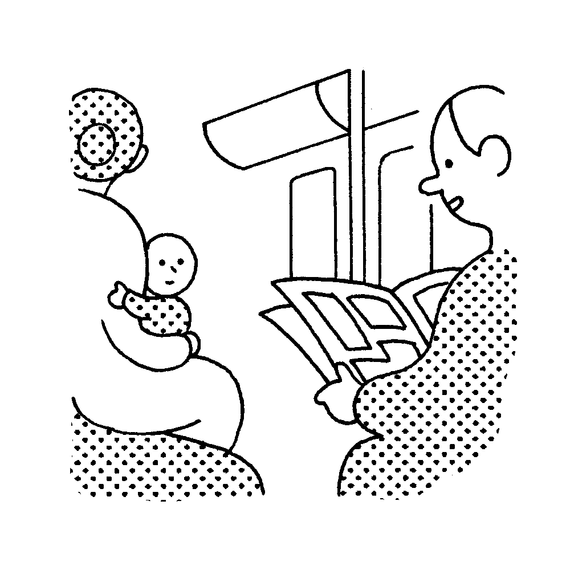
Illustration: Pete Gamlen
When you have kids, as I do, perhaps the stakes feel different, but most of us have kids. Maybe not our own, but if you consider yourself part of the human deal, you have kids. They may be in your family or friend circle or your neighborhood or just on your feed, but you have them, whether you want to think about it that way or not. Sure, we all know a few folks who treat the threat of apocalypse with an anti-natalist chuckle. What a relief that would be! Or they speak of people as a cancer on the planet as though their only allegiance is to shrubbery. But in the larger sense, most of us are looking after children. We’re just going to have to live with the globs of corn mush stuck to that idea, let our hands get sticky.
The other day, I communed with a stranger’s baby on the subway. With smiles and glances and wriggling fingers, we had about as deep a conversation as I’ve had in a while. Our exchange wasn’t cute. It was searching, anxious, tentatively delighted, a bit confused. It was human. Our different skin shades and our proximity on a rumbling train car was also very New York. So the melting pot was a bad metaphor. The subsequent multicultural salad-bowl image had some design flaws too. Get over it. Maybe we’re all just on an uptown local. My family’s been catching them for nearly a century, and I welcome each new rider. We can make room. Take off your fucking backpack and pay the fare, if you can (I’m looking at you, sharp-suited, briefcase-carrying dickhead who slithered over the turnstile shield at Cathedral Parkway last Tuesday). But the bottom line is that if you are on the subway, you are not the enemy, even if you are an asshole. Call it the mass-transit view. Broadway, after all, also bends.
Thank you for subscribing and supporting our journalism.
If you prefer to read in print, you can also find this article in the December 15, 2025, issue of
New York Magazine.
Want more stories like this one? Subscribe now
to support our journalism and get unlimited access to our coverage.
If you prefer to read in print, you can also find this article in the December 15, 2025, issue of
New York Magazine.