
Confessions of Fire
King’s Leap
November 6–December 20, 2025
New York
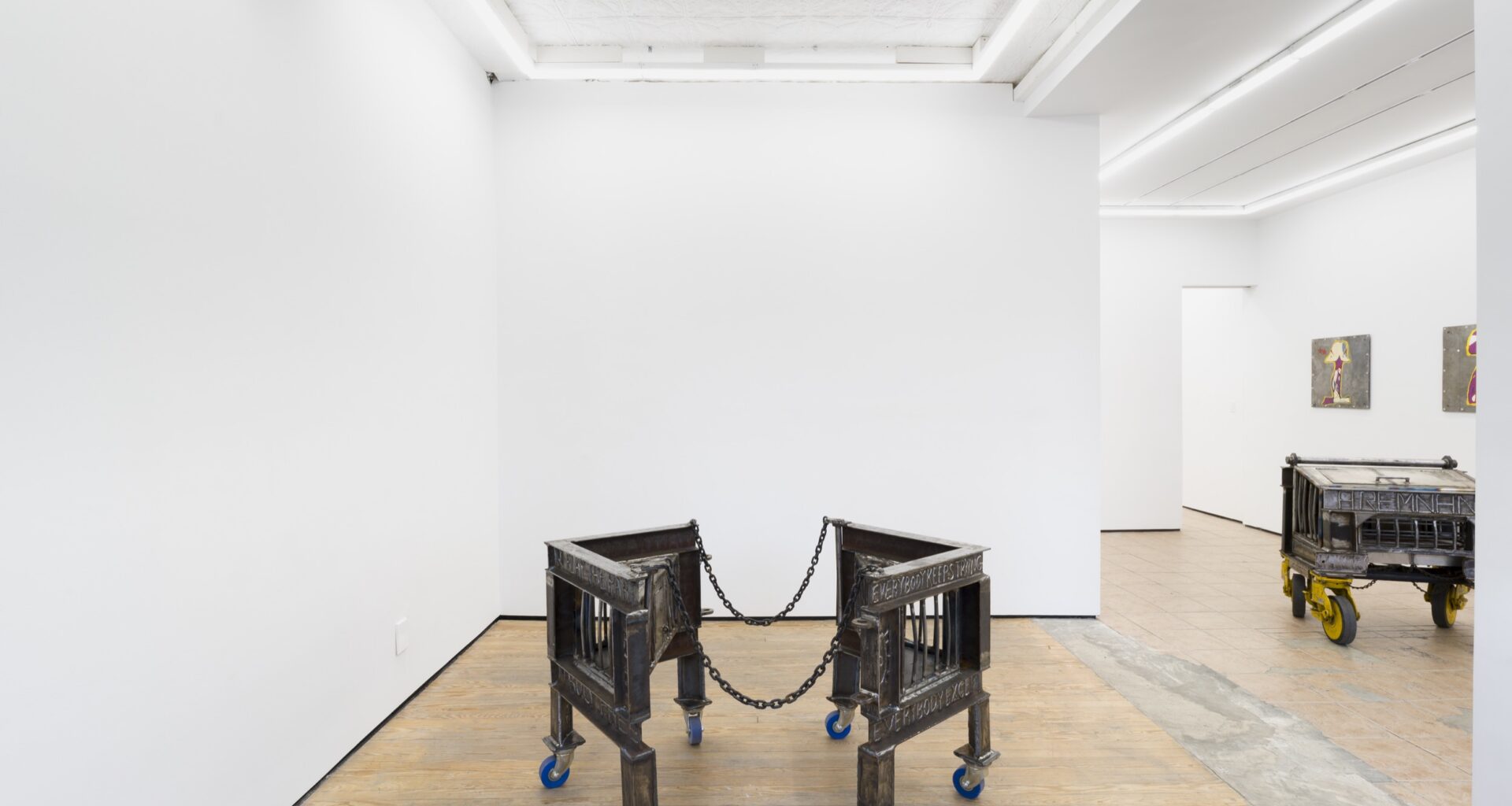
Isaiah Davis’s quasi-mobile, four-hundred-pound objects present as symptoms of industrialization with superficial excesses of weld spatters, bluing, and oxide stains. Invariably blistered and gouged, his sculptures are palpably resistant to the cold temperament of industrialization’s mass-produced goods and conspiring disciplinary architectures. Their vulnerable stomachs, constructed of cages—vacant yet confined by a hatch—multiply desire, flirting with our epistemological temptations to surveil and conquer. Referring to the work as “objects of enclosure,” the artist invites us to peer beneath the mythological cover.
The first of these mid-sized steel sculptures one encounters in Confessions of Fire at King’s Leap is entitled Slave (2025). At its heart lies a hidden hatch (perhaps one of those secret rooms locked safely at the back of our minds, yet which we are fated to perpetually, obstinately, pick at) that must be pried open, broken into two. But Davis presents the object already divided and furthermore, fastens it with a two-step security measure: pairs of steel poles and clasped chains, which must be unlocked by the hand of another. With its six industrial caster wheels, the creature-like object hums with a pressurized charge and no orifice through which to expel it. Slave sings, and not just because it bears the welded imprints of lyrics from Prince’s eponymous 1996 song, but because music may extricate pain’s implicated subject from coming face-to-face with the state’s polymelic terrors. The casters, too, remind us that these severed objects are unmovable without our manipulation and thereby subject to human mastery. For all its (material) bravado, its Damoclean violence—rough edges that might turn bone to fracture or knuckles to ripe red gashes—its vulnerability lies in its subjection to the alterity of another’s will.
A steel bumper affixed to the edge of a mass-produced wooden desk that meets gallerygoers upon entry is embossed with the words “A SERIES OF SAD SATANIC CONTRACTS,” a commentary on the violence of naming implicit in language. Whether the phrase prompts laughter, dejection, or ambivalence is a matter of one’s proprietary investments. The mass-produced piece of furniture, doubly functioning as a distribution site for contemporary art’s forest of promotional materials, seems to have grown a deformation of a kind that might’ve been sardonically produced by a striking factory worker. This fugitive tactic is picked up in the press release too, where Davis has supplanted the usual turgid vernacular and vacant contents and instead left a breadcrumb trail to “further reading”: Vincent Woodard’s The Delectable Negro: Human Consumption and Homoeroticism within U.S. Slave Culture (2014), a book that radicalized the ivory tower by taking seriously first-person accounts of enslaved Black people from the nineteenth century and expanded the frames of homoeroticism to the literal, metaphorical, and spiritual instances of cannibalism from the transatlantic slave trade and plantations.
Extending from the analysis of slavery as a consumptive institution of psychic and literal starvation as producing complex bidirectional erotic charges between Black and white men, Woodard analyzes the implicit libidinal economies undergirding Black male gender variance and cultural formation. Sexual orifices, decoupled from sexual practice and theorized by Woodard as zones of Black masculine interiority, is most explicitly materialized in Paul and Michael (2025), which figures an anus and penis on a steel plate. In Ving Rhames (2025), a wall sculpture named after the American actor whose roles included a crime boss raped by a white pawn shop owner and his cowboy-posing compatriot in Pulp Fiction (1994) and a drag queen in Holiday Heart (2000), a potentially violent, polyhedral steel mass hangs limply from a chain. Its weight is displaced by unnecessary panels of mediation and a thin, puny piece of steel that goes on to humiliate it, a wagging tongue. Have Davis’s cage sculptures, furnished with human-willed caster wheels, a demoralizing push bar, or a disemboweling lift handle, consented to placement and exhibition in the middle of a gallery, which irrevocably retrieves images of nineteenth-century European freak shows in its stark, ultra-luminescent display? And will they, for a humiliating fifteen-thousand dollars, oblige dispossession and migration to a collector’s home? At some point, it no longer matters because commerce is an art object’s natural destiny, and what it must do, it obeys.