
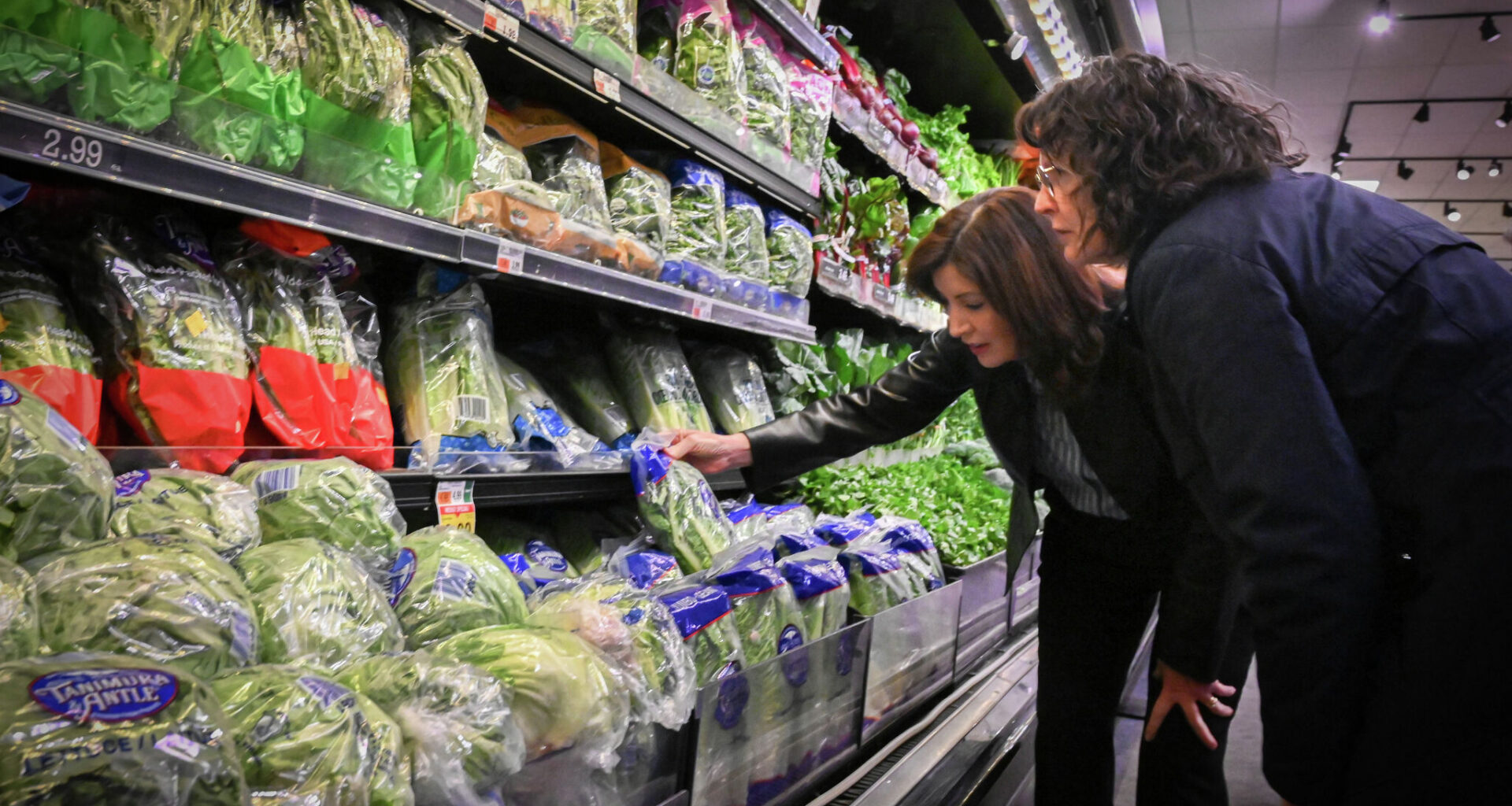
A new report released Wednesday shows how fragile many New Yorkers’ finances have become. Elected officials, including Gov. Kathy Hochul, left, have made affordability a focus of their campaigns and policy platforms.
Lori Van Buren/Times Union
ALBANY – A flat tire, a medical bill, a rent hike — any one of them can tip a New York household into crisis, according to a new report published Wednesday.

The report from Community Service Society of New York, a nonprofit that advocates for economic opportunity, shows just how fragile many New Yorkers’ finances were in September and October. One in four people reported having no emergency savings at all, and among low-income households, more than half lacked even a minimal buffer from deeper hardship.
Article continues below this ad
What’s more, New Yorkers are turning to debt, including credit cards or help from friends and family members, to cover costs.
The report draws on a survey conducted this fall of 4,000 adults from across the state. It revealed that New Yorkers of all income levels are grappling with high living costs, limited savings and mounting debt.
Related: How much do you need to make to be ‘comfortable’ in the Capital Region?
Make the Times Union a Preferred Source on Google to see more of our journalism when you search.
Add Preferred Source
The report emphasized that being “middle class” no longer guarantees financial security, and detailed that among moderate-income respondents, nearly four in 10 reported facing short-term financial strain. It also found that 36% of respondents reported that they could not make ends meet or were barely getting by.
Article continues below this ad
It’s worse for those earning up to 200 percent of the federal poverty level. In New York, that can range from $31,300 for one person to $62,400 for a family of four, according to the state’s Office of Temporary Disability Assistance.
New Yorkers are paying more for groceries and other expenses than a year ago. The financial struggles for many are occurring as housing prices have outpaced income in much of the Empire State. Lawmakers last session attempted to tackle a variety of affordability issues related to housing and consumer costs. It’s also become a focus in the 2026 race for governor.
U.S. Rep. Elise Stefanik has made New York’s cost of living a key part of her campaign for governor. Gov. Kathy Hochul has pulled the trigger on several initiatives aimed at reducing costs, including inflation refund checks and a middle-class tax cut.
The report, released weeks before the next legislative session, calls on state lawmakers to craft a bold policy agenda focused on universal programs that reduce the cost of living, stabilize incomes and address structural conditions undermining financial security statewide.
Article continues below this ad
The policies should address housing, health care, child care and other essentials that have outpaced wages, the report said. Changes should help give families more room to manage emergencies.
The report also called on policymakers to help make finances more stable by strengthening predictable income, reducing reliance on high-cost debt and expanding safe, affordable financial support.
In the absence of savings as a buffer against unexpected costs, many households told the nonprofit that they’re relying on debt to survive. More than a quarter of respondents reported relying on short-term debt from credit cards, buy-now-pay-later apps, cash advances and loans from family or friends to cover everyday expenses.
Moderate income households did so at higher rates than both lower- and higher-income groups.
Article continues below this ad
“The fact that more than a third must borrow to keep up with regular costs suggests a widening policy gap: moderate income households are excluded from most safety-net programs yet are still unable to meet basic expenses without taking on debt,” the report said.
Credit card use is widespread across income levels in New York, with many households using short-term borrowing to cover budget gaps.
Moderate-income households were the most likely to rely on credit cards, but even higher-income respondents reported similar levels — suggesting that credit card use has become a common way to bridge gaps in household budgets for New Yorkers across income levels, the report noted.
Lower-income households more often rely on friends, family, or rent arrears, while many New Yorkers simultaneously carry longer-term debts like mortgages, medical bills, auto loans or student debts.
Article continues below this ad
To feel more financially secure, respondents said they needed savings they could rely on, a guaranteed basic income and relief from unpaid bills or existing debt.
Priorities varied by income, with lower-income households emphasizing guaranteed income, moderate-income households focused on debt reduction and savings, and higher-income households prioritizing savings and property tax relief.
“Our survey findings show that financial security is an ecosystem,” the report noted. “Wages, housing, taxes, debt, savings, and care systems are interconnected; policies must address them that way. The experiences of New Yorkers make clear that helping people get ahead will require bold leadership, fresh thinking, and solutions that are as comprehensive as the challenges they face.”
Article continues below this ad