


Studios layouts have evolved to include bigger, fancier kitchens and baths in recent years.
Photo-Illustration: Curbed; Graphics: The Dupont, Getty
For decades, studio apartments have been the workhorses of the New York City housing market: affordable, utilitarian spaces that were the first apartments of countless New Yorkers. Their defining features were their small size and no-frills ethos: a galley kitchen or kitchenette crammed in a corner of the single room, plus a narrow bathroom, all of it made more livable with makeshift room dividers and space-saving strategies like lofted beds. They were the unglamorous postwar, middle-class response to the disappearance of the SRO, the boarding house, and the apartment hotel — the singles housing types that were largely legislated out of existence during the 1950s. Even for studios in luxury buildings, the grandeur rarely extended beyond the lobby: The real luxury was living alone.
More recently, however, a new type of studio has come to dominate the rental market. Its hallmarks are a full-size kitchen with high-end, full-size appliances; a spacious, spalike bathroom; an in-unit washer and dryer; and a single exposure with a giant window or wall of windows. With so much space given over to the kitchen, the bathroom, and the one big window, the living space itself may be somewhat ill-suited to living — not quite large enough to fit a queen bed, a full-size sofa, a desk, and a table at which to eat the food prepared in the large, luxurious kitchen. But it looks good. And it almost always comes with access to an array of amenities elsewhere in the building, lending it a sheen of luxury no matter how shoe-box-esque the space. Rents have gone up accordingly: The average new-construction studio runs in the mid-to-high $3,000s in Brooklyn and Long Island City, and one to two thousand more in Manhattan. “The studio of yore is proportional — small kitchen, small apartment. Now it’s bigger kitchen, more awkward layout, and more expensive,” says Jonathan Miller, of appraisal firm Miller Samuel. “It’s losing its identity as an affordable-housing alternative.”
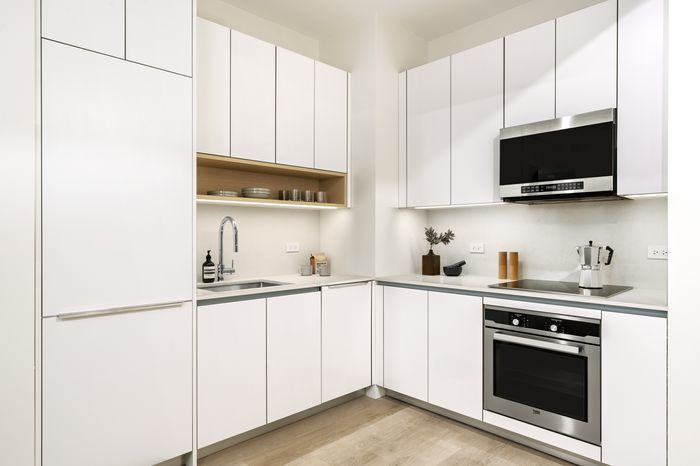
A studio kitchen at 25 Water Street, a Financial District office-to-residential conversion, that would not look out of place in a two-bedroom.
Photo: Streetsense
And developers are building a lot more studios than they used to — in the past decade or so, the percentage of studios in many buildings has doubled, according to Bobby Fijan, a developer who also writes extensively about floor plans. Now, studios make up a quarter or more of the units in many New York rental projects. Nationally, that’s true as well. “You see more and more developers doing 40 percent now,” says Isaac Henderson, a managing director at the Rockefeller Group whose most recent Greenpoint development, the Dupont, has a little over 16 percent — a larger number than Rockefeller Group would have built in the past. And the next project may well have more as “all of them have been rented out.” This new type of studio, in other words, is everywhere these days. But how did it end up taking over?
One theory is that studios changed because the renters did. Talking to developers and new development rental brokers, the word “sophisticated” comes up a lot — another way of saying that studio renters these days are older and wealthier than they used to be. There’s are also a lot more of them. About a third of New York City residents live alone (it’s half in Manhattan) and the bulk of them are in their peak earning years, between 35 and 65. Unsurprisingly, these older, weather residents don’t want roommates. And they’re willing to pay for the pricier studios, says Henderson, especially with more wealthy households opting to rent rather than buy. “I’ve been doing this for 25 years, and the design and level of finishes have consistently gone up: The refrigerators have gotten bigger; the stoves have gotten bigger.” Rebecca Epstein, managing director of residential leasing at Two Trees, has been seeing this too. Studio residents are “asking for full-size dishwashers.” For developers, there’s also a clear incentive to build more studios: They rent for more per square foot than larger units and also tend to rent faster than any other type of apartment. (The opposite is true in the sales market — buyers pay a premium for larger apartments, so developers rarely build new studio condos these days besides staff units in ultraluxury buildings.)
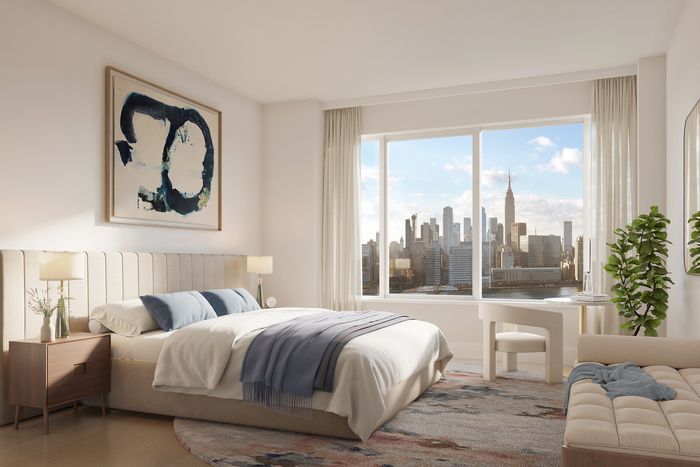
A studio apartment at the Dupont in Greenpoint. The rise of double-loaded corridors means deeper floor plates with single exposures. Windows tend to be large focal points of the apartments.
Photo: Joel Pitra at DDReps
At the Dupont in Greenpoint, where the studios rent in the low-to-high $3,000s, the appliances are Bosch, all the stoves are induction, and everything in the kitchen is panelized — that is, hidden behind cabinetry, so tenants don’t have to stare at the stainless-steel hulk of a refrigerator whenever they’re home. At 25 Water Street, a Financial District office-to-residential conversion that’s the largest such project in the country, the appliances are also panelized and there’s recessed lighting throughout — a high-end touch that’s about as far as you can get from boob lights, that staple of cheap rentals everywhere. Some studios even have double vanities in the bathrooms. “Five or six years ago, you would not typically have seen those in studios; now you’re seeing more and more of them,” says Sarah Patton, the co-head of Compass Development Marketing Group whose team is heading up leasing at 25 Water. Because of the building’s deep office floor plates, some of the studios are as large as one-bedrooms, with windowless interior rooms marketed as home offices, so it’s conceivable that some will be taken by couples. They’re priced like one-bedrooms, too: many rent for upward of $6,000 a month. Still, one broker I spoke with called the idea of putting a double vanity in a studio “totally insane.”
Whether or not renters are using two sinks and their big, fancy kitchens for more than decanting Seamless orders is kind of beside the point — they’re a luxury signifier. “There’s been an escalation of finishes overall,” says Justin Elghanayan, the president of major rental developer Rockrose. “Luxury housing is getting more luxurious.” A proportional kitchen may be more practical and elegant, but Americans “don’t really understand what a small apartment is supposed to look like,” says Stephen Jacob Smith, the founder of the Center for Building, a nonprofit that conducts research on building codes and standards and advocates for change. “A tiny French studio that’s 250 or 300 square feet would have a two-burner induction cooktop and a mini-fridge.” Most manufacturers don’t make smaller appliances for the U.S. market, either (besides things like dorm-room microwaves and mini-fridges), because there isn’t much demand. For developers, it’s also simply easier to buy — and maintain — the same set of appliances for the entire building. If a stove breaks, they can sub it out, often with one from a vacant unit in the same building.
But Elghanayan doesn’t think renter preference is what’s driving the lopsided layouts. He points instead to federal fair-housing laws passed in 1991 that mandated that all new housing meet accessibility requirements, like having certain turning radii in the kitchen, bathroom, and foyer — modifications that allow wheelchair users to live in them comfortably. James Davidson, a partner at SLCE Architects who’s been designing studios for 40 years, agrees: “Studios are now 10 to 15 percent larger because you need larger foyers, larger kitchens, and larger bathrooms.” And since rents are high because of new construction costs, and the cost of those big kitchens and baths, you may as well make the units as fancy as possible, creating an ever-escalating feedback loop.
Smith also believes we have the rise of the double-loaded corridor to thank for these layouts — that is, a tower with apartments on either side of a hallway, which became prevalent in New York because of zoning, leading to apartments that are “giant bulky rectangles with less natural light.” Prewar apartment buildings were often in H, T, U configurations, with courtyards and a lot more exterior wall space, offering lots of places to put windows. But the double-loaded corridor building means dealing with a single exposure and deep floor plates for everything that’s not a corner unit. An increasingly common way to address the challenges of using all that interior space and meeting accessibility requirements is by putting a kitchen (and sometimes the bathroom as well) right off the front door instead of a foyer, which has the added bonus of separating the kitchen from the sleeping area. (Another way to address the problem — widening the apartment to make the studio more of a square — makes it much larger, and therefore more expensive.) But the layout isn’t really ideal. “Not everyone likes having a kitchen and a bathroom that are part of your entryway,” says Jules Garcia, an agent at Coldwell Banker Warburg. “You also need to make sure the apartment has good ventilation when you have the kitchen and bathroom across from each other, or you could end up with some smell transfer.”
In a way, the new luxury studios hearken back to an earlier era — to the large, graciously laid-out studios of the 1920s and ’30s, which were a niche product intended for wealthy bachelors. The original studios, built around the turn of the 20th century, like the ones at the Hotel des Artistes, were even more upscale — live/work spaces with double-height ceilings and huge windows, purpose-built for gentleman artists. Real-estate developers then appropriated the term to make one-room apartments seem more bohemian and appealing. One major difference, however, is that those spacious prewar studios, with their separate foyers and kitchens — many of the bathrooms even had their own foyers, nooks off the main room, often with a linen closet as well — lent themselves to longer stays. Today’s studio is a strange combination of the luxurious bachelor pad and the bleak, middle-class apartments that emerged after World War II: an efficiency with a veneer of luxury.
It’s maybe not surprising, then, that even as studios rent faster than any other type of apartment, they also turn over faster, which Fijan believes is due, at least in part, to their design. “As soon as someone can get something better, they move out,” Fijan says. “I would describe it as shortsighted.”
One renter I spoke with moved from a studio in a Brooklyn carriage house to a “luxury” studio in a nearby tower after winning a housing lottery. Her carriage-house studio was about the same price and “infinitely cooler,” she says. “It had all these built-ins, a loft bed, a little kitchen off the main space, and skylights which you would never get in a new development.” But the heat was balky and the situation potentially precarious in the way it is with any small-time landlord: If and when they decided to cash out on their investment, she’d almost certainly have to leave. So she traded the better-designed space for the new one.
But when the pandemic started, she realized just how ill-suited the new space was for anything more than a crash pad. It had a tendency to overheat on sunny days because of the big window (which could only be cracked open a smidge), and the L-shaped kitchen was in the middle of the living space, which she wouldn’t have minded if the room weren’t also her bedroom. She also hated her entire life being on full display during Zooms. “There are better studio layouts, with alcoves and sunken areas, but most now are just one square space, and no one wants that unless they’re 25 and have a really active social calendar,” she says. When a coveted one-bedroom opened up in the building, she jumped on it.
So what’s the trick to living in, even loving, one of these new studios? Not spending too much time in it seems to help, which is very much possible given the cornucopia of amenities that developers are offering these days. Jake McFadden, who’s in his 30s and owns the med spa Forbidden Well, thought he might be done with studio living before he moved into 25 Water. He’s lived in a number of studios over the years, most recently a sublet in a 1970s Murray Hill tower that came with basic perks — a doorman, a gym — but they weren’t enough to make up for the apartment being small and dated. The $4,100-a-month studio he lives in now is amply sized, with an alcove that fits a king-size bed and “feels like living in a hotel suite,” he says approvingly. But he says he spends most of his waking hours at home in 25 Water’s amenity spaces, especially the co-working room and gym. (There are also basketball and pickleball courts, two swimming pools, golf simulators, bowling, and a spa.) “I’m only really in my apartment when I’m sleeping,” he says. “I treat it like a bedroom.”
Sign Up for the Curbed Newsletter
A daily mix of stories about cities, city life, and our always evolving neighborhoods and skylines.
Vox Media, LLC Terms and Privacy Notice
Related