
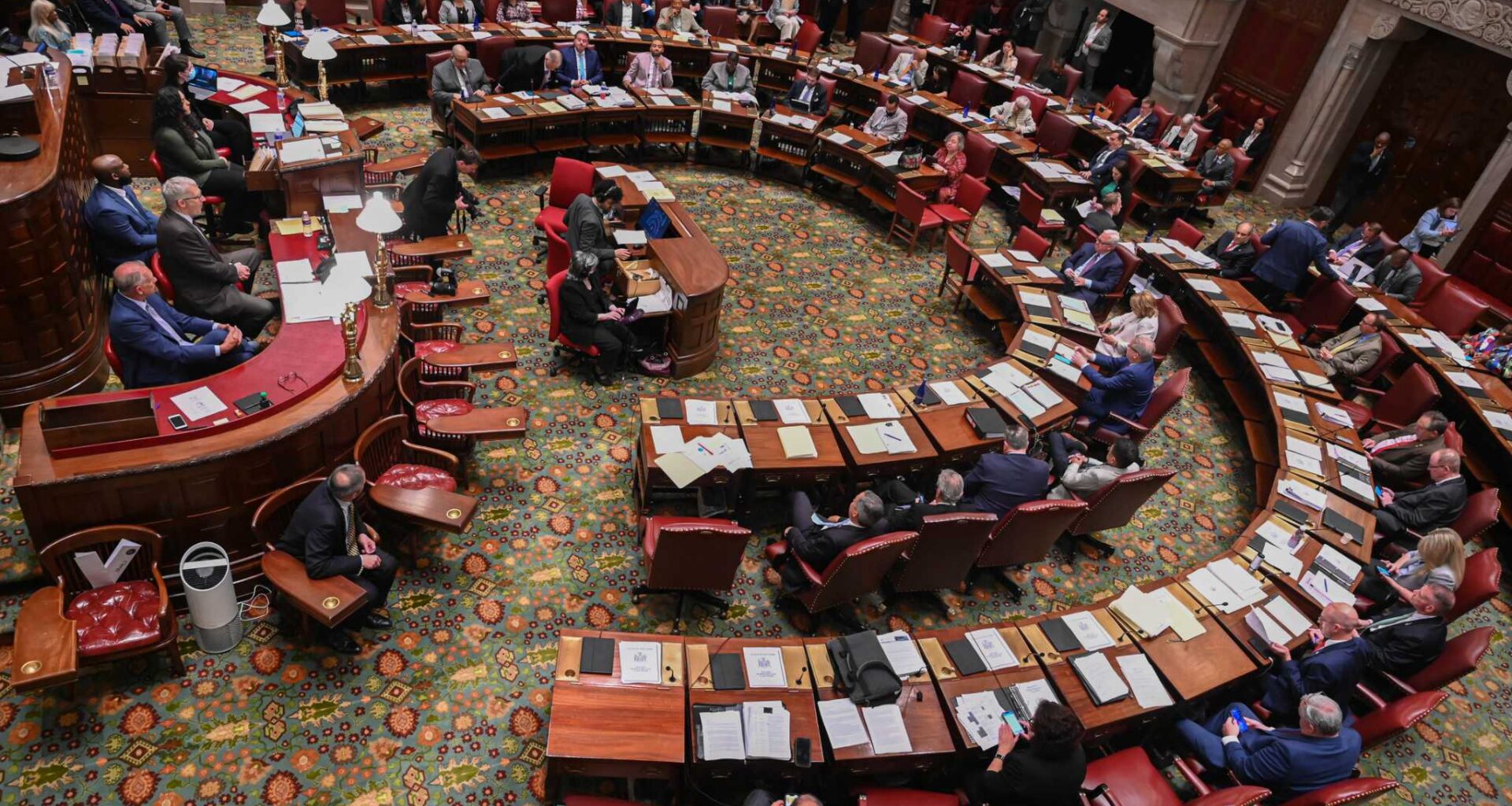
The state Senate in New York does not publish the individual votes of each member on nominees from the governor. A new report from Reinvent Albany makes the case for changing the chamber’s practice.
Lori Van Buren/Times Union
Dueling campaigns emerged both in support and in opposition to LaSalle’s nomination. Neither had to disclose who they spoke to or how they were funded.
Will Waldron/Times Union
ALBANY — When the U.S. Senate considers a nominee from the president, such as a federal judge or a cabinet official, the results of that vote are published on the chamber’s website for the public to review.

That’s not the case in New York, where the state Senate regularly considers nominees from the governor but does not publish publicly online how each member voted.
Article continues below this ad
Constituents instead must submit a formal request to the state Senate under New York’s Freedom of Information Law. Only then are they able to view the votes of each member on some of the state’s most influential officials.
That’s what inspired a new report published Thursday by Reinvent Albany, a good government group that’s urging the state Senate to proactively publish that information as it would with any other vote in the chamber.
“This is something that I think New Yorkers do have a right to see and understand better,” said Rachael Fauss, a senior policy advisor at Reinvent Albany. “There’s no reason to not put it online by default.”
Make the Times Union a Preferred Source on Google to see more of our journalism when you search.
Add Preferred Source
They’ve already done that work for the state Senate for nominees considered by the chamber in 2025 and 2024. All of the governor’s nominees were confirmed those years.
Article continues below this ad
After receiving the votes on each nominee through public information requests, Reinvent Albany compiled them into a searchable database that’s organized by date, the positions nominated and how each member voted.
They had also requested the votes for nominees in 2023 but didn’t receive them, Fauss said.
“The Senate said that they didn’t have them,” Fauss said.
That database is separate from the report, which includes analyses of how members of the Senate voted on nominees over the past two years and recommendations on how the chamber could make those decisions more transparent to the public.
Article continues below this ad
The state Senate could start by making the votes of individual members on nominees available on their own website, the report recommended.
State Sen. Liz Krueger said she doesn’t see a reason why the Senate can’t make those votes more easily accessible to the public but that another recommendation from the report may not be doable.
Lori Van Buren/Times Union
State Sen. Liz Krueger said she agrees with that recommendation and doesn’t see a reason why it can’t be implemented by the Senate. Krueger chairs the Senate Finance Committee, which considers most nominees before they receive a floor vote.
“That should be easily accessible,” Krueger said. “We don’t make it as easy as we should. It should be something that is built into the computer system.”
Article continues below this ad
Part of the problem, Krueger said, is that many of the state’s computer systems, including those in the Senate, are antiquated and don’t reflect the digital access expected by the public today.
But the report from Reinvent Albany highlighted other factors in the state Senate’s confirmation process that can make those matters more opaque.
That includes the state Senate’s common practice of voting on a slate of nominees at once. Lawmakers will often hold just one vote to approve several nominees simultaneously instead of considering each of them individually.
That creates a situation in which lawmakers are forced to vote in favor of nominees that they may otherwise reject and vice versa. The slate is treated as one item to consider instead of a series of individual nominations.
Article continues below this ad
“I have talked to a few who had mentioned that when they did vote ‘no,’ sometimes it was just one candidate that made it be that they ended up voting ‘no’ on the entire slate,” Fauss said.
Before the full state Senate considers a nominee from the governor, they are considered by the committees relevant to that role. Those votes aren’t available either.
Will Waldron/Times Union
There were only five nominees that received individual votes from the state Senate in 2024 and 2025, according to the report. The rest were approved in slates, with an average of 14 nominees per slate. The largest slate included 63 nominees.
Part of that is because of when the governor typically sends nominations to the state Senate to consider. Many of those nominees don’t reach the state Senate until the final weeks of the legislative session, which ends in June.
Article continues below this ad
About 77% of Gov. Kathy Hochul’s 175 nominees were confirmed by the state Senate in June. In 2024, about 60% of Hochul’s 144 nominees were confirmed that June.
“One of the recommendations is to give the Senate more time,” Fauss said of the report. “I do think they get jammed by the governor and that doesn’t help in terms of just general awareness of these nominees, too.”
That would be necessary if the state Senate decided to do away with slate voting, Krueger said.
Otherwise, the chamber wouldn’t have the time to consider each of the nominees sent to the state Senate weeks, and sometimes days or hours, before they’re scheduled to conclude that year’s legislative session.
Article continues below this ad
“We literally don’t have time to do non-slate voting,” Krueger said. “The only thing that will ever allow that to actually completely change is if the governor gives us all of these in the beginning of the year instead of the last two weeks of the year.”
The final recommendation in the report has less to do with each member’s vote and more to do with how they’re influenced by outside entities.
When someone lobbies state officials on regulations or members of the state Legislature on a bill, they have to report that activity to the state’s ethics commission. That’s not the case for lobbying members on one of the governor’s nominees.
The loophole that allows groups to evade disclosure of lobbying on gubernatorial nominations became apparent in 2023 when Gov. Kathy Hochul nominated Hector LaSalle to be chief judge.
Will Waldron, Times Union
That became apparent when dueling campaigns emerged to influence the state Senate’s decision on Hochul’s nominee for chief judge in 2023.
Article continues below this ad
Hochul had nominated Hector LaSalle, the presiding justice of the Appellate Division, Second Department. A campaign quickly emerged to oppose the nomination and was then matched by advocacy in support of LaSalle.
But none of the groups involved had to disclose that they had funded those efforts or spoken to members about the nomination, which was ultimately rejected.
That loophole, which was highlighted at the time by the Times Union, resulted in a bill that would change the state’s ethics laws to require public disclosure of lobbying efforts on gubernatorial nominations.
The report also recommends that disclosure be required to the state’s ethics agency when someone lobbies on a nomination from the governor. That’s not currently required. Blair Horner from the New York Public Interest Research Group has been lobbying in support of the bill for two years.
Will Waldron/Times Union
It’s supported by good government advocates, including Blair Horner, legislative director for the New York Public Interest Research Group.
Article continues below this ad
“If you’re lobbying to influence the (state) Public Service Commission’s decision on the utility rate, you have to report your lobbying,” Horner said. “If you’re lobbying to influence who makes that decision on the Public Service Commission, you don’t.”
That bill has passed the state Senate for the last two years but has stalled in the state Assembly. Horner said it would be an easy way for lawmakers to show they’re committed to government transparency.
“If somebody’s trying to put their thumb on the scale to get someone picked, they should report that activity,” Horner said.
Article continues below this ad
The state Legislature is scheduled to return to the state Capitol for the new legislative session in January.