
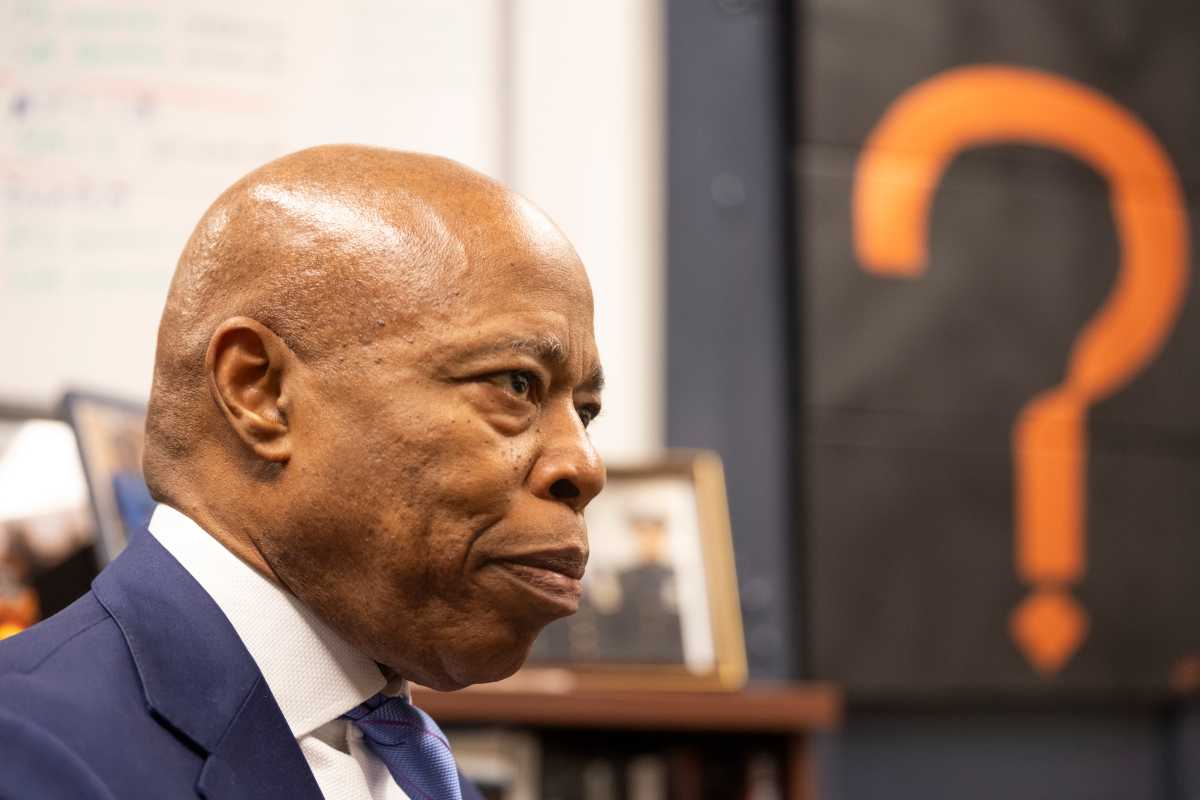
Mayor Eric Adams returned to a place that has long anchored his personal and political story as his time at City Hall draws to a close: the 103rd Precinct in Jamaica, Queens.
During the final days of his administration, Adams sat down with amNewYork at the precinct was where he held one of his first press conferences as mayor in 2022 — and decades earlier, where he experienced a traumatic encounter with police that he has often cited as formative.
“I really want New Yorkers to use my journey as a symbol,” Adams said, describing his decision to return to the precinct. “Even in the darkest moments of your life, it’s about how you turn pain into purpose.”
Adams recalled that the incident at the 103rd Precinct pushed him toward activism and eventually a career in law enforcement, rather than bitterness. “Sometimes we don’t realize the darkest moments of your life are not a burial, but it’s a planting,” he said.
While looking back at his four years as mayor of America’s largest city, Adams sought to frame how he believes his tenure should be remembered. He also offered words of advice (and warning) to his successor, Mayor-elect Zohran Mamdani.
“He should think them through before he actually makes these major changes. They may sound good because the advocates are calling for it, but when it comes down to where the rubber meets the road, it can endanger the lives of individuals,” he said, predicting that “some of the things he ran on, he’s going to adjust when he gets in the seat.”
Adams’ top priority
That framing reflects the throughline Adams has emphasized since his 2021 campaign: a former police officer and a victim of police violence who believed he was uniquely positioned to restore order without abandoning reform.
He said he made it clear to each of his four police commissioners that public safety was his top priority and that he would be “very much involved” in aligning the NYPD with that expectation. He described his current Police Commissioner, Jessica Tisch, as “a smart police administrator” and understands why incoming Mayor Mamdani opted to keep her in the role.
“His relationship [with her] may be different than mine,” Adams said, adding that he doesn’t “know if the next mayor is going to be that much engaged” in public safety.
 Photo by Lloyd Mitchell
Mayor-elect Mamdani, for his part, has ambitious plans for policing, including the creation of a Department of Community Safety to coordinate prevention and outreach programs. The new civilian agency is aimed at “preventing violence before it happens” with a proposed budget of $1.1 billion.
Adams is not sold: “There are many great quotes from me. One of the quotes that I think is the best is that idealism collides with realism. When you’re the mayor of the city of New York, it’s different from when you run to be the mayor.”
While crime statistics point to improved public safety during Adams’ tenure, his record on policing has been shadowed by a series of lawsuits from former members of the force, alleging that the NYPD operated under a culture of cronyism, bribery, and retaliation against whistleblowers.
In July 2025, five former high-ranking NYPD officials — including former interim Commissioner Thomas Donlon and four former chiefs — filed separate federal lawsuits claiming that Adams and his allies ran the department as a “racketeering enterprise,” bypassing established promotion procedures and retaliating against officers who raised concerns about misconduct.
Adams has vehemently denied the allegations.
Asked about the most testing times as mayor, Adams pointed to the migrant crisis, saying the city spent more than $8 billion responding to asylum seekers—costs he said were never factored into the city’s original budget planning. The unexpected spending, he said, required the administration to shift and scale back some of its ambitions, even as it continued to fund what he described as core priorities, including public safety, youth employment, education programs, and services for children.
Adams noted that while New York’s $115 billion budget appears vast, only a fraction of it is discretionary, which limits the city’s flexibility once the crisis takes hold.
Not a fan of Mamdani
One thing Adams will not do for certain is be a waiter when Mayor-elect Zohran Mamdani sits down at the table of success come Jan. 1.
Adams stressed to this paper that his interactions with Mamdani since the election have been cordial and professional, even as he made clear that his disagreements with the incoming mayor are deeply ideological.
“I don’t dislike the incoming mayor,” Adams said. “I dislike his policies and his supporters, the DSA (Democratic Socialists of America). I think their policies are dangerous. They’re harmful to our city, and they will take our city backward.”
Nevertheless, Adams pushed back forcefully against suggestions that he had delayed the transition or sought to undermine his successor with several executive orders.
He said his administration remained in constant communication with Mamdani’s team and assembled extensive transition materials to ensure continuity. “I’m here. I’m not going anywhere until December 31,” Adams said, adding that he wanted the incoming mayor to be able to “hit the ground running.”
Hizzoner has openly opposed Mamdani’s plan to freeze rents on rent-stabilized apartments and has not ruled out appointing additional members to the Rent Guidelines Board before leaving office, a move that could influence rent decisions well into the next administration.
“I don’t believe in freezing rents without doing an analysis… I’m going to appoint people who I believe understand that,” he said.
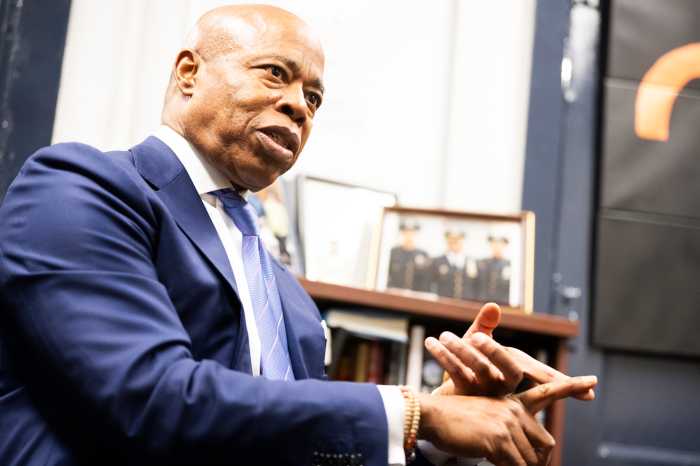 Photo by Lloyd Mitchell
Adams has also issued executive orders and made appointments that appear to lock in policies at odds with Mamdani’s platform. In December, he signed an order barring city agencies from engaging in contracting practices that could be construed as boycotts of Israel, despite Mamdani’s public support for the Boycott, Divestment and Sanctions movement. His administration also moved to designate Elizabeth Street Garden as protected parkland, limiting Mamdani’s ability to pursue affordable housing development at the site.
In education policy, Adams appointed former Republican councilmember Joe Borelli to the city’s Panel for Educational Policy, a body that plays a central role in overseeing public schools. He also tapped a pro-police ally as the new head of the NYPD’s independent oversight board earlier this month.
The appointments, which extend into Mamdani’s term, were widely interpreted as another effort to shape policy beyond Adams’ tenure.
Adams defended those late-term appointments and decisions as part of his obligation to govern through the end of his term, not an effort to constrain the next administration. While acknowledging criticism, he said mayors have long exercised that authority to protect their policy priorities.
“While you’re the mayor, you still have the power to make appointments that will protect your legacy and continue your legacy,” he said, calling claims that he was trying to block Mamdani “asinine.”
“We’re utilizing our authority to put people on boards, and other positions that’re going to fulfill what I have to do until I’m no longer the mayor,” he said.
Adams also addressed questions about whether he would attend Mamdani’s inauguration, saying he was wary of his presence becoming a distraction. He said he wanted the moment to remain celebratory and historically intact, expressing concern that some of Mamdani’s supporters might attempt to turn the event into a protest. Adams said he would prefer to speak directly with Mamdani before making a final decision, framing it as a matter of symbolism and respect for a smooth transfer of power.
‘I did nothing wrong’
The outgoing mayor spent much of the interview addressing his exoneration from serious allegations of corruption that he had repeatedly denied, but which had effectively derailed his reelection bid. Those included the September 2024 federal charges accusing him of bribery, wire fraud, and illegal campaign contributions, a case Adams has described as politically motivated from its inception.
The charges were ultimately dismissed by federal Judge Dale Ho in April with prejudice, barring the Justice Department from reviving the case. While President Donald Trump’s Justice Department initially sought a dismissal without prejudice, which would have allowed prosecutors to refile the charges at a later date, the court rejected that approach. The judge cited concerns that leaving the case unresolved could create the perception that the federal government was wielding the threat of renewed prosecution as leverage over the sitting mayor.
In his exit interview, Adams pointed to that concern directly, arguing that the case itself reflected a broader politicization of the Justice Department. He urged New Yorkers to scrutinize the charges themselves.
“People should read the indictment,” Adams said, calling the case an attempt to frame routine conduct as criminal. He also noted that President Biden had acknowledged problems within the Justice Department when pardoning his son, saying the agency had become “too political.”
Still, Judge Ho’s ruling fueled widespread speculation that Adams’ legal troubles were entangled with federal immigration policy, particularly allegations that his cooperation with the Trump administration’s immigration crackdown had been exchanged for leniency.
That speculation intensified in the weeks leading up to the case’s dismissal. On Feb. 13, Manhattan’s top federal prosecutor, Danielle Sassoon, and five other senior Justice Department officials resigned. Sassoon said she had refused an order to drop the corruption case against Adams.
On Feb. 14, Adams appeared on Fox News alongside Trump’s “border czar,” Tom Homan, saying they had discussed embedding more NYPD officers in federal task forces and developing a plan to allow federal immigration authorities to operate on Rikers Island — a significant departure from the city’s longstanding sanctuary policies. The proposal to grant ICE access to the jail complex was later blocked by the New York Supreme Court.
Adams forcefully rejected any suggestion of a quid pro quo. He said there was “nothing wrong” with his interactions with federal officials and denied trading policy decisions for personal legal relief.
“I did nothing wrong,” Adams said, adding that his positions on immigration and public safety long predated the indictment and were based, he said, solely on what he believed was in the best interests of New Yorkers.
When asked whether he would support the release of all files related to the case to clear his name, Adams said he believed the dismissal itself had already done so, arguing that the judicial process, including the decision to dismiss the case with prejudice, followed long-standing legal norms and required no further disclosure to validate his innocence.
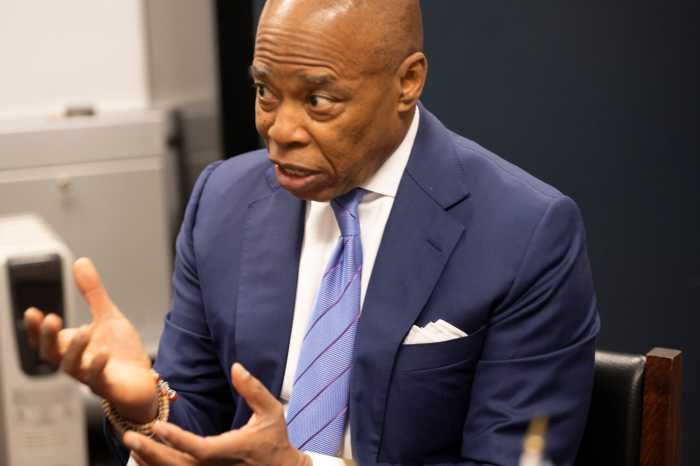 Photo by Lloyd Mitchell
Regarding his relationship with President Trump, he stated that it was consistent with how he treated President Biden. However, he credited POTUS for publicly criticizing the federal case against him while campaigning, not while in office.
“The president — while campaigning, not while he was president — said this is wrong, what they’re doing to Mayor Adams in New York,” he said. “Without knowing if he was going to win or not, he made it clear that it was wrong.”
He noted he traveled to Washington roughly 10 times to advocate for New York in the midst of the city’s migrant crisis, and said visits to Trump were no different from those of other Democratic officials and should not be viewed as suspect.
“I don’t understand when Governor Hochul went to visit President Trump, it was applauded… I went to visit… and I was looked down on,” Adams said.
He also credits Trump for handling border enforcement more effectively than the Biden administration, arguing that securing the border reduced the flow of asylum seekers into New York and eased the financial strain of the crisis.
“Should we go after those broken people who are just trying to provide for themselves? No, I don’t support that,” he said, drawing a line on the increased federal immigration enforcement efforts that have seen people with no criminal records detained and deported.
“But should we go after those who are committing a crime… and after they are convicted and serve time, have them deported? Yes, I support that,” he added.
In the interview, Adams also addressed the ongoing investigation by the city Department of Investigation, which is examining whether he violated ethics laws. He emphasized that he had “done nothing wrong” and framed the probe as part of a broader pattern of politicization against him.
Only time will tell
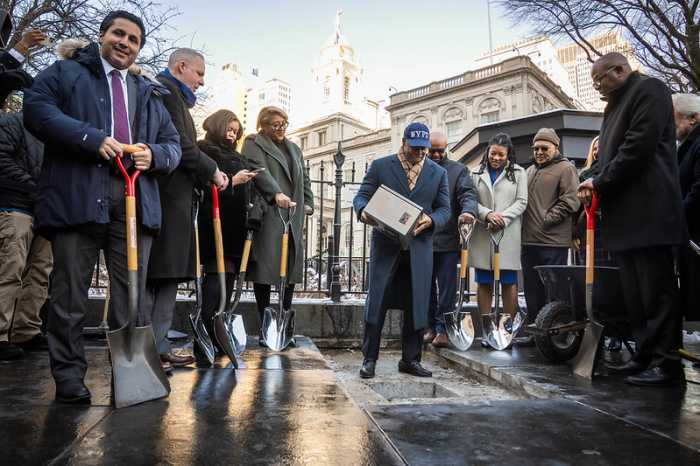
Days after the sit-down interview, Adams convened a final press conference with his senior leadership team in City Hall’s Rotunda, not to announce new policies, but to place a symbolic capstone on his administration: a time capsule.
One by one, commissioners and deputy mayors described their work and placed objects inside, intended to serve as a record for future New Yorkers.
A key, a tassel, a padlock, a drone fragment, a baby onesie, a miniature ferry, and a trash can were placed into the capsule by outgoing Adams administration officials, each meant to symbolize a pillar the mayor has spent four years elevating: public safety through technology and enforcement; housing production through rezonings and the “City of Yes” agenda; affordability through labor contracts, tax relief, childcare expansion, and debt forgiveness; quality-of-life initiatives such as containerized trash and the closure of illegal cannabis shops; and the city’s humanitarian response to the migrant crisis, represented by an ID card from the Roosevelt Hotel, once the nerve center of New York’s asylum-seeker operations.
As the ceremony stretched on, Adams returned again and again to the idea that history, like the time capsule itself, is shaped by what is chosen to be preserved.
 Photo by Ed Reed/Mayoral Photography Office.
“You have to take the totality and the full scope of the person,” he said, rejecting what he called selective narratives about his tenure. Asked recently about the difference between Eric Adams, the mayor, and Eric Adams the individual, he said there was none. “Unfiltered. Perfectly imperfect. I am just Eric.”
He used the final press conference, but like his interviews, to frame his mayoralty less as a political chapter than as an extension of a personal journey — from a dyslexic child raised by a mother who “never gave up,” to a mayor who insists that setbacks are not endings but inflection points. “A bend in the road is not the end of the road,” Adams said.
“History is not selectively picking out one piece that fits into your narrative,” he said. “History is showing the totality of what an individual does. And that’s what this time capsule is about.”
Sealed beneath City Hall, the capsule will remain closed for another decade. By then, the city will be under different leadership, shaped by different priorities. But Adams is betting that when future New Yorkers look back, they will see more than controversy or conflict.
“I’m ready,” he said. “I did what I had to do. And I’m leaving back a proud record for all of us New Yorkers.”