
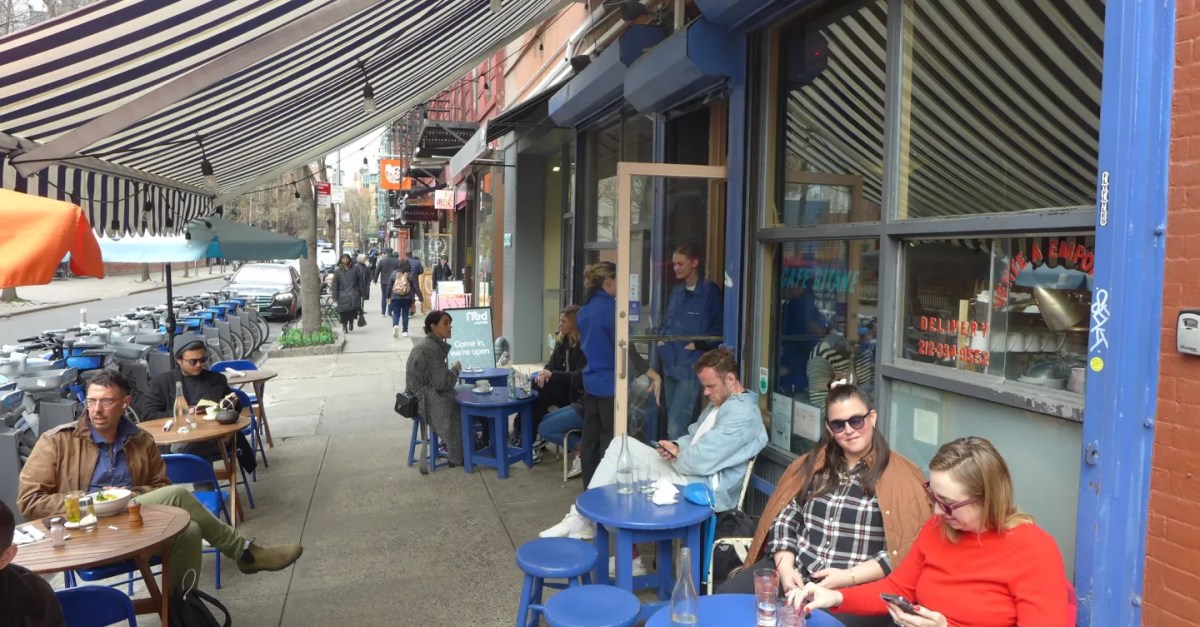
When Luc Lévy, originally from Morocco, opened Cafe Gitane at 242 Mott Street, near Prince Street, in June 1994, nobody showed up, Gothamist reported last year at the release of the restaurant’s 30th anniversary coffee table book, Cafe Gitane: 30 Years, written by Isobel Lola Brown, the cafe’s general manager. (A follow-up was released in October.)
It was so slow, Lévy recalled, that he sent his only waitress home — a musician named Charlyn Marshall, who, months later, recorded her first album as Cat Power at a practice space up the block shared by Sonic Youth and the Beastie Boys.
Now, more than 30 years later, the original Cafe Gitane, which became such an iconic New York institution, closed, apparently, a few days ago. A tipster alerted Eater that the longtime Nolita cafe was boarded up, and Eater followed up by calling the Vinegar Hill location, where an employee confirmed and lamented its closing. The website is also dead.
Before Nolita was even the name for this surrounding neighborhood, the cafe became a downtown living room and a clubhouse of sorts. And while the “intimidatingly cool” restaurant had its ups and downs as far as a hot spot, its reputation was back on the rise, according to the New York Times last year.
It was a regular spot for people like Spike Jones, David Bowie, Michelle Williams, and restaurateurs like Serge Becker and Zac Bahaj of Lucien.
“I have so many memories when I come here,” Helena Christensen told the Times. “The downtown landmarks like Cafe Gitane signify a time and vibe in New York that once was. Yes, the city has changed so much, but I still think Gitane is as cool as it always was.”
In a period of its heyday, Eater nodded to its help in making avocado toast ubiquitous, calling it the “fashionable toast specialist cafe.”
The timing lands in a neighborhood that has changed almost beyond recognition since its opening in the 1990s. Mott Street and the surrounding blocks have become a high-rent retail corridor, where longstanding independent restaurants are less likely to land unless, like Musket Room or Major Food Group’s Torrisi, they have high-dollar backing.
Last year, when Alison Stewart of WNYC’s “All of It” asked Lévy why he thought the place remained relevant for 30 years, he focused on the space. “There was not in any way like, ‘Okay, I’m going to be like this cafe in Paris or this place or this.’ It was just, “Okay, how do I feel? How would I want [it]? What would I want to put on this wall?”
But the apparent closure of the Mott Street original comes after a period of turmoil that has undercut the restaurant’s myth of steadiness. In October 2025, Grub Street published an article in which multiple current and former employees said they weren’t getting paid, describing missed paychecks and alleging they were owed back wages; the story also described a wider backdrop of financial and legal disputes involving the business.
Before the article, in October 2020, the Mott Street landlord sued Cafe Gitane for over $470,000 in unpaid rent and fees, a sum Levy settled, Grub Street reported. He then apparently signed a lease for a spot in Red Hook and later announced an expansion to Los Angeles.
Eater has reached out to the owner to learn more about the closing.