
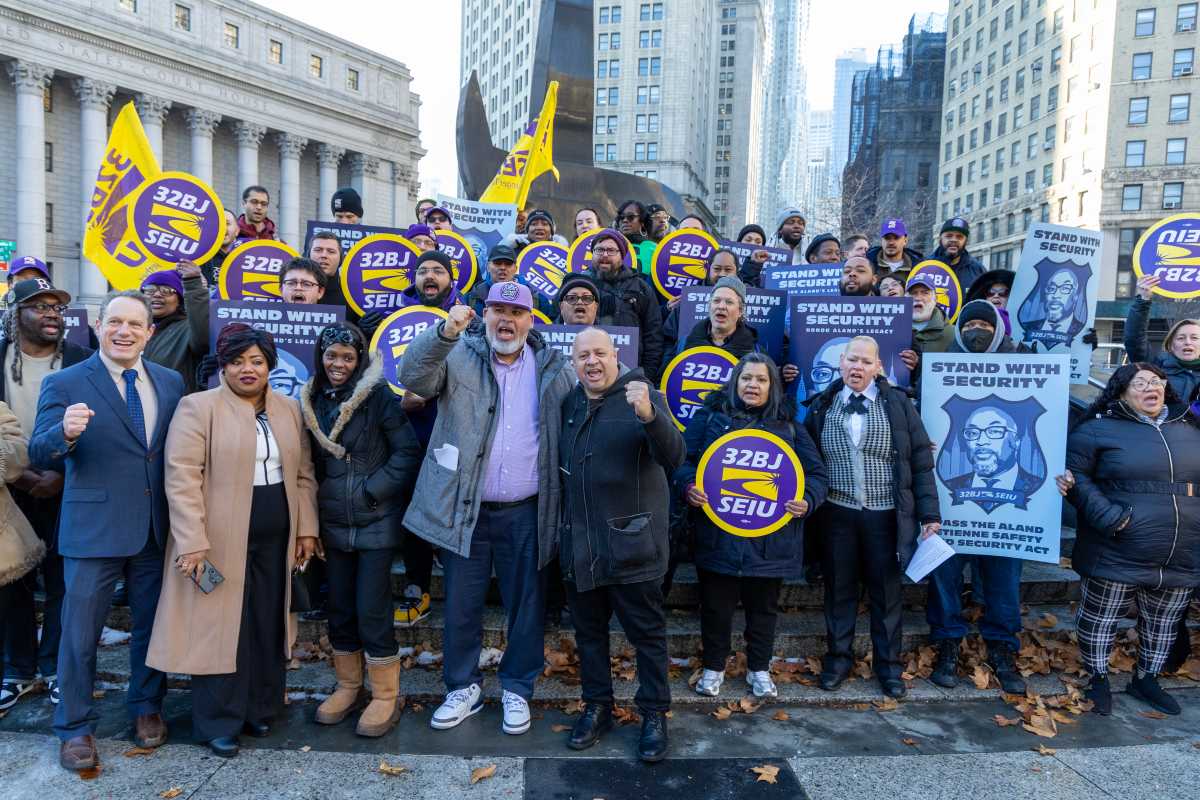
The New York City Council, in a marathon end-of-year meeting that lasted late into the night on December 18, passed the Aland Etienne Safety and Security Act, phasing in new minimum pay and benefits standards for this industry in New York City.
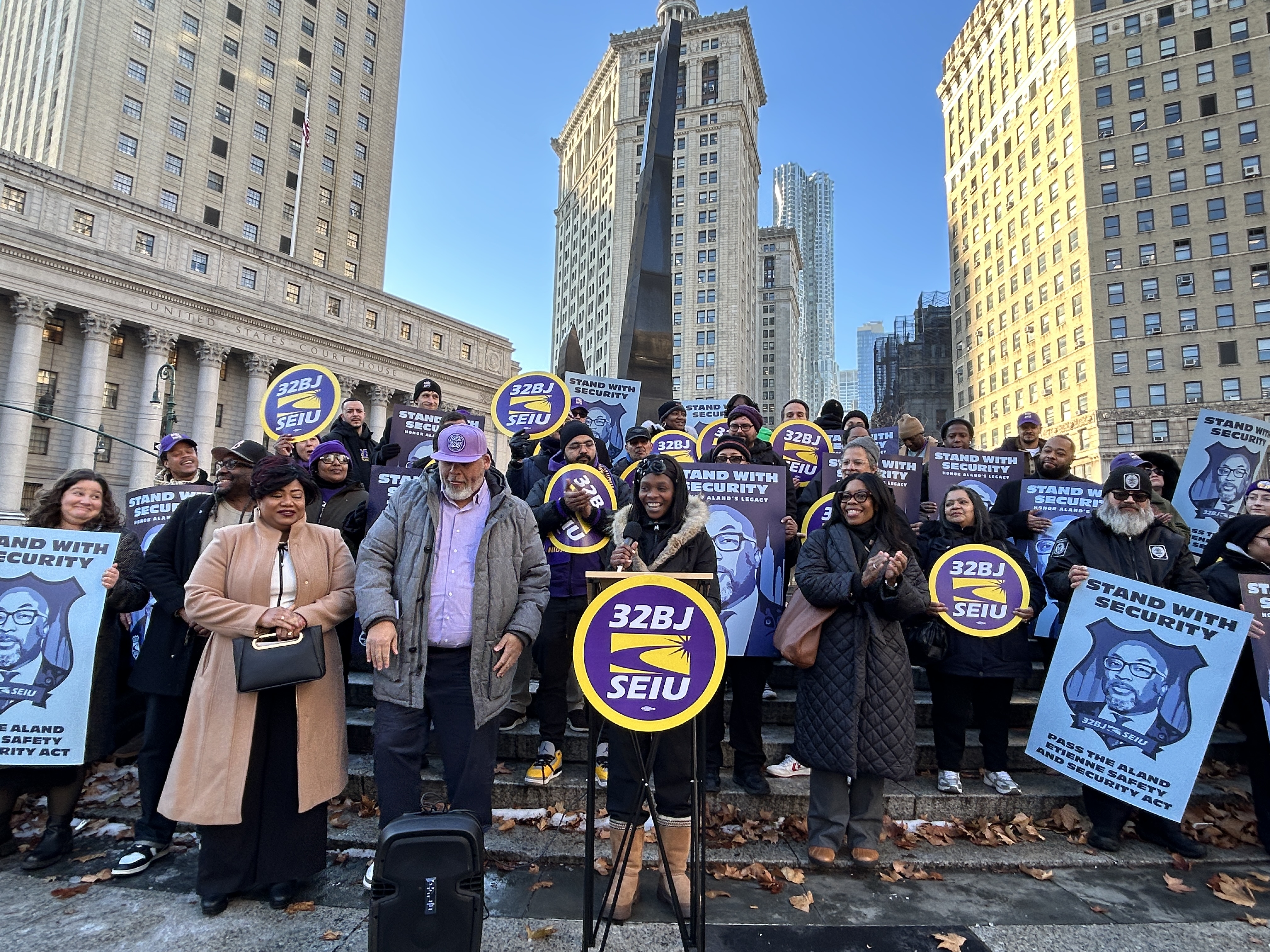
The legislation, which still must be signed into law by the mayor, was sponsored by Speaker Adrienne Adams and dozens of co-sponsors, and heavily supported by 32BJ SEIU which represents 20,000 security guards in New York City and held numerous rallies to support it passage.
It is named for Aland Etienne, a security officer and Brooklyn resident who died in a Midtown mass shooting at 345 Park Ave. in July. And it followed several rallies in recent days, with the phrase “Protect the protectors” as a kind of rallying cry.
Etienne, 46, of Brooklyn, and off-duty NYPD officer Didarul Islam, 36, working a security detail, were killed July 28 in a shooting at 345 Park Ave.
Wesley LePatner, 43, a senior managing director at Blackstone, and Julia Hyman, 27, an associate at Rudin Management, which owns the building, also were killed. The shooter then took his own life.
 32BJ SEIU President Manny PastreichPhoto courtesy of 32BJ SEIU
The legislation was described as an effort to honor Etienne by improving working conditions in his industry, recognize the value of the job and address high turnover.
Earlier versions included new training requirements, but this version left existing training requirements in place, while seeking to improve base pay and benefits.
Current training standards include eight hours before starting work and obtaining a license, 16 hours on-the-job training within 90 days of employment, and eight hours of annual training. The legislation seeks to improve required pay, although some guards’ compensation already exceeds this, while addressing an increasing turnover rate.
The Department of Consumer and Worker Protection would be tasked with enforcing wage standards, as well as paid sick and vacation leave and benefits as they are phased in over three years.
“Security officers are integral to our city’s public safety infrastructure, safeguarding our offices, homes, public institutions, and so much more,” Speaker Adams said. “Every day, security officers put their lives on the line, and yet they aren’t always compensated or treated like the essential workers they are.”
 Rachelle Paoli, Aland Etienne’s partnerPhoto courtesy of 32BJ SEIU
Others who support the legislation touted a need to set a higher base pay for workers on the front lines of safety for New Yorkers.
“Despite putting their lives on the line to keep our city safe, security officers have been overlooked for too long,” 32BJ SEIU President Manny Pastreich said. “This marks a historic win for thousands of working people.”
He said it honors Etienne and those in the industry and improves compensation, at least for those currently paid beneath this new standard for workers daily on “the frontlines of keeping our city safe.”
The legislation, Patreich said, will provide these security guards with a “living wage, access (to) affordable health care, and (let them) take time off to recuperate.”
Rachelle Etienne, Aland Etienne’s partner, said he was “someone who protected and uplifted others” and “protected the public on the job.”
“As a father, partner, brother, son and mentor he did whatever he could to uplift not just his family and friends, but strangers and colleagues alike,” she said. “I am grateful that today, we can honor his legacy by supporting his colleagues across the city.”
Raven Skinner, a security guard who worked with Etienne, described him as inspirational and this legislation as a way to honor him and improve the lives of those in his industry.
 Raven Skinner, NYC Security Officer.Photo courtesy of 32BJ SEIU
“He inspired me to be a better security officer and a better parent. Ultimately, Aland gave his life trying to protect the people he worked with,” Skinner said. “By recognizing the thousands of security officers like him, we are honoring Aland’s memory and legacy.”
While some security guards’ payment already exceeds this amount, a recent independent study found industry conditions were conducive to turnover.
A UC Berkeley Labor Center study found that private sector security guards in New York City earn an average of $40,311and 37.8% lack health insurance through their employer or a household member’s employer.
The study also found that the sector in New York City had a turnover rate of 77% in 2024 , above an already high rate of 69.3% before the pandemic in 2019.
More than three-quarters of security guards or 77.3% are men and 90.6% are workers of color including half who are Black, according to the study.
The legislation phases in a new base wage, benefits, and paid time off standards for the 81,900 private sector security guards.
 Photo courtesy of 32BJ SEIU
Clarissa Baynes, a security guard in New York City, said she has “had a few health problems pop up over the years” and that good health coverage could truly protect security guards.
“Each time, I’ve had to pay out of pocket for medical care,” she said. “As I get older, that’s terrifying.”
Security guards in New York City in the first year after passage must be paid a wage equal to or greater than that of private sector security guards employed on city contracts, currently set at $18.02-$21.201, depending on years of experience and certifications.
They in the second year would be entitled to at least the same time off required for private sector security guards employed on city contracts, including holidays, vacation, and sick leave.
In the third year, they must be provided with no less than the benefits or cash equivalent of those for private sector security officers employed on city contracts, as benefits, cash, or a combination.