
A bill that could have a significant impact on the the operations of final mile delivery companies in New York City, Amazon in particular, ended 2025 without any action being taken on it.
The bill was introduced by City Council member Tiffany Caban in September. Its formal name is the Delivery Protection Act and it is strongly backed by the Teamsters.
However, unlike legislation that does not get approved in Congress, the bill does not need to be reintroduced to be considered by the new Council that will be seated at the start of 2026.
The Act was always viewed as being directly aimed at Amazon. The most significant aspects of the bill were the requirement that a final mile delivery service that operates a warehouse or storage facility obtain a license from the city, and that the license could be suspended if there was a “pattern or practice of violations.”
After being introduced, the bill went nowhere despite the fact that 41 members out of a 51-seat Council were co-sponsors, including Caban.
The City Council page devoted to it showed no progress since the legislation was referred to the Committee on Consumer and Worker Protection. No committee hearings were held on the proposal.
Ran out of time
Sources close to the Council say that was a function of the late introduction of the legislation. It condensed the amount of time available to get the Act approved before 2025 came to a close.
New York City’s City Council had its last session of the year Thursday.
“The Council has championed efforts to regulate last-mile facilities, including securing a commitment as part of the City of Yes for Economic Opportunity to require a special permit for the facilities,” a spokeswoman for the City Council told FreightWaves in an email. “This will require negotiation with community stakeholders for the facilities to be approved for operation. Workers who are employed by last-mile companies and facilities play an important role in our economy, and they deserve greater safety and protections. With dozens of bills under consideration for the final week of the legislative session, this bill did not have a hearing and was not completed in that time period.”
Teamsters are angry
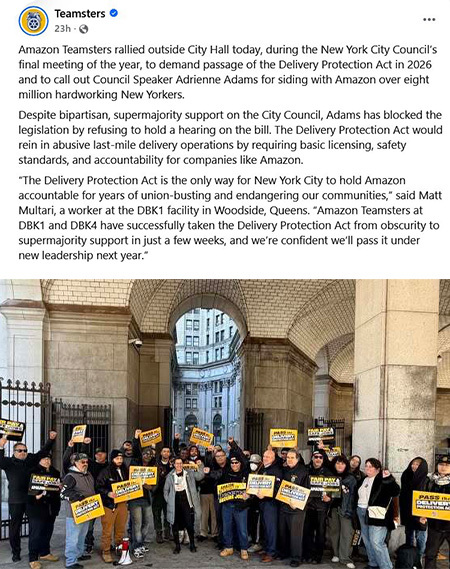
But the lack of even a committee hearing, much less a full council on the bill, drew the ire of the Teamsters. The union staged a demonstration outside City Council Thursday before the full legislative body held its final session of 2025. .
On its Facebook page, the union ripped into Council Speaker Adrienne Adams for not scheduling a committee meeting on the Act.
She was criticized for “siding with Amazon over eight million hardworking New Yorkers. Despite bipartisan, supermajority support on the City Council, Adams has blocked the legislation by refusing to hold a hearing on the bill. The Delivery Protection Act would rein in abusive last-mile delivery operations by requiring basic licensing, safety standards, and accountability for companies like Amazon.”
The two key provisions of the legislation would require operators of “certain warehouses and storage facilities from which goods are delivered to final consumers in the City“ to obtain a license to do so from the Department of Consumer and Worker Protection. Depending on how “warehouses” and “storage facilities” were defined, it might have been able to allow smaller delivery services that don’t store any goods, but just transports them, to avoid the licensing requirement. Amazon (NASDAQ: AMZN) obviously would fit the definition of a warehouse operator.
The other key provision would have allowed the commissioner of that agency to deny a license application or renewal of a company if it “has engaged in a pattern or practice of violations of any city, state, or federal law relating to workplace safety, road or highway safety, environmental protection, unfair or deceptive trade practices, or workplace or worker protections in connection with operating one or more last-mile facilities.”
Legal battles possible after passage
Should the bill pass the Council in 2026, it may spur new court battles. There are two likely legal questions, according to transportation attorneys.
One is whether a locality can regulate a company that could be found to be engaged in interstate commerce. In turn, the question of whether a last mile delivery service is involved in interstate commerce, even if it does not cross state lines, is now a question before the Supreme Court in the Flowers Foods case.
Secondly, there could be a question whether such a local action be in conflict with the Federal Aviation Administration Authorization Act, the 1994 law that prevents state or local action that affects a transportation “price, route or service.” F4A as it is known is regularly litigated in the court system and is in front of the Supreme Court now on the question of broker liability.
Amazon had not responded to an email from FreightWaves by publication time.
More articles by John Kingston
Strange bedfellows as states say brokers not protected under ‘safety exception’