
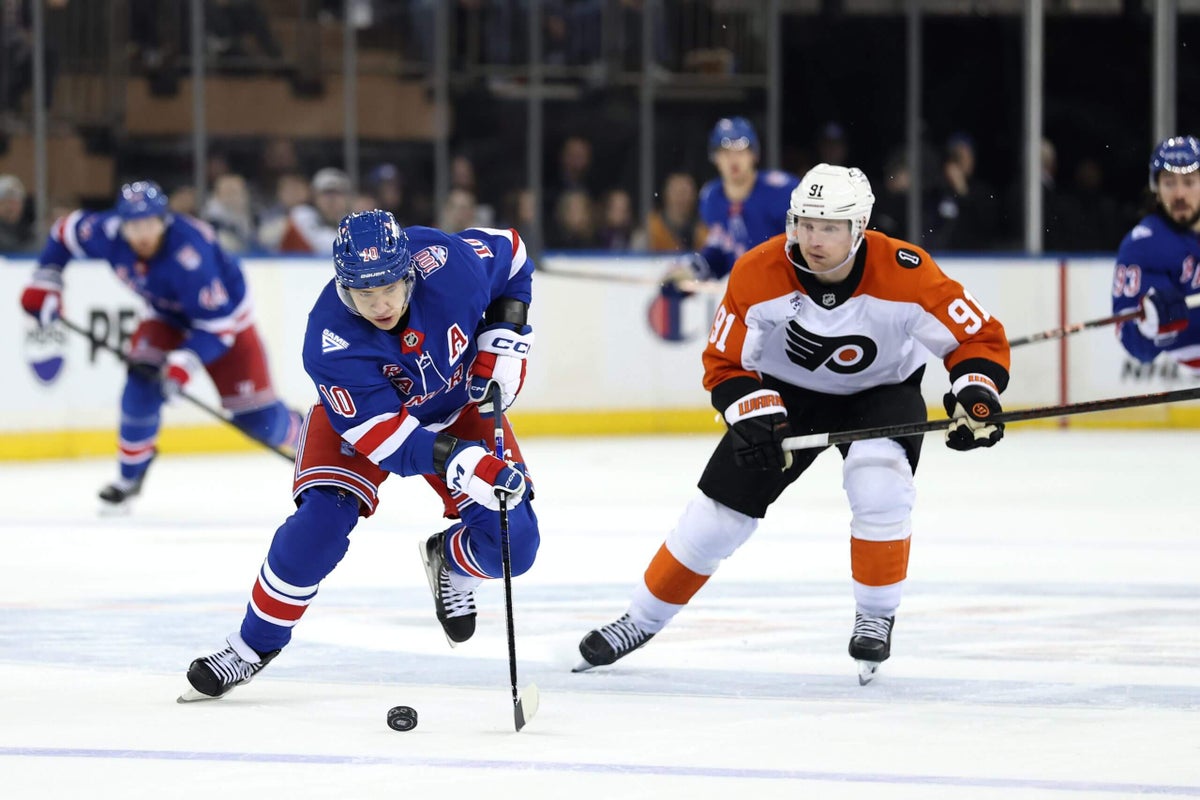
NEW YORK — The New York Rangers sulked into the Madison Square Garden locker room at second intermission Saturday, staring down the possibility of another demoralizing loss on home ice.
They had just completed a sloppy, uninspired 20 minutes and trailed the Philadelphia Flyers by two, but rather than ride his team for their mistakes, coach Mike Sullivan decided to try lifting them up.
“We talked about just getting the next goal going out into the third period, and just having the ability to shrug it off and not allowing it to bleed into our game moving forward,” Sullivan said. “That’s such a huge part of a team’s ability to have success, and it starts with a belief. We’ve got to believe we can do it.”
It’s easy to talk about belief, but feeling it is something different.
To this point, the Rangers have had little proof of concept.
They entered with only four wins in 17 tries at MSG, largely because of an inept offense that lacks finishing talent and depth. Those big-picture concerns remain, but at least Saturday’s 5-4 shootout win offered a glimmer of hope.
“It’s one thing to believe, but you’ve got to get something out of it, too,” said Mika Zibanejad, who scored the tying goal with 2:34 remaining in regulation. “You’ve got to get something to kind of rally around and get that energy.”
The Rangers (18-15-4) counted most on the players who delivered.
Zibanejad and Artemi Panarin were driving forces in the comeback effort, with that duo involved in three of New York’s four regulation goals. Panarin scored twice, the first coming on a stellar assist from Zibanejad, who won a foot race to a loose puck along the boards and absorbed a hit while putting the pass on the money. Zibanejad then completed the third-period rally with a power-play one-timer. The former also converted the decisive shootout attempt, beating Philly goalie Samuel Ersson with a nifty backhand.
“We need goals from our top six, and that’s been kind of the struggle lately,” said Vincent Trocheck, who also contributed a goal by following his own rebound to cut the deficit to 4-3 early in the period. “It’s nice to see them scoring. Nice to see our power play get one late. All those things are important for us.”
The burden on those players could be even heavier moving forward.
Flyers defenseman Nick Seeler hammered Rangers captain J.T. Miller on an open-ice hit with 10:04 remaining in the third period, and Miller went down hard. His right shoulder seemed to take the brunt of it, with the 32-year-old forward showing immediate pain. He slowly skated to the bench while grabbing his right arm, hunched over on the bench for a moment, then headed to the locker room and did not return.
Here’s what happened to J.T. Miller. ⬇️ #NYR https://t.co/mI4s4dNRuj pic.twitter.com/Q1GPFfZUez
— Snark Messier (@SnarkMessier) December 20, 2025
After the game, Sullivan said Miller was still being evaluated with an upper-body injury. Given the way he reacted to the hit, it would come as a surprise if he suits up for Sunday’s quick turnaround in Nashville against the Predators. The fear is he’ll miss more time than that, making an already undermanned New York lineup — which played without top defenseman Adam Fox for the 10th straight game — paper-thin.
“I don’t want to ever see anybody on our team go down,” Trocheck said. “J.T. is obviously a huge part of our team, so it hurts whenever you see a guy like that go down. I don’t know the situation yet, so we’ll look at it (and) see if he’s going to miss time. If he does, then, like they always say, next man up.”
Here are 10 more thoughts from the Rangers’ sixth comeback win of the season:
1. The Rangers have been too reliant on a select few veterans to carry the offense, even with Miller in the lineup. Sullivan has doubled down by placing his two most dangerous forwards, Panarin and Zibanejad, on the same line for an extended stretch. It’s created an imbalance that’s even more stark when those two aren’t producing.
The underlying numbers have been solid for Panarin, Zibanejad and Alexis Lafrenière, with a 54.49 percent expected goals-for rate and 40-23 advantage in high-danger scoring chances across 169:13 of ice time, according to Natural Stat Trick. Until Saturday, though, it had only led to three goals while allowing six.
Panarin and Zibanejad spent much of the previous six seasons working on separate lines, and when they did get a rare look together, it never lasted long. That’s changed this season, with Zibanejad expressing appreciation for the long leash Sullivan has given them to build chemistry.
“In the past, maybe it’s been a few games, and then it switches, or a period, then it switches,” the 32-year-old center said. “You don’t get that length of time, I guess, to really work on it. … So far so good, and I think we can keep getting better.”
2. Panarin and Zibanejad have statistically had more dominant games. They were out-attempted (18-15), outshot (12-7) and on the wrong end of the HD chances battle (4-2), but the scoreboard read 2-1 Rangers during 14:04 of shared TOI at five-on-five. They looked assertive from the start and stood out as New York’s most threatening skaters, even if it occasionally led to the puck coming back the other way. If any line should have the leeway to take those risks, it’s them.
“They’ve been driving a lot of offense,” Sullivan said. “Mika has the ability to think the game on the same level as Bread, and I think he has the ability and the talent level to execute the plays, in particular off the rush. Because I think that’s one of Bread’s strengths, it’s just his ability to generate off the rush. And I think Mika can play that game. He also has a responsible game. He sees it pretty well defensively also, and I think that’s an important element of that line.”
3. Not much went right for the Rangers during a second period in which they surrendered all four Philadelphia goals, including a shorthanded tally from Rodrigo Abols that pushed the Flyers’ lead to 4-2 at the 14:36 mark. The first two goals, though, which came during a deflating span of 23 seconds, weren’t of the high-danger variety.
The first came from Travis Sanheim, who, on a power-play tally, had a clear look from the high slot, but so did Igor Shesterkin. The wrister went off the goalie’s blocker and in to tie the score at 1-1, with Owen Tippett scoring from almost the same spot on the next shift. There was a little more traffic in front of Shesterkin on that one, but he called it “a clean shot,” adding, “I should stop that.”
“We went in the second period without a goalie,” Shesterkin said bluntly.
4. New York’s defense has shown significant improvement under Sullivan, but Shesterkin hasn’t fared as well while facing reduced volume. He started the season strong, but there’s been a noticeable dip of late. That includes 28 saves on 32 shots faced Saturday, which dropped his save percentage to .908. He’s been .880 or worse in four of his last five games and was clearly frustrated after this one.
“They were easy goals,” he said. “I was upset, but I just tried to come back and give us a chance to win.”
Then he tried to lighten up, adding, “We played so well in the offensive zone today. I owe dinner for everyone.”
5. Trocheck scoffed when he heard Shesterkin was so hard on himself.
“I didn’t see anything wrong with the way he played,” he said. “We kind of screwed him in the second on the power play. He made stops in the shootout against some of the better shootout players in the league. So I thought he was outstanding. I actually told him after the game that I thought he was nasty tonight.”
6. Shesterkin wouldn’t have been facing an odd-man rush while the Rangers were on a second-period power play if it weren’t for an egregious turnover from defenseman Scott Morrow. The 23-year-old tried to make a cross-ice pass through the neutral zone that was telegraphed and easily intercepted by Sanheim, directly leading to Abols’ goal. I thought that might be the end of the Morrow experiment on New York’s top power-play unit, but Sullivan decided to stick with it.
It paid off later in the game, when Morrow had the primary assist on Zibanejad’s tying goal. However, there was another unsightly blunder in overtime when he passed the puck right to Flyers forward Trevor Zegras, then tripped him to put the Rangers on the penalty kill for the final 51 seconds of OT.
It was an error-filled game that made you question whether Morrow will be in the lineup Sunday, but Sullivan attempted to prop the rookie up after the game.
“What I’ll say is that he’s an incredible kid, and his ability to shrug off some of the plays and continue to perform out there, I think, speaks volumes for the character of what he’s about,” Sullivan said. “He’s a young player. He’s going to make some mistakes, and let’s be honest: we’re putting him in some really high-profile positions, whether it be on the power play and overtime, things of that nature. He’s playing a significant role here with this group right now, especially with Foxy being out. … He’ll become a better player because of these experiences that he’s going through.”
7. Before Morrow’s OT penalty, Panarin was called for slashing eight seconds into the extra period. That left the Rangers killing penalties for over half of the five-minute overtime. Has that ever happened to a Sullivan-coached team?
“No,” he said. “And I hope it never happens again.”
8. Before the game, Sullivan gave a detailed explanation of why he decided to start top prospect Gabe Perreault on the third line after using him in the top six for his first go-around of the season last month.
“Our observation when we had him up the last time was, it was a really difficult task,” the coach said. “Our thought process was, when we put him right up into the top six, is we understand the type of player that he is, and we’re trying to put him in a position to be successful. He’s an offensive player with good offensive instincts, and so our intention was to put him with our best offensive people, and that’s what we did.
“The flip side of that is you’re going to play against the opponent’s top players. You’re going to get the top defense players. You’re going to get the very best players that you’re playing against. And so, this time around, we thought more in terms of, would it make sense for Gabe if we put him around some different people, and maybe he doesn’t get the top defense pair? It gives him an opportunity to act on his instincts and do his thing that way, and then we’ll watch him and we’ll see.”
9. True to his word, Sullivan bumped Perreault up with Trocheck and Miller to begin the second period. That was partially because of how the 20-year-old was playing — other than a prime scoring chance in front of the Philly net in which he briefly hesitated before shooting wide — but maybe even more so because of a poor start from Conor Sheary. Sullivan values the 33-year-old veteran’s speed and forechecking, but he had a couple of botched attempts and defensive mistakes during a tough opening period.
Perreault made a few subtle puck touches to help maintain possessions and ended up assisting on Trocheck’s goal across 15:31 TOI, including 7:31 on a line with Trocheck and Miller. They generated three HD chances without allowing any while doubling the Flyers with a 10-5 ratio on shot attempts.
“We liked Gabe’s game,” Sullivan said. “We thought we’d give it a shot. I had this conversation with you guys before the game, so it’s probably nothing that you didn’t expect, and then you saw it. I hope that’s proof that I’m speaking the truth.”
10. Fellow rookie Brennan Othmann played a much smaller role and has clearly not earned Sullivan’s trust yet, as evidenced by a game-low 4:51 TOI. He spent more time in the penalty box for fighting notorious Flyers brawler Nicolas Deslauriers, who hit the 22-year-old forward from behind during the second period and got called for boarding.
Othmann immediately dropped his gloves, perhaps unaware of who he was challenging, and got pummeled for it. It was an ugly scene, but at least give him credit for having the cojones to engage one of the league’s most-feared punchers. (Even if it was unknowingly.)