
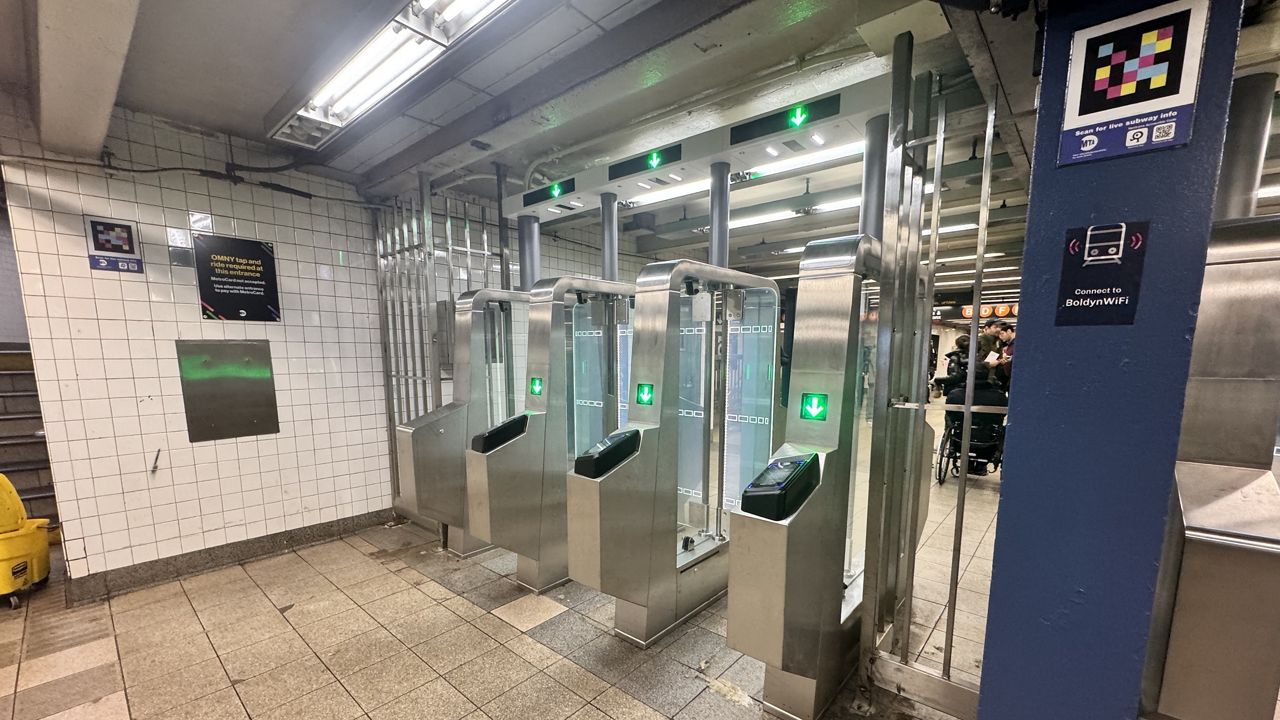
They’re finally here: new fare gates in the subway.
“It reminds me of Europe,” commuter Xaviar Murillo said. “So cool, I like it.”
What You Need To Know
The first 20 modern fare arrays are being installed by three companies as part of a pilot at no cost to the MTA
The wide-aisle gates with paddle doors eleminate the need for the current emergency gate where 50% of fare evasion happens, while providing a safe, efficient way for riders to evacuate in case of emergency
Dozens of sensors can distinguish between strollers, luggage and wheelchairs, and also detect when someone doesn’t pay the fare — which won’t go unnoticed by loud alarms
The MTA rolled out a model from Conduent at Broadway-Lafayette and the 138th Street-Third Avenue station in the Bronx.
“Since its inception, we had turnstiles that left so many people behind, people like myself who use wheelchairs, also parents with strollers,” Quemuel Arroyo, the MTA’s chief accessibility officer, said. “People with luggage and who have the guitar, they all struggled to get through — this is what true access looks like.”
Dozens of sensors connected to AI can distinguish between luggage, wheelchairs and children.
“I really like them,” Aanya Sanghvi said. “It’s really easy to get my luggage across, so I’m really thankful as you can see, I’m traveling.”
The technology can also detect who hasn’t paid. And even if someone tries, it won’t go unnoticed.
“You’ll hear from these gates, you know, a very loud noise when there is an attempt at a fare evasion,” Jamie Torres-Springer, president of MTA Construction and Development, said. “And then, we’re able to act on that.”
One of the biggest features with these new fare gates is they eliminate the need for the emergency exit gates, which the MTA calls the superhighway of fare evasion.
“No system is going to be 100% immune to fare evasion,” Torres-Springer said. “But what we’ve got with this technology is vastly minimizing the amount of evasion that you’re going to see. And also it’s going to give us the information we need to act and make sure that everybody’s paying.”
The gates will collect that data to show the MTA where the most fare evasion is happening. They also provide for safer evacuation in case of emergency, instead of having one emergency door.
“When a fire alarm goes off, or when one of our ticket booth agents, you know, triggers it, the gates will open and they’ll stay open so that people can exit the system in that circumstance,” Torres-Springer said. “It is much safer in addition to being accessible and secure.”
They can also be opened remotely. For now, this is a pilot among three companies who are paying for the fare gates to be installed at 20 stations in the coming weeks.
The MTA may pick one or several vendors to install them at 20 more next year and has a $1 billion in its capital plan dedicated to installing them at 150 stations over the next four years.