
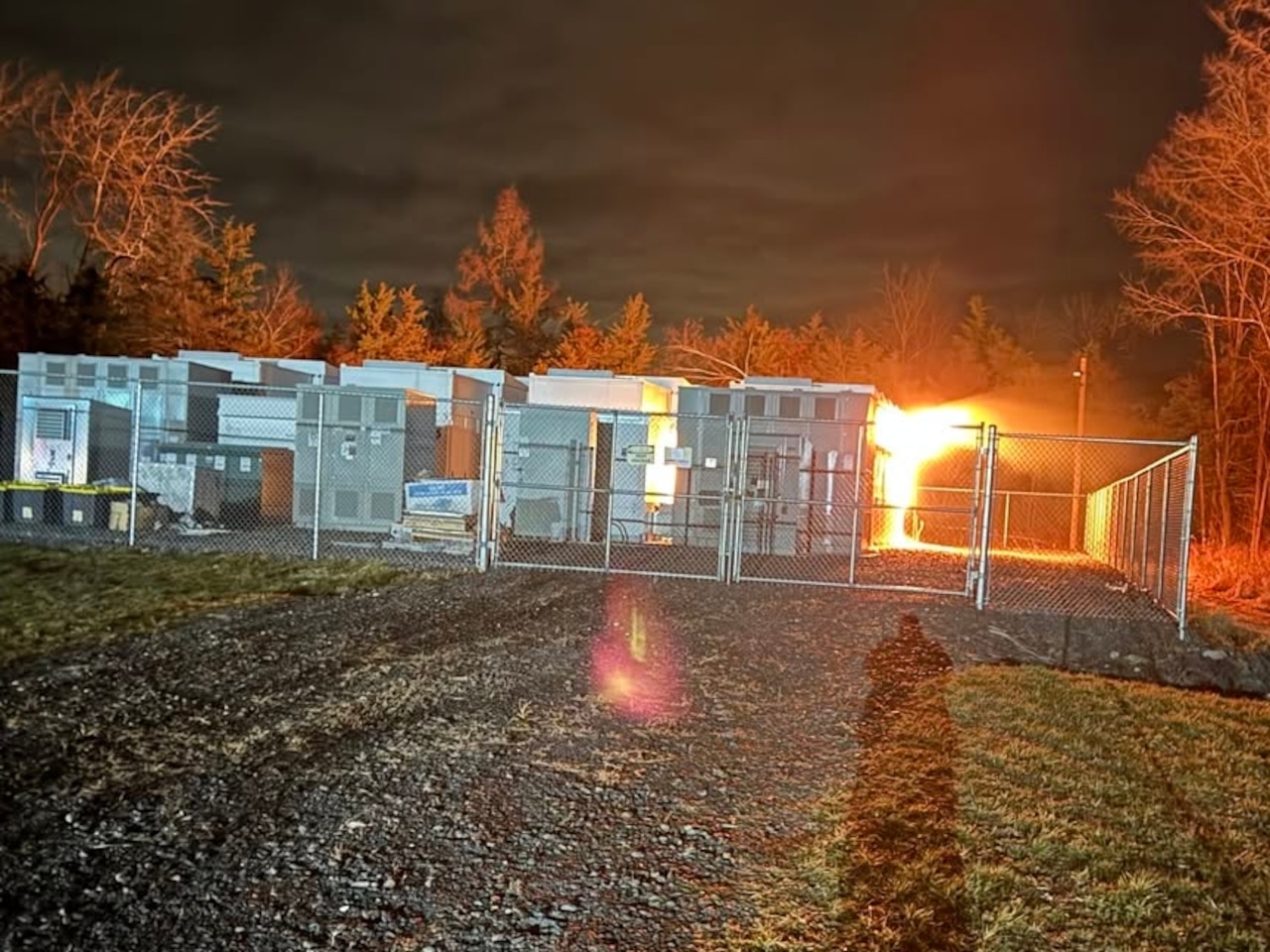
Residents in Warwick, N.Y. are dealing with the aftermath of a battery energy storage fire, which ignited on Friday night and took nearly 24 hours to extinguish. The event marks the third fire to hit the town’s small network of lithium-ion facilities since 2023.
“The Town of Warwick continues to actively monitor the battery energy storage facility fire that began Friday evening at a site located within the Village of Warwick,” town supervisor Jesse Dwyer noted on Warwick’s Facebook page. “Although the fire has diminished, the emissions from this event represent an enormous public safety concern.”
According to News 12 Westchester, the fire broke out shortly after 10 p.m. on Dec. 19 at an energy storage facility operated by Convergent Energy and Power on Church Street.
“When it was at its worst, there were flames and it was heart-stopping — especially since we’ve been here before,” Warwick Mayor Michael Newhard told the news station. “We had driving rain and wind — the perfect storm.”
A company spokesperson for Convergent Energy and Power said the fire was “localized in one of the units…extinguished within 24 hours and resolved without any injuries. Hazmat measured air quality as safe throughout the weekend. A physical presence remains at the site as a precaution.”
News 12 reports that this is the third lithium-ion battery fire in Warwick in roughly two years, involving two separate Convergent Energy sites. In 2023, back-to-back incidents occurred at both the Church Street facility and a different energy storage facility located on property owned by the Warwick Valley Central School District.
“After that first fire, the Town of Warwick immediately enacted a strict moratorium prohibiting the construction of any new battery energy storage facilities within the town,” Dwyer noted in his Facebook post. “That moratorium remains firmly in place, and incidents like this only reinforce why it was necessary.”
During this most recent fire, Orange County Emergency Management deployed multiple air-quality monitors around the Church Street site, as well as nearby neighborhoods and parks. The New York State Department of Environmental Conservation (DEC), which conducted a spill response investigation, reported no environmental impacts to air, soil or water beyond the localized fire site.
A technology that uses a group of batteries to store electrical energy, allowing the energy to be released later when needed, the storage system sites — commonly referred to as BESS — essentially act as backup power sources for homes or the grid, particularly during peak demand or power outages. They are often used in conjunction with renewable energy sources like solar power.
Developers and green energy proponents tout the lithium-ion structures — which started popping up in several NYC neighborhoods in 2022 — as quiet neighbors that are a necessary agent for renewable change. They are designed to remove pressure from the city’s stressed grid, using rechargeable batteries to store electrical energy from various sources, and then releasing that stored energy when needed.
But over the past two years, Staten Island residents and borough officials have voiced concerns about their siting. Community Boards voted against their proximity to bakeries and storefronts and elected officials issued a moratorium on applications filed within residential districts. In one instance, an energy developer retracted plans to place batteries in a Bulls Head church parking lot.
Borough President Vito Fossella says the latest Warwick BESS fire should serve as a warning to NYC residents and is calling for an immediate shut down and inspection of all Convergent sites.
“For years, we have warned that BESS units are inherently unproven and dangerous, that if they catch fire they burn for days, and when they do they release toxic gases,” Fossella noted in a statement. “We have also warned that these facilities are prone to catch fire under a wide variety of circumstances, including water damage. Unfortunately, our concerns have once again been realized.”
Fossella is now calling for an amendment to both state law and city zoning ordinances to increase setbacks to 250 feet in business and industrial zones and 1,000 feet in residential and mixed-use zones.
“The safety of our residents and neighborhoods must come first,” Fossella concluded.