
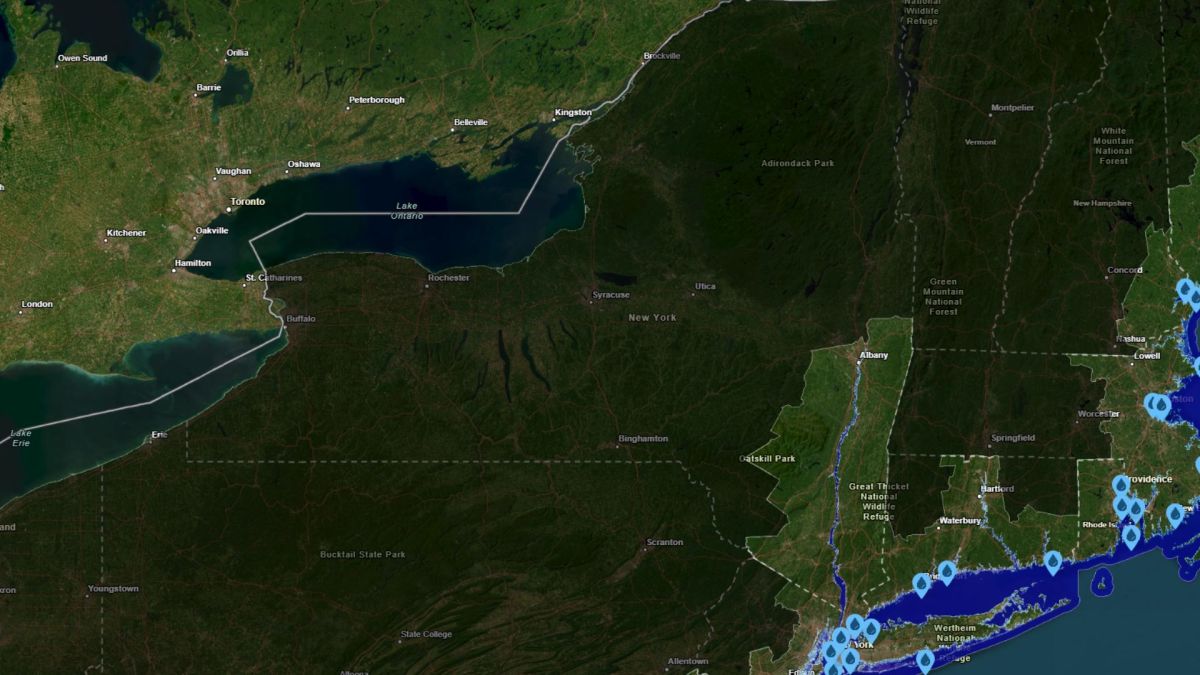
Major cities in New York, including New York City, would be flooded with water if sea levels rose by 10 feet, according to a projection map by the National Oceanic and Atmospheric Administration (NOAA).
Although, not only would cities be impacted, but many hospitals, fire stations, and other vital facilities.
“A 10-foot sea level rise would do far more than flood coastal roads and homes,” Shangjia Dong, a professor of construction and environmental engineering and a core faculty member of the Disaster Research Center at the University of Delaware, told Newsweek.
“More critically, it would severely disrupt the essential facilities that communities depend on for health, safety, and daily functioning,” he added.
Why It Matters
While it has been predicted by a number of experts there is around a century to go before sea levels could rise by 10 feet, they have said that it is a possibility.
Some have even predicted it could be sooner. “We will likely reach 10 feet of sea level rise or more this century,” Harold Wanless, a professor in the Department of Geography and Sustainable Development at the University of Miami, told Newsweek.
This would have implications nationwide with some states, like Florida, particularly impacted. Wanless said, as only 9 percent of Miami-Dade County is greater than 10 feet above sea level, “habitation would have been long over when 10 feet is reached.”
Factors like greenhouse gas emissions, global warming, thermal expansion of sea water, and melting glaciers and ice caps are all contributing to the rise in sea levels, and experts have said that even if greenhouse gas emissions were reduced to zero today, there would still be a delayed, but ongoing impact from the emissions for sometime.
 Which Cities, Landmarks in New York Would Be Affected?
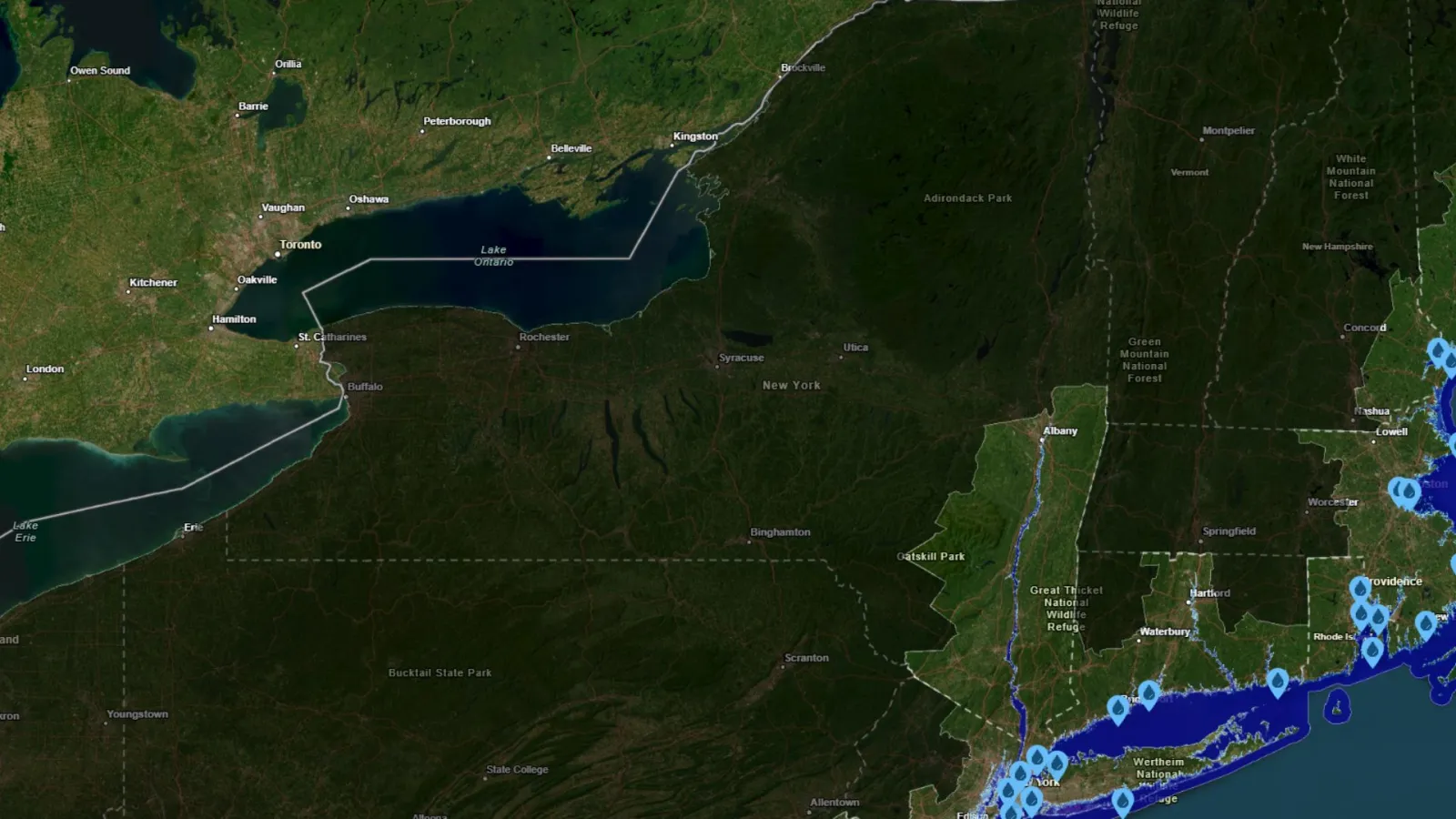
According to NOAA’s map, big parts of the state’s famous New York City would be impacted by major flooding if sea levels rose 10 feet. Parts of Brooklyn, Manhattan, Queens, Staten Island and Bronx would all have some areas fully submerged in sea water, with other areas impacted by serious flooding.
Newark Liberty International Airport would also experience notable flooding, as would nearby areas. The MetLife Stadium, which is one of the biggest stadiums hosting the World Cup in 2026, would also be seriously flooded.
It is also likely that some of the Statue of Liberty National Monument would also be underwater, based on NOAA’s map.
Not only would the cities by the coast by impacted though as, according to NOAA’s map, as those sitting along the Hudson River would also likely be severely flooded in some areas, including Yonkers, Newburgh, Poughkeepsie, Kingston, Albany, and Troy.
Impacts To Vital Services If Sea Levels Rise 10 Feet
It is also not just cities that are at risk, Dong said. His team overlaid the projected 10-foot sea level rise with national datasets of critical facilities, including hospitals from the Centers for Medicare and Medicaid Services (CMS) and fire stations from the U.S. Fire Administration.
They found that there would be “substantial risks to emergency and healthcare infrastructure in several states,” Dong said.
He said that in Florida, 55 of the state’s 221 hospitals would be “inundated under a 10-foot sea level rise scenario,” while in California, this would be the case for four of 378 hospitals.
In New York, this would be the case for six of 191 hospitals, and in Texas, it would be two of 462 hospitals.
In relation to fire stations, once again Florida would be the most impacted. Dong said they found 63 of Florida’s 389 fire stations would be underwater, and in New York it would be 15 of 1,648.
In Texas, it would be 20 of 1,530, and in California, it would be 14 of 853.
“Beyond hospitals and fire stations, other critical assets, including employment centers, shelters, and schools, face comparable risks, further compounding the societal impacts of extreme sea level rise,” Dong said.
He also said that in his research, he has found that “flooding also creates isolation effects, where communities may lose access to essential services even when facilities themselves are not inundated.”
“Roadway flooding, bridge failures, and network disruptions can effectively cut off hospitals, fire stations, and other critical services, amplifying the human and economic consequences of sea level rise,” he said.