
EDITOR’S NOTE: This story is part of a series of profiles created by UMass’ Journalism 332 Sports Writing class.
On Yahmani McKayle’s right forearm, the name “Mike” sits in cursive, carefully tattooed next to an image of the world right above a pair of angel wings.
It’s a reminder of home, not necessarily the place, but a person.
Michael Rodriguez and McKayle were inseparable, practically siblings, even platonic soulmates. The two spent countless hours together, including nightly sleepovers at the other’s house for years.
“He was my number one supporter,” McKayle said. “He was the best friend you could ever ask for. The best person you could ever ask for.”
In 2023, tragedy struck when Rodriguez died by suicide. Even though Rodriguez isn’t physically here, there are eerie reminders.
At the women’s basketball home opener against Siena on Nov. 8, the team celebrated Mental Health Awareness Night put on by UMass Athletics.
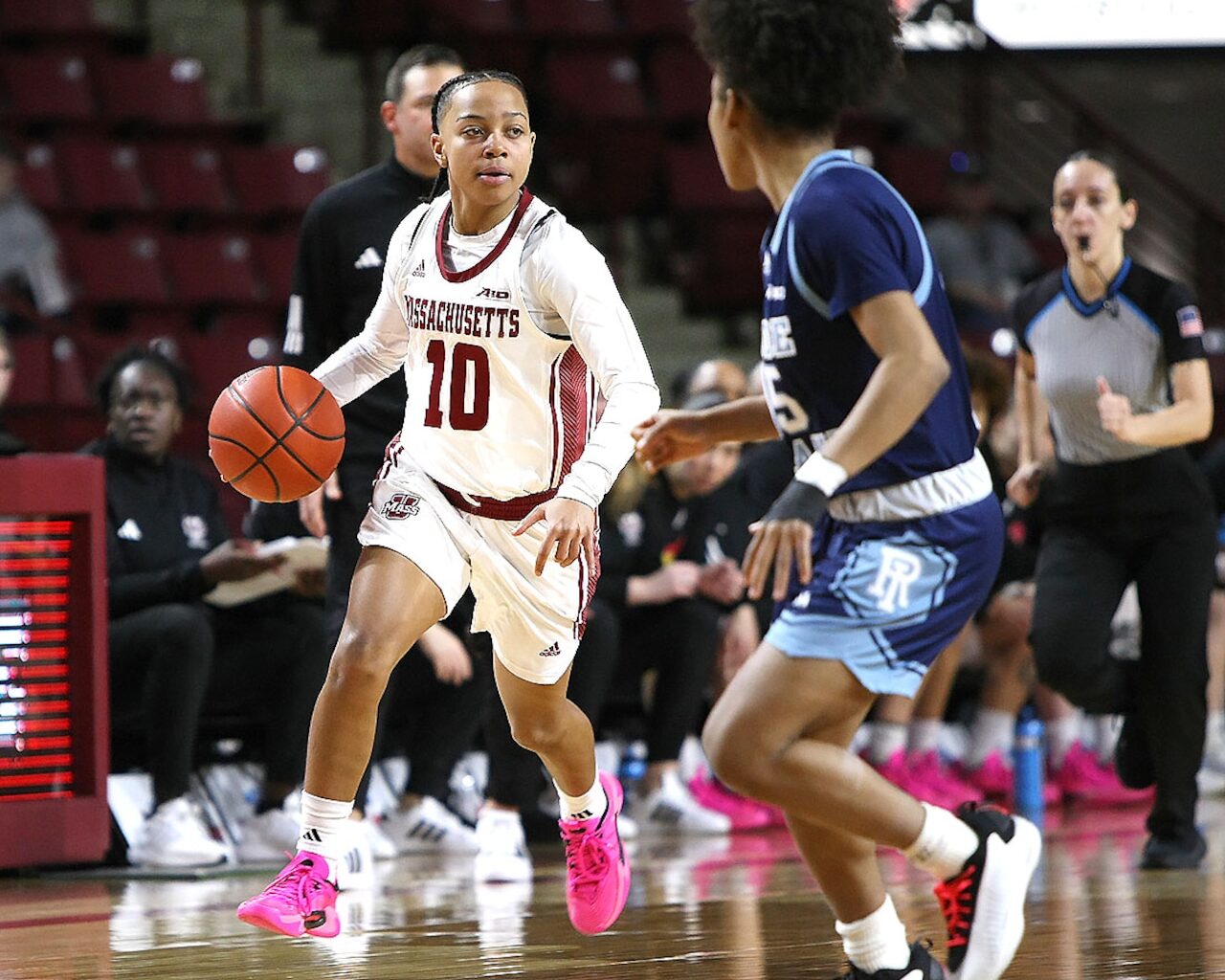
McKayle dropped 22 points.
Rodriguez wore No. 22 growing up playing basketball.
“Everything I do, I think about him,” McKayle said. “We used to talk about stuff like this. Everything I am doing now, we literally talked about.”
Losing Rodriguez was not the first time McKayle faced tragedy. From the beginning, hardship shaped her path.
Born and raised in the apartment complex, Lefrak City, in Queens, New York, McKayle comes from a neighborhood riddled with economic hardships and the opportunities to rise above the neighborhood are few and far between.
McKayle faced her first setback early. Her father, Jabari McKayle, died before she could truly meet him.
As the youngest of four and raised by a single mother, McKayle found herself spending copious amounts of time outside.
Downstairs from McKayle’s apartment complex sits a community basketball court and a tennis court. Having watched her older brother dabble in football and basketball, it was natural that McKayle would join him on the court.
McKayle has always had a knack for the sport. The first time she ever touched a basketball, her older brother, Dupree Lakins, put it in her hands. At the age of 5 or 6, she made the first shot she ever took.
How the undersized guard made a basket on a 10-foot hoop at 5 or 6 years old is still a mystery.
“Sometimes, I think basketball chose me,” McKayle said.
It’s on these courts where McKayle was dubbed “the Golden Child.”
The nickname was prominently used by her brother. Lakins would tell his friends McKayle was going to be the greatest in the family.
McKayle had the support of the community behind her. It wasn’t uncommon to find people working out and practicing with her or spreading the legend of the “Golden Child.”
To develop her game, McKayle competed against boys.
The boys’ physicality was on a different level. Pairing that attribute with the faster pace of play and their biological makeup, McKayle was challenged on the court.
To improve, she looked at the court like a battlefield, developing strategies and anticipating her opponents moves.
Still, to reach the next level, she needed to start playing with and competing against girls.
“I hated it at first,” McKayle said. “I used to think I was better than every girl on the court because I played against the boys.”
That’s where Nicholas Lopez entered the picture.
After the boys team coach referred McKayle to Lopez, she began training with him. Later, Lopez encouraged her to attend South Shore High School, the school Lopez worked for and later, his club team Top Notch Lady Ballers.
Top Notch Lady Ballers is an all girls AAU program based in New York City that started a dozen years ago when Lopez’s daughter started playing. McKayle was part of the inaugural team and who Lopez attributes its continued success.
Starting around the sixth grade and then transitioning into the AAU scene, McKayle’s natural feel for the game was evident. She dominated the court and her quick reaction time allowed her to be one step ahead of the other girls.
“It was very advanced,” Lopez said. “She was a girl that you could win with just her on the team.”
Off the court, Lopez’s impact has not been lost on McKayle – even a second father. He brought her to school every morning, took her to all her basketball games so she didn’t have to take the train, and reminded her of her goals when she couldn’t see the big picture.
Now, McKayle is living the prophecy of “The Golden Child” as the first in her family to attend college. McKayle’s appreciation for her home and the people who live there is evident.
“I think if I was from anywhere else (in the world), I don’t think I’d have the confidence I have (now) from all the people that believed in me on my journey coming to UMass just, my whole basketball journey and life,” McKayle said.
That sense of community she holds close to her heart is one she has found at UMass. Her adjustment was easy thanks to the Minutewomen’s coaching staff.
Prior to committing, McKayle said the coaches were always checking in on her, making sure she was doing well and calling just to talk – actions that reminded her of home.
“The fact that (McKayle) did as well as she did is such a credit to her,” UMass women’s basketball coach Mike Leflar said.
Once overlooked, McKayle forced the spotlight on her with historic performances – a testament to the hard work and dedication she’s instilled in her dreams.
During her freshman season, McKayle became the first freshman in UMass history to record a triple double and the fourth Minutewoman named Atlantic 10 Rookie of the Year.
“She handled the responsibility of being a point guard. So much of her development was worrying about the team and making right decisions,” Leflar said. “I think the things we saw in her during the recruiting process were true.”
From the courts in Queens to the hardwood floor at UMass, McKayle has proven the prophecy of “the Golden Child” true. Yet, her journey is far from finished.
Every step forward carries the spirit of her community and the memory of Rodriguez, as she builds the future they once dreamed about together.