
There’s a view of the human situation that goes something like this: 14 billion years ago, give or take, the universe exploded into being. The Big Bang didn’t create everything, but it did provide everything necessary to create everything else: a collection of immutable physical laws, a hot soup of subatomic particles, an unthinkably vast quantity of energy. After 10 billion or so years of expansion and cooling, the universe contained some trillion trillion stars, and at least as many planets. Around that time, on one of those planets orbiting one of those stars, a random series of chemical reactions produced self-replicating molecules. Chemistry made way for biology as four billion years of further chance developments generated a bewildering diversity of living organisms. Eventually one of those organisms, a bipedal primate with small teeth and a prominent chin, developed the capacity for complex language and abstract thought. This species called itself Homo sapiens, the wise man, but this was only puffery, the illusory boast of an apex predator at the extremely temporary peak of its powers.
Allowing for some rather drastic approximations, the understanding of humanity that I’ve just sketched is the mainstream scientific view. It is not a complete view, in that it cannot tell us why or whence the universe leapt into being. It is, nonetheless, persuasive. Part of what makes it persuasive is that it does so much with so little. It doesn’t need gods or djinni or demonic demiurges to explain why the sun shines, or ice floats, or death comes for everyone. All it requires are some basic principles of biology, chemistry, and physics. Mostly what it needs is math.
The scientific view is not necessarily hostile to morality. Nothing about it prevents you from living as though your decisions mattered and your life had meaning. Ours is not a universe, even in the most flagrantly materialist interpretation, in which you cannot believe in justice, or mercy, or patriotism, or friendship. You are welcome to insist that might shouldn’t make right, or to abhor tyranny and climate change. Nothing in the naturalistic view says you can’t assert, as loudly and as often as you choose, that every person has an inalienable basic dignity.
Yet it is also true that this view of things makes it ridiculous—literally laughable—to speak seriously about human significance. It is ridiculous because, in the universe described by science, there is no such thing as human significance. Not just to a first approximation but to a five hundredth, nothing that any one of us does, not even everything all of us have done since the dawn of the species, matters in the slightest. This is not only a question of scale. The same epistemological parsimony that makes science so persuasive also rules out, in principle, any kind of metaphysics that might give our lives durable meaning.
We might feel as though the experience of love offers access to something eternal. We might insist that a genocide must not count for nothing. We might claim that our faith in democracy, or the class struggle, or the human project writ large needs no transcendental grounding. But science keeps the score. It tells us that all of our philosophy, all of our politics, all of our religion, all of our art is no different—except, perhaps, in its tragicomic pretensions—from the flashes of instinct that attract butterflies to horse manure. To the extent that we want to talk about a purpose for our lives, the most that science will allow is that we exist to satisfy the second law of thermodynamics, which is to say, to hasten the heat death of the universe.
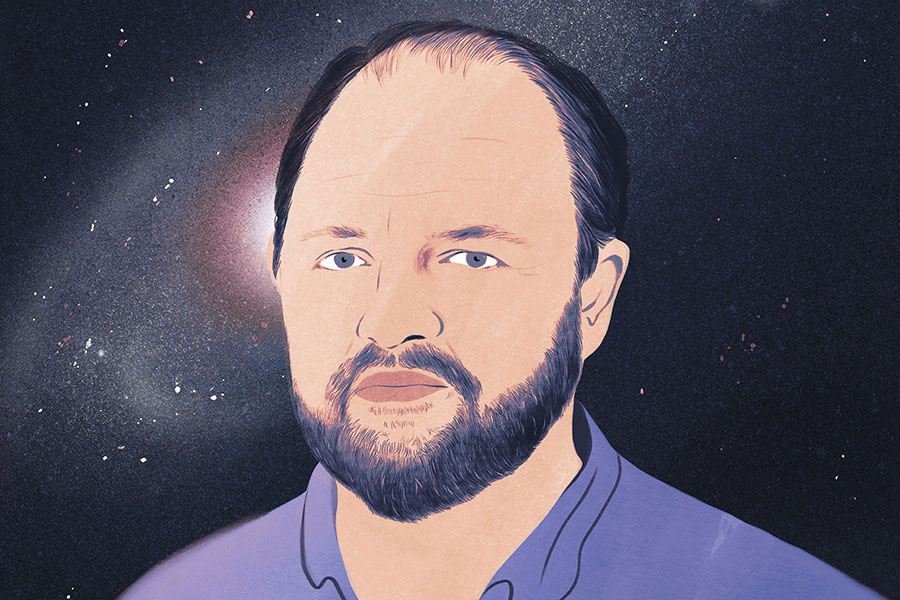
Believe, the recent book by Ross Douthat, a conservative opinion columnist at The New York Times, presents itself as a work of apologetics—a case, as the subtitle has it, for “why everyone should be religious.” Though late chapters do make a positive case for religious belief, and the final chapter offers a half-hearted pitch for Douthat’s own strain of conservative Catholicism, I don’t think it misrepresents the book to say that it is mostly interested in disqualifying the comprehensive skepticism I outlined above.
That Douthat should write such a book is not a great surprise—and not only because several of its arguments are familiar from his columns in the Times, where he has been on staff for over sixteen years. His brief at the paper, as best as I can determine, is to offer its serious and liberal readership what American reality, over the past two decades, has for the most part steadfastly refused to provide: the prospect of a serious and reasonable conservative.
By any estimation, Douthat is a thoroughgoing contrarian. Yet his polemics sound nothing like, say, the steamroller intensity of the late Christopher Hitchens. Nor does he traffic in the Blackshirt barbarism of the “MASS DEPORTATION NOW” signs that flooded the Republican National Convention before the last election. Douthat has admitted to a “distancing that I do from ideas that I do in fact hold,” which is a nice way of saying that he is often coy to the point of disingenuousness. In his columns he prefers to dance, deflect, and obfuscate, so as to better conceal the savageries of actually existing conservatism. Only occasionally will you find him offering a full-throated endorsement of his preferred policies. He is much more likely to billow forth a fog of counterfactual thought experiments and seen-it-all Weltschmerz, or to press the case against the case against whatever he is for.
Some people, clearly, admire this arch performance. (The New Left Review recently called him “the most consistently original mind writing about American politics in the pages of the New York Times.”) I can’t pretend I’m one of them. Douthat’s punditry has long struck me as glib and sententious, and it particularly rankles when you notice how many of his arguments borrow the look-what-you-made-me-do rhetoric of domestic abusers and playground bullies. Whether his subject is immigration, or abortion, or gay marriage, or trans rights, or free speech, or the broad rollback of civil rights taking place under the cover of the “anti-DEI” backlash, Douthat likes nothing more than telling his liberal readers that conservative extremism is in fact all their fault.
I also loathe his politics, which have to count at this late and dispiriting date as functionally pro-fascist. Though he has dutifully registered objections to Donald Trump’s moral character, and was once a Never Trumper, in more recent years Douthat has regularly used his column to run cover for Trump’s assault on American democracy. (Seventy years ago his mentor William F. Buckley performed a similar two-step in defense of Joe McCarthy.) In 2024, in a rare burst of uncamouflaged awe, Douthat described Trump as “a man of destiny…a figure touched by the gods of fortune in a way that transcends the normal rules of politics.” More typical, however, was a column he wrote in April in which he lamented the depredations of Trump 2.0 not for substantive economic, legal, or ethical reasons but because their “tough-guy excess” threatened the political stability of the MAGA coalition. A few weeks later, in an interview with J.D. Vance, Douthat raised a plausibly Times-coded concern that the administration’s inhumane and illegal deportation policies were “ripe for war-on-terror-style abuses.” Yet as soon as Vance showed the first hint of struggling with the question, Douthat reassured him with a comment that laid bare, however briefly, his deeper motivations. “Let me be perfectly honest,” he told the vice-president. “I’m not interested in having you trapped here.”
When he is not busy blaming Democrats for Republican misrule or soft-pedaling the enormities of the Trump administration, Douthat writes often about religion. He is a practicing Catholic, and as he puts it in the introduction to Believe, part of his job at the Times is “to make religious belief intelligible to irreligious readers.” Sometimes this means arguing, as he did in 2024, that “today’s religious conservatives are mostly just normal American Christians doing normal American Christian politics, not foot soldiers of incipient theocracy.” Other times, as on his podcast in October, it means giving a figure like Douglas Wilson—a self-described “theocrat” who cofounded a network of conservative churches that counts Secretary of Defense Pete Hegseth as a member—an extended opportunity to elucidate his views.
Believe is both more ambitious and less contentious than Douthat’s newspaper writing. He declares at the start of the book that “religious belief is not just an option but an obligation”—a claim, he says, that needs no sophisticated metaphysical defense. He thinks that the rationality of religion ought to be obvious: since “reason still points godward,” only “ordinary intelligence and common sense” are required to appreciate the truth of faith.
Believe is a work of a familiar sort, then: an attempt by a religious writer to sway his faithless contemporaries. To make this case, Douthat argues for something he calls “mere religion,” an idea he adapted from C.S. Lewis’s “mere Christianity.” Brushing aside academic doubts about whether religion amounts to a coherent theological or sociological category, Douthat says he wants to
lay a general foundation for religious interest and belief, to persuade skeptical readers that it’s worth becoming a seeker in the first place, and to provide guideposts and suggestions for people whose journeys begin in different places or take them in different directions.
This goal is so wantonly relativistic that it’s hard to believe it is being proposed by a guy who wrote an entire book—To Change the Church (2018)—accusing Pope Francis of insufficient orthodoxy. It becomes even odder when Douthat starts chest-thumping about the importance of religious truth claims, so as to set himself against softheaded liberals like Karen Armstrong, whose The Case for God (2009) argued that religious practice was at least as important as doctrine.
But the deeper I read into Believe, the more I began to see why the idea of mere religion appeals to Douthat. He is a pundit, not a theologian, and he admits early on that he has no interest in debating the kinds of questions that have traditionally animated Christian apologetics—about Christology, say, or apostolic succession. (You will find Tyler Cowen, Ayaan Hirsi Ali, and the Claremont Review of Books cited in his notes but only passing mentions in the text of Augustine, Aquinas, and Kierkegaard.) What Douthat does want to do is argue with atheism, especially with the lingering legacy of New Atheism, the Anglo-American media phenomenon from the early Aughts that sought to disqualify religious belief tout court.
This is where mere religion comes in. Though it makes little sense as a rigorous conceptual category, it does work reasonably well as a catchall for everything the New Atheists despised. By stripping away the thorny and often mutually contradictory truth claims of this or that faith tradition, Douthat is able to focus his rhetorical energies in a way that suits his polemical style. It allows him to argue, in other words, by means of a familiar double negative: not the case for religion so much as the case against the case against any kind of faith.
Here it’s probably worth noting that I share Douthat’s rejection of the nihilism demanded by the scientific view. This is not a sermon, so I won’t bore you with the particulars of my own demurral. But I acknowledge this somewhat uncomfortable personal fact—uncomfortable, at least, in the context of these generally secular pages—to make it clear that, while I don’t think everyone should be religious, some part of me would have been happy to see Douthat’s book succeed. I would like to be able to tell you that his proofs against skepticism are dispositive. I would like to report that his arguments in favor of the supernatural are as rational and commonsensical as he insists. Alas, it’s not to be. If anything, the weakness of Douthat’s case against the case against religion has the opposite of the intended effect: after reading Believe, the bleak view of the universe seemed more, not less, likely to be true.
Part of the trouble is Douthat’s tendentious misunderstandings of basic science. He appears to think, for instance, that when physicists talk about the observer effect in quantum physics, they mean that human consciousness is “the only thing that transforms quantum contingency into definite reality, wave into particle, probability into certainty.” But this is not what most physicists mean at all. As Werner Heisenberg noted, “The introduction of the observer must not be misunderstood to imply that some kind of subjective features are to be brought into the description of nature.” A quantum observation is a type of physical interaction; it has nothing to do, contra Douthat, with any “mysterious but essential role” for specifically human observation.
Another part of the trouble is Douthat’s dependence on the argumentum ad ignorantiam, a fallacy so common in apologetic literature that it has its own Wikipedia page. Arguments of this type, known derisively as “the God of the gaps,” look for holes in our scientific understanding of the world and claim those as proof, or at least a heavy suggestion, against the secular hypothesis. Douthat wants us to see mysticism, near-death experiences, our own consciousness, and even the physical constants that make life possible in the universe as evidence that a superreal Something Else must be going on.
I can’t object to this entirely. I have some sympathy, for instance, for the idea that our existence is not a freak cosmic accident. But I can’t accept Douthat’s blithe assumption that “God is not trying to trick us” and has therefore littered the universe with little riddles, like Easter eggs, meant to reward diligent seekers. Nor can I share his confidence that what is currently unexplained by science will remain permanently unexplainable. Historically this has been a losing gamble: just ask the biblical literalists who insisted that the universe was created in six days, or ask Isaac Newton, who invoked “the Counsel and Contrivance of a voluntary Agent” to explain why the stars shine and the planets do not.
At one point Douthat suggests that the physical laws that govern the universe ought to be seen as evidence of a divine mind. He compares the universe to a house and scientific laws to “finely wrought schematics” that imply a Great Architect in the sky. But here the double-negative reasoning that Douthat loves so much shows its limits. The fact that science can’t explain where physical laws come from is an epistemological nullity; it can’t be tweaked to reveal some esoteric alternative. Maybe physical laws do come from God or the gods. Or maybe they’re the local manifestation of the multiverse. Or maybe they simply are, for reasons we’ll never grasp. The possibilities are endless, and nothing allows us to prove which option is superior.
A more general problem with Douthat’s brief for religion is what I can only describe as a failure of statistical imagination. He has no feel for scale, no appreciation for the contingency of contingency. A few times in Believe he dutifully concedes the power of the so-called law of truly large numbers, which says that on a big enough scale even extremely improbable events ought to be expected. He grudgingly allows, for instance, that some apparent medical miracles “might just be a vanishingly rare example of spontaneous remission intersecting with the happenstance of a prayer being offered at a particularly timely moment.” It’s clear, however, that he doesn’t really accept this. He thinks there are just too many cases of reported miracles for all of them to be false, even though he knows—or should know—that in every religion prayers for better health are essentially constant among true believers.
A related innumeracy shows itself when Douthat turns to evolution. He seems to accept a version of the Darwinian theory, even as he wants to argue that the emergence of the human species is too complex, too mind-bogglingly unlikely, to have occurred without divine guidance. It’s true that if you tallied the likelihood of all the billions of events that led up to the evolution of human beings on Earth, you would end up with a probability that, on any human scale, looked indistinguishable from impossibility. But the long process that led to our species did not take place on a human scale. It happened over billions of years, in a universe with something like 1,000,000,000,000,000,000,000,000 planets—a universe old enough and big enough, in other words, to offer statistical room for a lot of approximately impossible events to take place.
Does this mean that science can rule out the possibility that evolution was directed by a divine intelligence? Of course not. But it does give the lie to Douthat’s desperate claim that “the universe isn’t really hiding the ball from us when it comes to cosmic order and human exceptionalism.” Reason can tolerate the belief that God had a hand in evolution, but only at the price of admitting that He took pains to conceal public evidence of His interventions.
Perhaps the most serious weakness of Believe is its poor handling of religious pluralism, which is in many ways a far more difficult challenge to belief than scientific skepticism. Douthat clearly wants mere religion to help him dodge the problem as long as possible; arguing for a general acceptance of religion—which is to say, a general rejection of secularism—allows him to hold off questions about specific religions until well after the midpoint of the book. But eventually he turns to the hard question left open by his title: Believe in what?
To answer this, Douthat downplays all the fantastically complicated disagreements that have marked religious history for centuries. Instead he narrates a tidy tale of convergence toward a handful of broadly similar, and mostly monotheistic, major faiths. With the unearned confidence of a Whig historian, he allows himself grand and absurd pronouncements like “The more popular, enduring, and successful world religions are more likely than others to be true” and “If God cares about anything, He cares about sex.” Claims like these are so theologically preposterous, especially coming from a practicing Catholic, that it’s hard to know quite what to make of them. If nothing else, though, they reinforce my sense that the existence of Believe is its own best counterproof: in a world where religious truths were as obvious and reasonable as Douthat wants them to be, there would be no need for him to write it.
The book’s strangest feature is its enervating conception of belief. Douthat claims that he doesn’t look to Christianity primarily for comfort, and yet he writes about religion as though its major purpose were to banish any thought of our insignificance. He wants religion to assure him not only that “our conscious existence has some cosmic importance, some great consequence,” but that the universe was designed with one end in mind: “Toward making us possible, the readers that the book of nature was awaiting all along.”
Obviously this sort of existential consolation has always been an important part of religion’s appeal. Most of us don’t want to disappear into nothingness when we die. We don’t want to feel that the whole drama of our lives is pointless, and we don’t want to accept that our moral intuitions and judgments are a meaningless hangover of evolution. But religion—real religion, not Douthat’s complacent abstraction—is weirder, wilder, more violent, and more destabilizing than Believe would have us believe. Think of Abraham and Isaac on Mount Moriah. Think of Muhammad’s Mi‘raj. Think of Jesus’ teaching that we must love our enemies, hate our families, and sell everything we own. Think of all the many religious teachers who insist that genuine encounters with the divine are humbling, surprising, and very often terrifying. They promise nothing like the smug self-aggrandizement Douthat appears to demand from faith.
Oddly it’s his own mother who provides the best reminder that a serious engagement with religion often provides the opposite of an ego balm. About halfway through Believe, Douthat quotes her account of a spiritual experience she had in the 1980s:
It just came into me with a roar, and clamped onto me, like a thousand volts, or like one of those machines they use to start someone’s heart on the operating table. It clamped onto both sides of my face, and over my thyroid, and gripped my arms down into my hands that were still hovering over my waist and vibrating…. I had no idea how to respond. I remember the name Lazarus flashing into my mind, and the incredible thought: This is a power that could raise the dead.
This may sound like nothing more than a florid delusion. And maybe that’s all it was. But here at least, as almost nowhere else in the book, we make contact with the alien force of transcendence, and get a sense of why someone might cast aside skepticism in order to believe in something that defies four hundred years of hard-won scientific knowledge.