
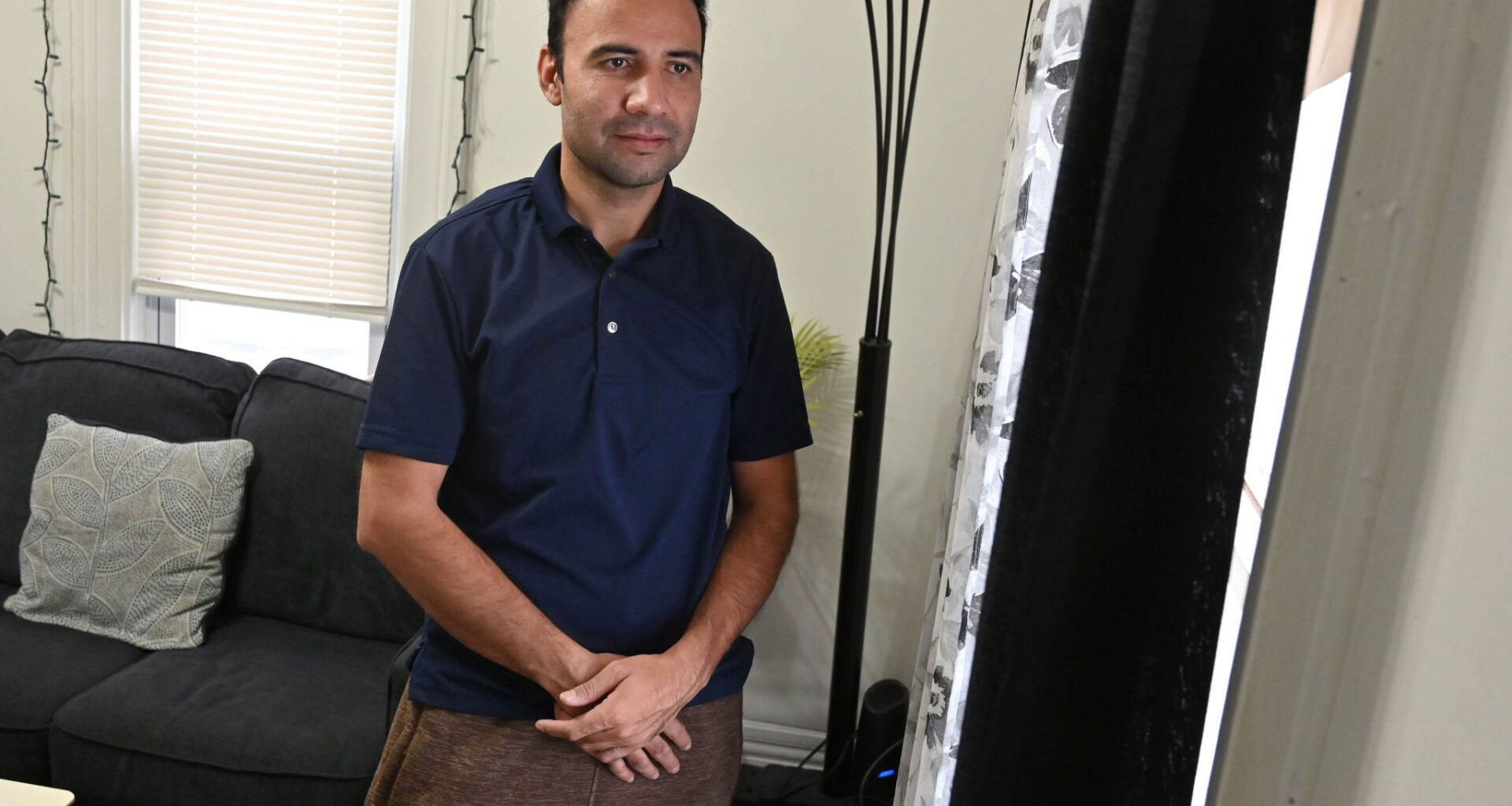
Afghan resident Sami Ghairatmal looks out a window at his home on Dec. 17 in Schenectady. Ghairatmal, a former journalist, is among the 7,500 Afghans who have relocated to New York to seek asylum since 2021.
Lori Van Buren/Times Union
After the Taliban took over Kabul following the retreat of U.S. troops from Afghanistan in August 2021, journalist Sami Ghairatmal began receiving threats.

At the time, he led a local chapter of NAI, an organization supporting independent media in Afghanistan, where he taught young journalists — men and women — about the importance of freedom of speech and democracy in an area frequently targeted by the Taliban. He previously worked for Al Jazeera and a radio station broadcasting in U.S. Army-controlled Kandahar airspace, as well as with different media projects for the U.S. Agency for International Development.
Article continues below this ad
Because of this, Ghairatmal was a target. The Taliban accused his organization in one press release of “destroying islamic values,” “spreading obscenity” and broadcasting “in favor of (American) invaders.”
The release included a direct threat: “He will take responsibility for any subsequent decisions.”
Ghairatmal, his wife and his five children went into hiding, and in December 2021, they were evacuated by the National Endowment for Democracy. They went to Qatar, then to America, landing at a New Jersey air base. They eventually made it to Schenectady, where Ghairatmal had friends who had also worked with the U.S. Army.
Article continues below this ad
Make the Times Union a Preferred Source on Google to see more of our journalism when you search.
Add Preferred Source
Ghairatmal’s current job as a delivery driver involves fewer risks than being a journalist in Afghanistan. But now, a new kind of fear has taken hold.
“We were scared, there, of the Taliban. But here, we don’t have good sleep (because of) ICE. My daughter is always crying. She says, ‘Why (is) our life like this? We need a good life. We need to sleep good,’” Ghairatmal said.
Ghairatmal and his family are among the 7,500 Afghans who have relocated to New York seeking asylum since 2021. Many have resettled upstate, where they’ve rebuilt their lives, found work and enrolled their children in school.
Article continues below this ad
But for many, whatever tenuous sense of security they’ve found has vanished as a result of a renewed crackdown on Afghans by President Donald Trump’s administration after two National Guard members were shot in Washington, D.C., allegedly by Rahmanullah Lakanwal, a 29-year-old Afghan refugee who entered the country during Joe Biden’s presidency and was granted asylum earlier this year.
Trump called the shooting a “terrorist attack” and criticized the Biden administration for not properly vetting Afghans who worked with U.S. forces during the Afghanistan War. Many Afghans were key allies of American troops throughout the war, which started in 2001. But the president paused the refugee resettlement program on his first day back in office.
In response to the National Guard shooting, the government also paused asylum applications, green cards, visas and other immigration cases for migrants from Afghanistan and 18 other “high-risk” countries that had already been included in a June travel ban. On Dec. 16, the administration expanded the travel ban to several other African and Middle Eastern nations and began reviewing security and vetting protocols for those countries.
The crackdown is characteristic of Trump’s second term, which has been marked by aggressive immigration reform after illegal crossings at the U.S.-Mexico border soared above 2 million in each of the final two years of the Biden administration. The president’s policy has included a surge of ICE arrests as part of a mass deportation plan, bolstered border enforcement, restrictions on legal and humanitarian immigration pathways, and efforts to end birthright citizenship and ramp up denaturalization. The administration has touted these policies as the key to making the country safer. Illegal border crossings this year fell to their lowest level since 1970, according to Homeland Security data.
Article continues below this ad
ICE is on track to arrest twice as many people in New York this year compared to last year. Nationwide, more than 65,000 are in ICE custody and nearly 300,000 have been deported this year, The Guardian reported. The agency has regularly arrested immigrants in their homes, during traffic stops, at their jobs, at immigration offices, at state prisons, at local jails, at police stations and at probation offices.
While the majority of the arrests have been of Latino men and women, arrests of Afghan immigrants also spiked. Some detentions include women from the Hazara community, an ethnic and religious group that is “the single most vulnerable category of people among Afghan nationals,” said Shala Gafary, managing attorney of special projects at Human Rights First, who has provided legal assistance to newly arrived Afghans since 2021.
Afghans were already being rounded up before the government stopped processing their immigration claims. In one of the most high-profile cases in New York this year, New Paltz resident and Bard College student Ali Faqirzada was arrested after completing a credible fear interview at a Long Island asylum office in October. He remains in ICE custody in Newark, N.J., while his attorneys challenge his detention in immigration court. His previously scheduled appearance before an immigration judge was postponed to early next year.
In the Albany area, at least a dozen Afghan men with pending asylum claims have been arrested and detained by ICE in the last two weeks, according to Yousaf Sherzad, acting president of the Afghan American Community Center in Albany. Others are being summoned to sudden immigration check-ins across the state, giving way to emotional scenes outside federal buildings. Some have been called in to the ICE office at Federal Plaza in New York City so the government can collect new photos and “biometrics” on them.
Article continues below this ad
Roman Mohammadi, 12, cries during an emotional interview with the press outside the Malta U.S. Immigration and Customs Enforcement facility on Dec. 8. His family had an interview with ICE inside.
Lori Van Buren/Times Union
ICE has also conducted a few mass worksite raids in New York. The largest happened on Sept. 4, when federal agents apprehended 57 people at the Nutrition Bar Confectioners plant in Cato, a small Cayuga County town. At least six of the workers have been released with valid asylum claims or other legitimate immigration statuses, but others are still detained and 18 have been deported, according to attorneys and advocates. Five were charged with reentering the country after a prior removal, a felony. Some of those scooped up in the raid are challenging the raid in the courts.
“There seems to be an irrefutable sense of the fact that ICE officers are getting instructions to detain every single Afghan they can,” Gafary said. “It’s really been very disheartening. (Afghans) are confused as to what to do. They’re confused as to the attitude and approach that the U.S. government is now, unfortunately, taking with them. They’ve come to accept that they’re now suspects just by virtue of the passport that they hold.”
Many immigrants — even some who are in the United States legally — continue to be scared to go to work, take their children to school, or visit the doctor for fear of being detained. Across the state, immigrant families have been separated and lost loved ones and their only breadwinners. Others have decided to self-deport. But many are riding it out.
Article continues below this ad
‘Home is prison’
Among Afghans who helped the United States, there is a feeling of betrayal.
A 25-year-old Afghan man living in Albany, who spoke on condition of anonymity for fear of reprisal, said the Taliban killed his father, grandfather and other members of his family. He and his immediate family hid for months following the fall of Kabul, fearing that if they were found, they’d be tortured and killed because of his service in the Afghan Air Force, where he worked closely with the U.S. military and NATO forces.
“We were in the same camp, and we were working together. We were eating food together, we had parties, missions together … we were like brothers, like family,” the man said of his relationship with U.S. troops in Afghanistan, some of whom he’s still in touch with.
Article continues below this ad
The man and his family fled the country in late 2022 and went to Brazil before eventually making their way to the U.S.-Mexico border, where they asked for asylum. They settled in Albany and relied on the local U.S. Committee for Refugees and Immigrants for pro bono legal assistance. But this year, the organization lost federal aid for programs to help newly arrived refugees.
Now, the man and his family are afraid of going outside, worried they will be arrested and deported to a country where they don’t feel safe. He and his 23-year-old brother are the only ones who can work.
“Emotionally, we are under torture,” he said. “If they send us back, we will be killed by the Taliban. Right now, we feel like home is prison.”
He and other Afghans the Times Union interviewed condemned the shooting of the two National Guard members and expressed frustration that the actions of one individual were impacting an entire nationality.
Article continues below this ad
“We all were sad about what happened and we share our condolences with that family,” the man said. “Even if a bad person does something wrong, it doesn’t mean to punish all of society. … We are not here for making a headache. We are here to take our part in making society better.”
While Afghans are the latest community to be targeted, “it’s important to remember that all immigrants are at risk because of the cruel policies of the current federal regime,” Daniel Butterworth, the executive director of Refugee and Immigrant Support Services of Emmaus in Albany, said.
“Many of our Afghan neighbors are here because of their service to our country, making this latest ICE crackdown all the more heartbreaking. The Capital Region is and has always been a welcoming community. If we want it to remain that way, it’s our collective responsibility to recognize our shared humanity, honor the immigrant heroes in our own lives, and stand in solidarity to support our neighbors who are most vulnerable.”
Since 2021, Hearts & Homes for Refugees has welcomed 480 Afghans resettled in New York through government programs, including some who aided American troops and were evacuated, said Kathie O’Callaghan, president and founder of the Westchester County-based nonprofit.
Article continues below this ad
“We made a promise to give them a life of safety and dignity. We have failed to keep that promise for thousands of those Afghans,” O’Callaghan said. “What we are witnessing right now is a profound and growing sense of fear and uncertainty among Afghan families in New York. Trump’s policy shifts are retraumatizing people who believed they were finally safe — disrupting family reunification, stability and the ability to plan for the future.”
More than 190,000 Afghans have resettled in the U.S. since 2021 through programs created by Biden to assist U.S. allies fleeing the Taliban, according to a report published this year by the U.S. Department of State. In 2022, the Office of the Inspector General for the Department of Homeland Security found the U.S. government did not always have critical data to properly screen, vet or inspect about 80,000 of those evacuees.
Former Biden administration officials have disputed that claim. O’Callaghan said that Afghan families went through years of “the strictest possible vetting” and arrived through lawful pathways. Gafary added that before entering the country, every Afghan stopped at a U.S. military air base, where they went through background checks and medical tests.
“Every one of our clients is very eager to follow all the laws,” Gafary said. “They really want to have their day in court to be able to share the reasons for their fear and their persecution, because they understand that their claims are that strong.”
Article continues below this ad
Anxiety has also spread among Afghans whose asylum cases have been approved and, in some cases, have obtained lawful permanent residency and even become naturalized citizens. Last month, the Trump administration announced a review of green cards issued to individuals who migrated to the U.S. from the 19 countries “of concern.” The government is also planning to ramp up efforts to strip some naturalized Americans of their citizenship starting next year, according to guidance given to the U.S. Citizenship and Immigration Services that also asks that the agency pursue a minimum of 100 to 200 denaturalization cases per month, the New York Times reported.
Zarlasht Sarmast, an Afghan scholar and employee at Bard College who received her green card in March, said she was considering changing her travel plans to see her mother in Germany for the holidays.
When the Taliban took over Kabul, Zarlasht Sarmast was studying at the American University of Central Asia in Bishkek, Kyrgyzstan, which partners with Bard College. She was part of the college’s evacuation efforts and played an important role in evacuating more than 370 Afghan students, which inspired her to write two books about the experience.
Courtesy of Zarlasht Sarmast
“I’m worried that when I go to (John F. Kennedy International Airport) this time, it might not be like the previous times. They might not just check my green card and let me go. They might be like, ‘We have to question you,’” Sarmast said. “I’m afraid of missing my flight. I’m worried about not seeing my mom. And I’m worried that even if I go and see her, I’m not going to be fully present in my trip, because I will worry about what will happen when I come back.”
Article continues below this ad
Sarmast worked with the International Committee of the Red Cross and the United Nations Assistance Mission for Afghanistan and was part of several peace-building projects. She never wanted to leave her home, but is holding out hope for the future.
“Now that I’m here without it being my choice, I’m still trying my best to offer something good to the community,” she said. “That should also be seen and echoed, just like this individual’s actions are being generalized onto the whole Afghan community, because there are so many more good Afghans compared to that one person who did something bad.”
Pushback against Trump’s immigration policy changes
While immigration has been a key issue for Trump since he entered the national political arena, public sentiment turned against the president this year, with Americans now saying they see the administration’s approach to immigration more negatively than positively.
Article continues below this ad
In upstate New York, communities mobilized to protect their immigrant neighbors from ICE, connecting them with legal and basic services, conducting know-your-rights workshops and forming rapid response teams to alert others about ICE and gather information about detainees to notify their families. When people were in ICE custody, locals raised thousands of dollars for legal defense and organized public events to voice support.
Immigration raids and mass deportations were also at the center of hundreds of “No Kings” protests across the nation in June and October. Meanwhile, already overwhelmed immigrant-support groups struggled to keep up with the demand for legal and basic emergency services.
A Troy resident describes how here husband was detained in August in Albany by immigration authorities on Sept. 5 outside Troy City Hall.
H. Rose Schneider/Times Union
Response to the influx of migrants and the surge of ICE arrests created thorny issues in state government. Gov. Kathy Hochul has tried to maintain a balanced political posture, highlighting her support for immigrants while also saying her administration will cooperate with ICE to deport criminals.
Article continues below this ad
Some Democratic lawmakers have advocated for stronger legislation to prohibit state and local officials, including police, from sharing information or resources with federal immigration authorities. ICE’s tactics — particularly its use of masks — were criticized by immigrant groups and some Democratic lawmakers, who have introduced a bill in the state Legislature to prohibit law enforcement officers from wearing masks or plainclothes when interacting with the public.
Municipalities have approached immigration policy in starkly different ways. During the first Trump administration, Albany, Hudson, Kingston and Beacon were among upstate cities that adopted “sanctuary” or “welcoming” resolutions restricting police cooperation with ICE and barring municipal employees from inquiring about immigration status. (Some aspects of those resolutions were rendered moot by the state’s passage of the Green Light Law.) Police departments in some cities have also not cooperated when federal immigration agents conduct operations in town, which has prompted ICE not to alert local law enforcement before its agents show up, as had been standard.
Others agreed to collaborate with ICE by signing 287(g) agreements, which allow ICE to deputize local law enforcement officers to perform specific federal immigration enforcement functions. At the start of 2025, only Rensselaer County had such an agreement in New York; now, 10 law enforcement agencies in eight counties do, according to ICE data.
This year, the federal government increased its scrutiny of state and local governments concerning immigration. Among other moves, the Department of Agriculture requested data on the immigration status of SNAP recipients, prompting a lawsuit over the “sovereign rights” of states to shield such information from the federal government; the Department of Homeland Security sought information about registered voters in at least three upstate counties, a move that alarmed election commissioners, who believed it was an attempt to support an unsubstantiated claim that undocumented immigrants are voting illegally; and U.S. Citizenship and Immigration Services halted naturalization ceremonies, reinstated them after public and bipartisan outcry, and then canceled them again under a different rationale.
Article continues below this ad
In Schenectady, Ghairatmal’s family has changed some aspects of their life, like reducing time spent outside and ordering groceries online. They worry that ICE will take him away. He’s scared, too, but has to continue working while he grapples with complex emotions and awaits a decision on his asylum and Special Immigrant Visa applications, whenever that happens.
“We are human. We came here after 20 years of serving the U.S. government. We came here, but we don’t have a normal life,” he said.
“Unfortunately, ICE wants to give me and my family back to them.”
Article continues below this ad