
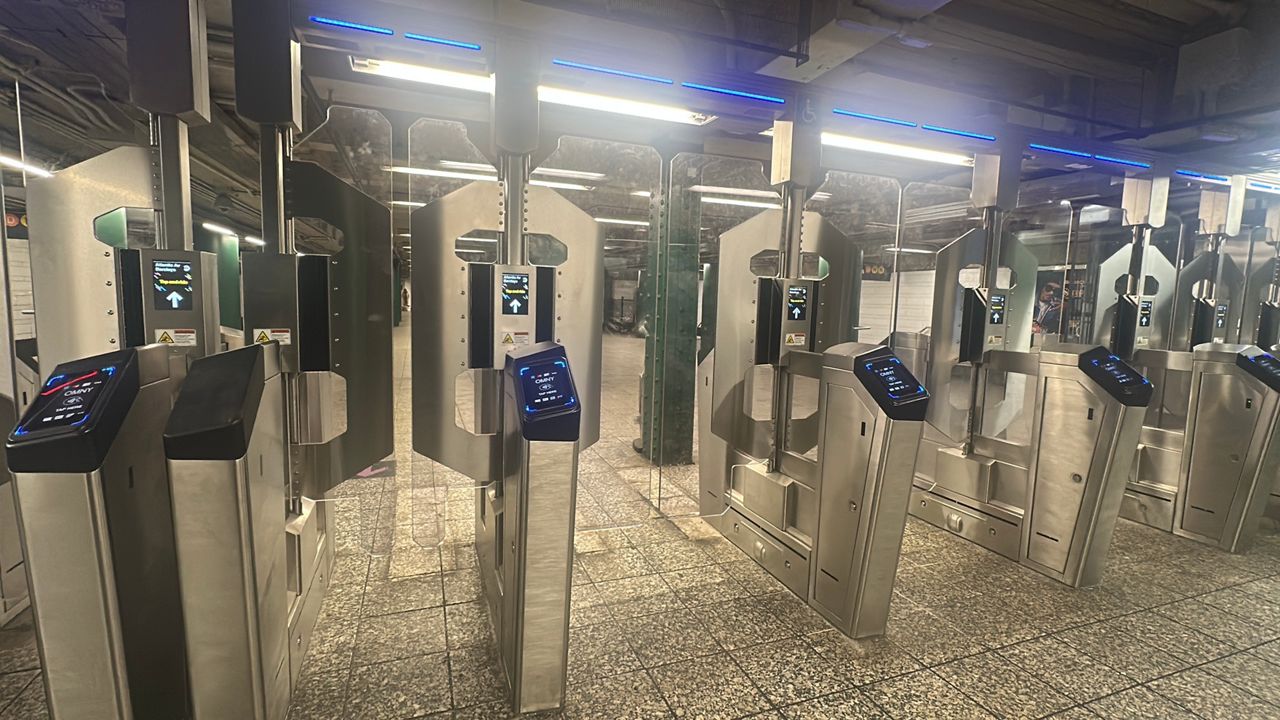
New fare gates from Cubic, the company behind OMNY, began rolling out early Wednesday at the Atlantic-Barclays station in Brooklyn.
The gates are the second model being tested in a pilot program funded by one of three private companies, meaning the MTA is not covering the cost at stations where the gates are installed.
The gates are similar to those installed last week by Conduent at Broadway-Lafayette and Third Avenue-138th Street. They feature saloon-style doors that close quickly and trigger alarms when someone tries to enter without paying.
What You Need To Know
New fare gates with AI and cameras are being tested at Atlantic-Barclays station
The gates are designed to deter fare evasion and improve accessibility for strollers and wheelchairs
Riders are divided on whether the gates will stop people from evading fares
MTA plans to install gates in 150 stations citywide by 2029 under a $1.1 billion capital plan
The new Cubic gates, however, are quieter and include cameras and AI technology that can detect wheelchairs, luggage, children and fare evasion.
Some riders are skeptical about the gates’ effectiveness.
“It’s not going to change nothing,” said Saviel Rosa. “Everybody’s going to find a way to get around. ‘Cause this in New York and we’re going to find our ways.”
Another rider noted some may still attempt to evade the fare by going underneath the gates. The space at the bottom of the new gates is much smaller than the Conduent model, and the doors are reinforced with metal.
The MTA says the design is intended not only to deter fare evasion but also to eliminate the emergency exit gate, which accounts for about half of the fare evasion in the system.
“Not only is it preventing fare evasion, or diminishing fare evasion, it’s not going to wipe it out entirely,” an MTA official said. “But if we don’t have a cop standing at every fare gate, it also gives us a much better accessibility model. People with strollers, people with wheelchairs, folks with mobility issues can get into the system much more easily.”
Other riders said the gates could be effective.
“I hope it stops fare evasion,” said Aaron Schorr. “I hope it works well. We’ll see. But it looks really good.”
“They can’t jump this way,” said another rider. “So, I think it would be a good idea if they do more of it around the city.”
The MTA plans to install the gates in 20 stations initially, with another 20 by the end of next year. The agency’s $1.1 billion capital plan calls for the gates to be installed at 150 stations by 2029.