
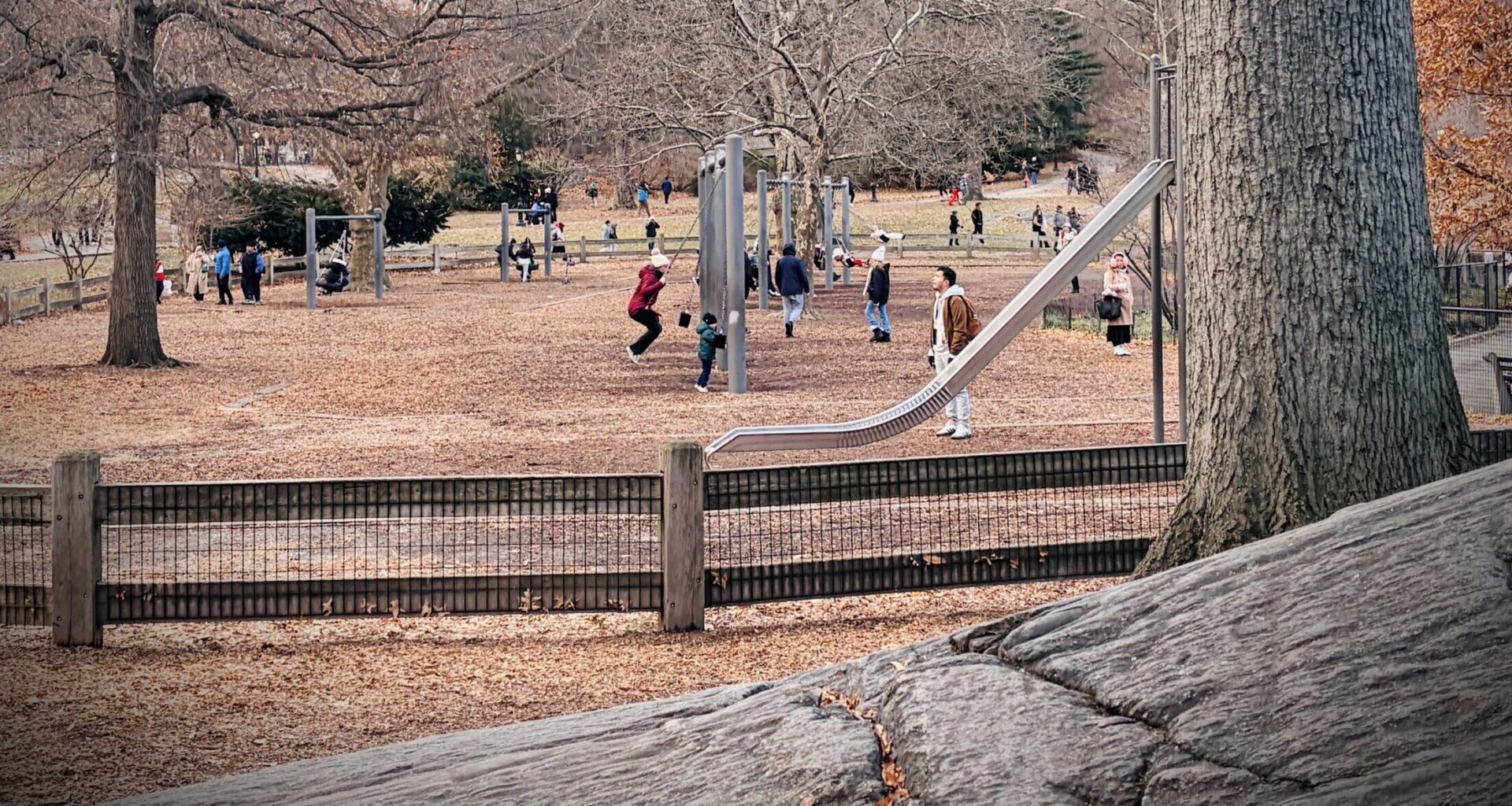
 The swings at Heckscher Playground in Central Park. Photos by Yvonne Vávra.
By Yvonne Vávra
One of the swings at Heckscher Playground in Central Park needs oiling. Clank, clank, it goes whenever a child takes flight. Funny enough, I was sitting on this very bench when that clank, clank sent my mind spinning into a story about New York that would later become my book. That was 12 years ago. And still the swing keeps going, making me smile. Clank, clank.
Time passes, but much stays the same—even in this city that loves to surprise you with a new face if you so much as glance aside. We give her attitude for it, shaking our heads at her refusal to ever be content with herself. But we’re no different. We’re always looking to improve this or that, especially at the end of the year, when suddenly we feel that spark to change. Next year, we’ll go higher, faster, further.
Nothing magical happens on January 1st; the minutes march on just as before. But our minds don’t care. A new year opens like a blank page, and suddenly change feels possible: That was then, this is now. We’re no longer the version that failed. This time, the real thing might finally begin.
 Ancient slabs of Manhattan schist.
Sitting on my bench—clank, clank—I’m watching the massive slabs of Manhattan schist slouching in Central Park. They’re older than the city, older than any idea of it. They’ve witnessed the Upper West Side begin—in fact, they helped shape our neighborhood. Central Park may have been man-made, but it let parts of the island’s original landscape shine, like the ancient bedrock. New Yorkers loved it, and the park’s success made city planners rethink their devotion to straight lines. Suddenly, everyone was into scenery, including Andrew Haswell Green, comptroller of the Central Park Commission.
He abhorred the ruthless logic of the street grid bulldozing its way north. In 1867, he was put in charge of redesigning the land west of the park. Imagine the blank canvas before him: rocky hills, overgrown farms, and muddy fields stretching toward the river. A place ready for a new chapter, waiting for someone with a vision.
Green wanted to work with the island’s natural drama, not against it. And even though the grid had already set some rigid lines, blocking many of his ideas, he still left his mark: Morningside Park with its steep ridges, Riverside Drive curving along the river, and a broad boulevard with a planted mall down the middle, just like in the much-envied grand European capitals—Broadway as we know it today.
Walking home from the park, I realize that the Upper West Side still has plenty of blank spaces. Of course, they feel less inspiring when you’re staring at them through a dusty storefront window. Vacant storefronts—just last month, the Rag counted 80 on Broadway alone—make us grumble. We see them as failures and worry about what the neighborhood is losing.
 Empty storefront? Or blank canvas?
In the spirit of the new year, I wonder if they could be seen in a more hopeful way, as small blank canvases waiting to be reimagined. You’re right to roll your eyes. How naïve, even cruel, to say: Don’t be grumpy about the economic scars, see the possibilities instead. Most of us have no say in what’s happening behind those papered windows. With astronomical rents and razor-thin margins, opening a brick-and-mortar these days comes with a long list of reasons not to.
Still, to have a vision doesn’t require believing it will come true. It just means staying awake. Andrew Haswell Green wasn’t able to realize more than fragments of his ambition. But if he hadn’t dared to dream beyond the grid, the Upper West Side would have far less charm today.
 What would you like to see here? In 2026, let’s fill in the blanks with our dreams.
It might seem silly to wish for galleries, indoor play spaces, or a store dedicated to double-choc fudge. But that wish for fudge, or anything else, is a form of citizenship. Imagining what you’d love to see in the neighborhood—even knowing you can’t make it happen—keeps you from giving up on it. So next year, let’s walk with our eyes open and fill in the blanks with our dreams. Because if we don’t, it will change us. Sneakily, it will rob us of our sense of belonging.
2026 will turn the page, and some things will change while others stubbornly stay the same. And at least with one thing, I won’t mind. Because that clank, clank that plays with my mind so nicely? I hope it keeps going.
Subscribe to West Side Rag’s FREE email newsletter here. And you can Support the Rag here.