
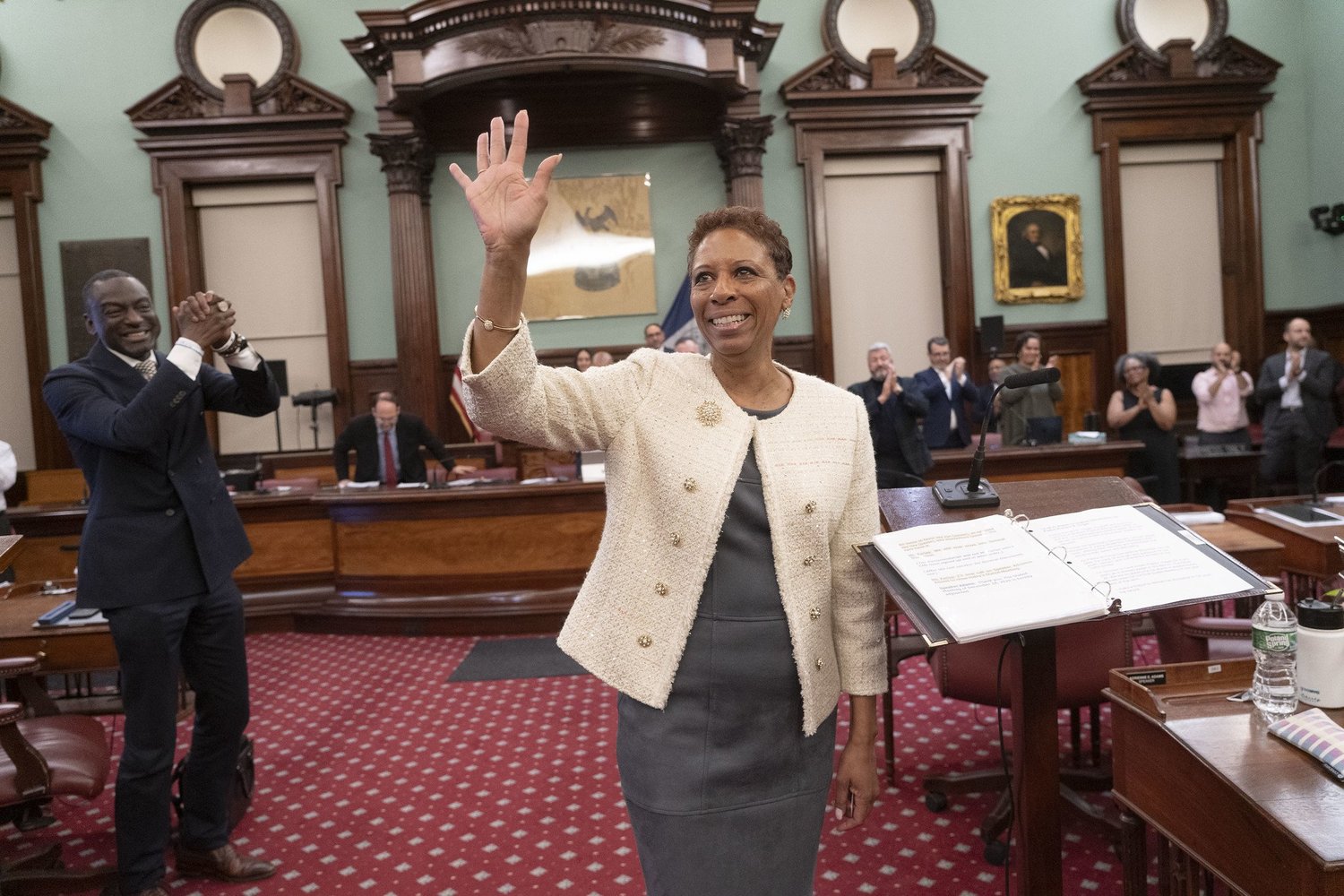
“It is the biggest thing to happen to New York,” the speaker said. “This is the most housing that has been generated in decades, in generations. So we’ve never seen anything like this before.”
There was pushback to the plan, mainly from Queens’ more suburban-esque enclaves that worried the City of Yes would harm the character of their neighborhoods. Some of the pushback came from the more home owner-centric areas of Adams’ own Southeast Queens district.
“This is my backyard,” she said. “It’s personal to me, certain things we were not ready to let happen in the interest of maintaining our Queens resident’s way of life, and our quality of life, and the reason that we live in Queens in the first place.”
She said that she felt there was a lot of misinformation about the City of Yes.
“I think that the no was sold very well, that people came out to community boards, were able to get access to community boards to actually speak about why this should not happen,” she said. “There was just so much misinformation that was given to Queens and to the Bronx, and it just spread, like you put mayonnaise on a sandwich.”
The Council also approved two massive neighborhood plans for Long Island City and Jamaica, which felt personal to Adams.
“We’re going to be doing tremendous things finally, right here in Jamaica,” she said. “It’s going to be a boom for Southeast Queens. All I can say is it’s about time. It’s about time.”
While Adams made headlines for tiffs with the other Adams and for citywide issues, she was a uniquely Queens figure at a time when the borough had unprecedented representation in government.
For a period of time in 2025, Queens representatives in the Council included herself, Majority Whip Selvena Brooks-Powers, Minority Leader Joann Ariola, and Minority Whip Vickie Paladino.
“The world sees Queens,” she said. “We put Queens on the map. We feel that we have presented Queens as a beautiful borough, a welcoming borough, that we are an amazing, diverse borough.”
Her love of Queens was part of her broader governing strategy.
“The City Council, to me, was so Manhattan-centric, the laws were centered around the needs of Manhattan,” she said.
In leaving the Council, she’ll likely be passing the gavel off to Councilmember Julie Menin, a moderate councilmember from Manhattan who is expected to be elected speaker in January.
She’ll also be handing off her Southeast Queens district – the “Great 28,” as she calls it – to Ty Hankerson, who has worked alongside her for years and who currently works as her district chief of staff.
“Ty has been with me since I pretty much walked through the doors of becoming an elected official,” she said. “There is not too much that he doesn’t know already. That’s why I was perplexed why people chose to run against him, because nobody has as much knowledge as Ty Hankerson has, as far as governing right now, as far as sitting in these offices and listening to constituents, as far as building a staff.”
She struggled to come up with a key piece of advice to bestow upon Hankerson, who she said already knows so much about what the job entails.
“Make sure that you are taking all of the people of the city into consideration, and not just your district,” she said.