
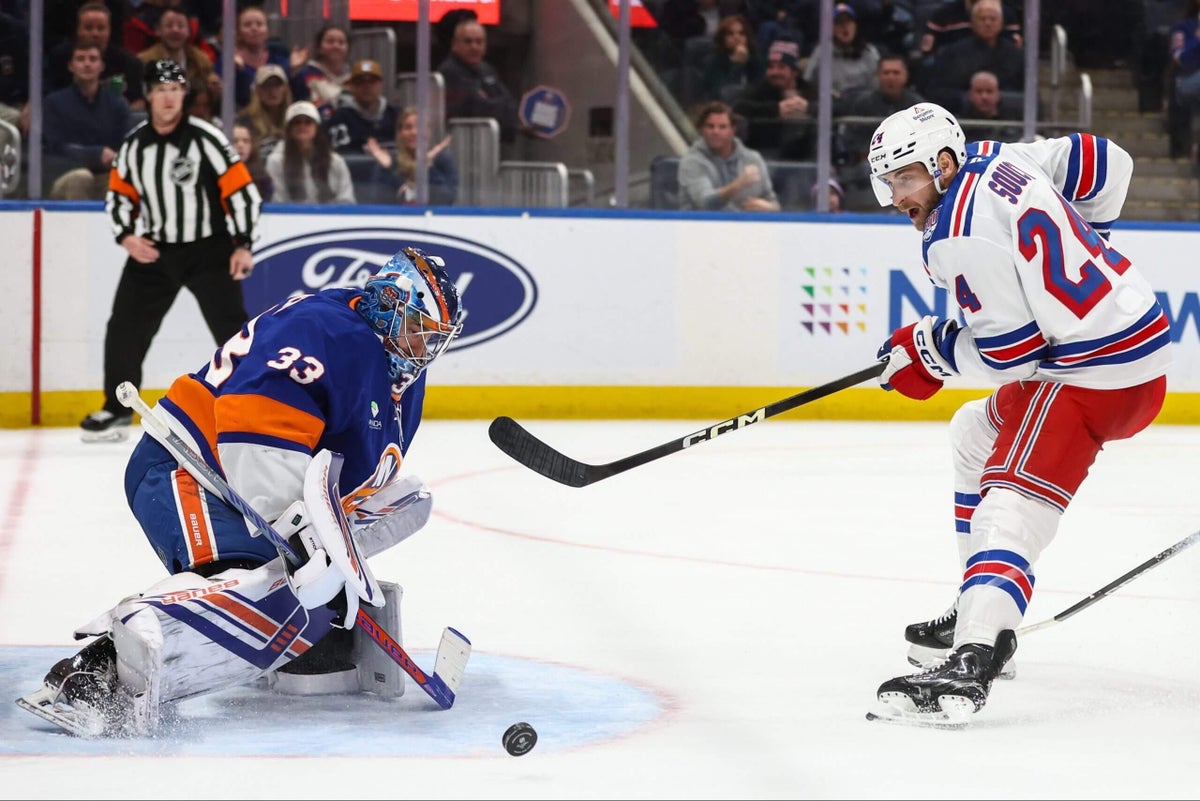
ELMONT, New York — For the Rangers, what’s become familiar is now reaching unprecedented levels.
Through 40 games, New York has been shut out eight times. That’s as many shutout losses as they suffered in 276 games between Feb. 7, 2022, and Oct. 6, 2025, the day before the 2025-26 season began. The Rangers are one of only seven teams this century to have eight shutouts in the first half of their year, per NHL Stats. They’re halfway to the modern-day season record held by the 2006-07 Blue Jackets, who had 16 on the year.
It’s a problem. It’s been a problem all season.
“When we go on the ice, we’re not thinking, ‘Oh, we have eight games already without goals,’ but it’s frustrating,” Artemi Panarin said after a 2-0 loss to the Islanders. “We’re doing that over and over this year. We’ve got to fix everything. We’ve got to fix our offensive zone. We’re not playing close together.”
In a different year, Saturday’s game wouldn’t have been too much of a cause for concern. Sure, the Rangers got outplayed in the first 10 minutes, but they recovered and had what Vincent Trocheck called a “pretty even match” overall. The Islanders capitalized on a bounce early, scoring after Carson Soucy couldn’t corral a puck deep in his own zone, and their goalie, David Rittich, played well, staving off the 27 Rangers’ shots he saw, including a few from dangerous areas. Those games happen.
But this year they have happened far too frequently. The Rangers are last in the Eastern Conference in goals scored despite leading in games played. It’s the major reason they are 15th in point percentage (.525), ahead of only Columbus.
“We’ve been talking about it all season,” Mika Zibanejad said. “When we’re not connected as five, it’s hard for us to play. It’s hard for us to create. It’s hard for us to defend them. It’s hard for us to play offense.”
“We need more people inside so that when we do ultimately get pucks there, we’ve got numbers to create on pucks and create off the broken play or create off the shot,” coach Mike Sullivan added when asked if the team is moving enough when it has possession in the offensive zone. “I think sometimes the motion of the movement gets good to us and then we don’t get inside with enough people. When that happens, I don’t think we get as much to show for it as the time that we spend there.”
The power play — a strength of the Rangers in past years — has also struggled mightily. It’s converted on only five of 37 chances (13.5 percent) in the 13 games since defenseman Adam Fox went down with a shoulder injury. Against the Islanders, they couldn’t score on three chances, a Soucy penalty shot or when goalie Igor Shesterkin was pulled for an extra attacker.
“I just didn’t think we were as clean or as sharp or as crisp as I know that we’re capable of,” Sullivan said. “From that standpoint, that was a missed opportunity.”
Without Fox, the quarterback on the power-play unit, and captain J.T. Miller, the Rangers are down two offensive threats. Those are unfortunate realities, but New York has other capable playmakers who need to find ways to generate offense. If they don’t soon, the pack of teams fighting for playoff spots in a crowded Eastern Conference could start to pull away.
Here are seven other thoughts from the Islanders game.
1. The Islanders struck 58 seconds into the game. Trocheck described the play as the Islanders getting a bounce. An Anders Lee shot appeared to go off Will Borgen’s skate and off the glass. Trocheck thought he could get the puck behind the net, but Soucy hit it from the air and was unable to gain possession. Mathew Barzal did, though, and put it off Shesterkin. The puck then bounced to Lee in the slot, and he buried it.
The Rangers, meanwhile, didn’t manage a shot for the first 10 minutes.
“I thought they got momentum from the first shift, the drop of the puck,” Sullivan said. “They were quicker to pucks, they were harder to pucks. I felt after the first eight or nine minutes I felt like we started to play. From there on in, I thought we were fine.”
The Islanders didn’t score again until an empty net goal in the final minute.
2. The Rangers’ penalty kill was a positive. It shut down all five chances the Islanders got. Zibanejad was particularly noticeable, seizing possession of a puck atop the Rangers’ offensive zone and setting Soucy up for a breakaway that led to his penalty shot. In total, Shesterkin had to face only three shots with the Islanders on the power play.
“It feels like we’re in our spots a lot more than we were earlier on when we were going through some stuff,” Trocheck said. “Taking away their important options, forcing guys to be uncomfortable, and then our trigger points have been good. Gotta keep that up.”
Shesterkin helped when called upon. Bo Horvat found Jonathan Drouin with a seam pass on a second-period power play, and Shesterkin got across his crease just in time to stop his shot.
3. Shesterkin made 24 saves and had an eventful day with two injury scares. At morning skate, a shot hit him in the lower mask or neck and he skated to the bench, where a trainer attended to him and brought him ice. He missed the end-of-skate huddle at center ice, but Sullivan came to talk to him and Shesterkin said he was OK. He returned to take a few shots before going to the dressing room.
In the evening, Braden Schneider hooked Max Shabanov in the second period and sent him flying into Shesterkin. The goalie stayed down after the play, and the trainer came out to check on him. He remained in the game.
4. Brennan Othmann can’t buy a goal. A puck deflected to him alone in the slot late in the second period, but Rittich stopped his shot. The young forward didn’t get much ice time in the special-teams-heavy game, playing only 5:47. Matt Rempe also played under six minutes.
Othmann, a 2021 first-round pick, is still searching for his first NHL goal through 31 games.
5. Panarin earned the Rangers’ first power play, drawing an interference penalty on Adam Pelech. New York appeared to quickly capitalize. With the Islanders caught too far up ice, the visiting New York club got a clean zone entry and an odd-man rush. Zibanejad passed to Will Cuylle for a look, and Cuylle rang it off the crossbar. He thought the puck went in and celebrated as such. The official said the puck went in, but Islanders players quickly shouted for a review. Video showed the puck hit the crossbar and never passed the goal line, so the score remained 1-0 Islanders, much to the Elmont crowd’s delight.
6. If Sullivan had to write out a list of players he’d want to take a penalty shot, Soucy would probably be in the bottom three or four. He’s had a satisfactory season for the Rangers in his role as a defensive-first player, but shootout moves aren’t part of his artillery.
Calum Ritchie slashed Soucy on a third-period short-handed breakaway, and the officials awarded him a penalty shot. The defenseman approached Rittich but didn’t attempt a move; instead trying a wrist shot that the goalie easily stopped. His teammates gave him high fives as he returned to the bench.
“I wanted to see him go down and bury one for us,” Trocheck said. “Obviously that’s exciting. You don’t see very many opportunities for him to get a breakaway, let alone a penalty shot. Would’ve been huge but we’ve got to pick him up whenever things don’t go our way.”
Sullivan presumably would’ve preferred a power play to a penalty shot, but when the former is awarded, the coach isn’t given a choice.
7. Not all No. 1 picks wind up stars, but some do. Saturday offered a glimpse at that. Rookie Matthew Schaefer played 27:03 and appeared on both Islanders’ special teams units. Sullivan raved about him pregame, calling him “one of the more exciting young players to watch.”
Alexis Lafrenière, meanwhile, played only 14:28, in part because he isn’t on the Rangers’ top power play unit and doesn’t kill penalties. The 2020 No. 1 pick has 20 points in 40 games this season, which is four fewer than the 18-year-old Schaefer. Keeping Lafrenière to the standards of a No. 1 pick isn’t fair at this point — he’s shown he can be a complementary winger in the top six but perhaps not much more — but the contrast between him and the Islanders’ young defenseman, who could make Canada’s Olympic team, stuck out to me Saturday. Whether a club finds a franchise cornerstone player with a high lottery selection or selects a serviceable-but-non-gamebreaking one with their pick can dictate its outlook for years.