

For many Brooklyn renters, the difference between stability and stress often comes down to one thing: access to information.
Starting Jan. 1, the city’s new Rent Transparency Act (Intro 1037) will require landlords to post notices in buildings that contain rent-stabilized apartments — a move advocates say could help thousands of tenants better understand their rights. But for Brooklyn-based housing expert Allia Mohamed, the law is only part of the solution.
“I love talking about rent, I love talking about housing and particularly as it relates to transparency,” Mohamed told Brooklyn Paper.
Mohamed is the CEO and co-founder of Openigloo, a Brooklyn-based startup launched in 2020 that helps renters research buildings and landlords — and, crucially, determine whether an apartment is rent-stabilized. The idea grew directly out of her own frustrating experience navigating New York City’s rental market.
“I had horrible landlords that never picked up the phone when something went wrong despite me paying way too much rent on time every single month,” she said.
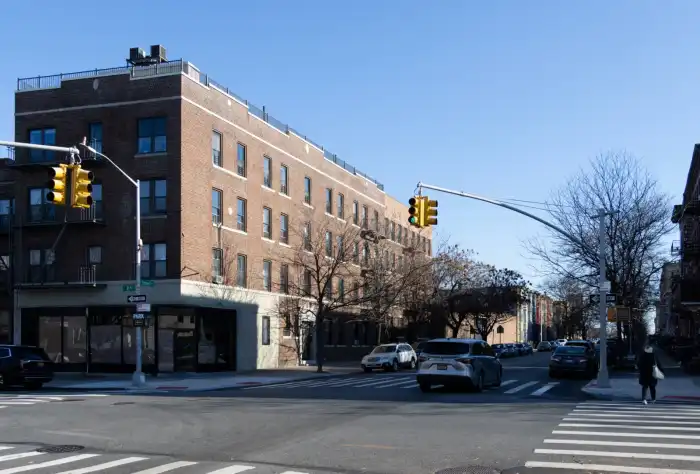 The Rent Transparency Act, which will go into effect on Jan. 1, will help tenants fight illegal rent hikes, demand better living conditions and restore illegally deregulated units. File photo by Susan de Vries
While apartment hunting, Mohamed began standing outside buildings she was considering and asking residents directly about their experiences.
“That’s how I found my perfect rent-stabilized apartment in Brooklyn that I’ve been in for the past eight years,” she continued. “I’m not moving until, you know, I’m in a body bag.”
Today, Openigloo has supported more than three million NYC renters and evolved into a platform where users can research buildings, browse listings and filter specifically for rent-stabilized or good-cause eviction-protected apartments.
As the Rent Transparency Act goes into effect later this week, Mohamed said it will be most useful for people already living in their apartments.
“This notice is gonna go up in the common areas of their building that says, ‘Hey, there are rent-stabilized apartments in this building, and this is how you go about requesting your rental history,’” she said. “So this is gonna be really helpful for people who are already in place.”
But she is less convinced the signage will help renters who are actively apartment hunting.
 Sandy Nurse, council member from District 37, introduced the Rent Transparency Act, which was passed in May 2025. File photo by Paul Frangipane
“When you’re apartment hunting, you’re not going door to door on the block and looking to see if those notices are gonna be present,” Mohamed said. “These notices are not going to tell you which units are stabilized. They’re not going to tell you what the legal rent is supposed to be.”
That lack of clarity reflects a deeper issue Mohamed sees daily: many renters don’t know whether their apartment is stabilized. About 35% of users on Openigloo say they are “not sure” if they live in a rent-stabilized unit.
“Which breaks my heart,” she added.
Mohamad hopes the new law will dispel the myth that rent-stabilized apartments are rare.
“There is this common myth in New York City that, ‘Oh, rent-stabilized apartments are really difficult to find,’” she said. “They’re not realizing that nearly 50% of the housing in New York City is stabilized. That’s almost a million apartments.”
According to the city’s Rent Guidelines Board, “About one million of New York City’s 2.3 million rental units are considered to be rent stabilized (with an additional 16,400 rent controlled).”
Still, Mohamad argued that transparency efforts remain too burdensome for tenants. Rent histories are only released by the state’s Division of Housing and Community Renewal to current occupants, through a mailed request tied to a specific apartment.
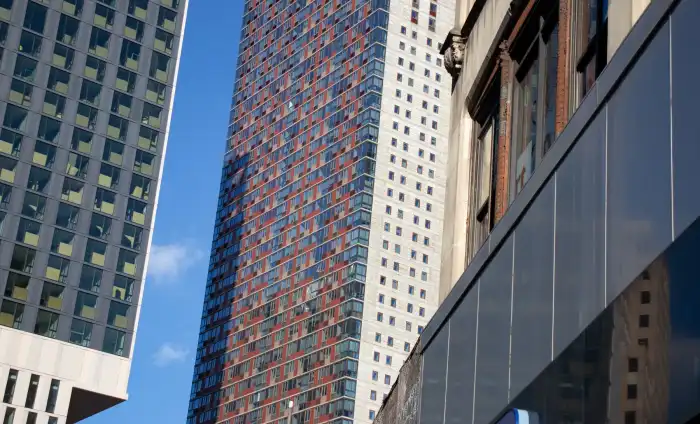 Finding a unit’s rent history can be burdensome for tenants, Mohamad said. File photo by Susan De Vries
“This is a very cumbersome process, especially in a day and age where everything can be digitized,” she said.
Openigloo has attempted to bridge the gap by crowdsourcing rent histories submitted by renters and building a public map that flags stabilized units and analyzes pricing trends. The results, Mohamed said, can be dramatic.
“We’ve come across dozens of cases where renters have been overcharged $1,000, $2,000 and $3,000,” she said. “We just had a recent success of a renter who got her rent cut from $3,400 to $1,400.”
Despite her platform’s reach, Mohamed believes the responsibility shouldn’t fall on renters alone.
“Why isn’t [the state Division of Homes and Community Renewal] the one that’s auditing and flagging and finding those mistakes in real time?” she said. “The onus remains on the renter to be able to enforce and uphold their rights.”
As part of its transparency push, Openigloo launched the city’s first public map of rent-stabilized properties, helping renters identify buildings with stabilized units and avoid searching blindly.
That message resonates with the more than 60,000 followers Mohamed has built on TikTok, where she debunks common misconceptions about rent stabilization.
“One myth is that a lot of people think that rent stabilization is really rare,” she said. Another is that stabilized apartments are always cheap. “There are now $3,000 stabilized apartments, $8,000 rent-stabilized apartments. The most expensive rent-stabilized apartment in New York City on record is $50,000 a month.”
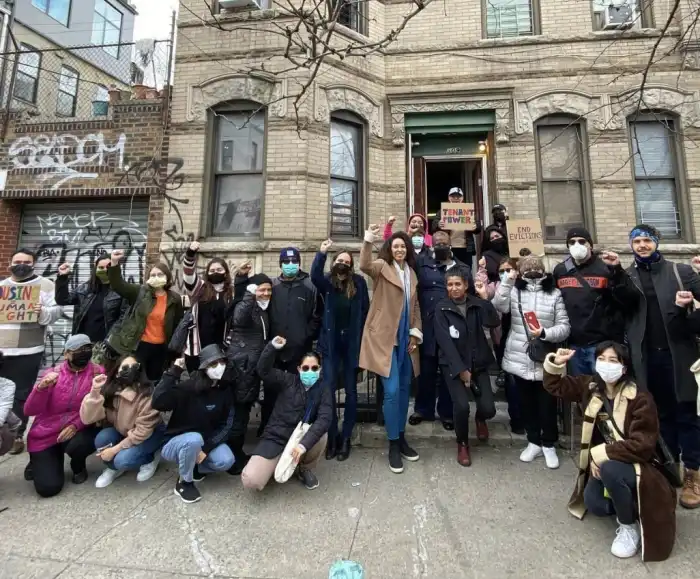 The Rent Transparency Act, introduced by Council Member Sandy Nurse (center), empowers tenants to fight illegal rent hikes, fight for better conditions and bring illegally destabilized units back into compliance. Photo courtesy Council Member Sandy Nurse
For Brooklyn renters feeling overwhelmed by rising rents, Mohamed’s advice is straightforward.
“The number one thing that every renter needs to do, particularly in Brooklyn, where the market is changing so frequently, is to know your rights,” she said. “Know them inside and out and not be shy to enforce them.”
The bill itself states that “the owner of a multiple dwelling containing rent stabilized units to post a sign, stating that the building contains rent stabilized units and providing information about how tenants can submit inquiries to New York State Homes and Community Renewal to find out if their units are rent stabilized. The sign would be required to be in English and Spanish, and placed in the common area at such building’s entrance.”
It was enacted by several Brooklyn council members, including Sandy Nurse, Lincoln Restler, Crystal Hudson and Alexa Aviles, who all sit on the Committee on Housing and Buildings.
As lawmakers focus more on housing transparency, Mohamed says she’s cautiously optimistic.
“Anytime there’s legislation that helps support that mission, we’re supportive and excited,” she said. “Hopefully, renters can keep an eye out for those notices in their vestibules come 2026.”