
Aaron Glenn must go.
Yes, it is common knowledge that the first-year head coach isn’t going anywhere. It is widely believed that the New York Jets will give their former Pro Bowl cornerback a mulligan for the 2025 season due to their lack of a passable quarterback (pun intended) and the in-season trades of two All-Pro defenders.
The likelihood of Glenn’s impending return does not change the cold, hard truth: Glenn should be one-and-done as the Jets’ head honcho, even if he won’t be.
Aaron Glenn has shown nothing to believe in
I write this article somewhat reluctantly, as I was among those who championed Glenn as the Jets’ best head coaching target in the 2025 cycle among those who were realistically available. I’ll never walk that back. I loved his resume and thought he was cut out to be a great NFL head coach.
However, I could not care less about being wrong in my prognostications. If I missed the mark, I missed the mark.
And I’m ready to admit that I missed the mark on Glenn.
We live in a sports media world where every analyst is desperate to make accurate predictions in hopes of gaining that sweet, sweet dopamine rush from the thrill of watching a number beside a little heart symbol rapidly climb after they retweet a great take from 15 months earlier. Personally, though, I would rather admit that I was wrong and confront reality than cling to my initial opinion in hopes of being proven right so that I can look smart to strangers on the internet.
Let’s be honest, folks: Glenn has provided absolutely no reason to believe that he will ever lead the Jets to any semblance of success.
After inheriting a five-win team, expectations were low for Glenn, but he has somehow fallen miles below a bar that was barely above the Earth’s surface. His team embodies the “Our Expectations Were Low, But Holy —” meme. He has turned the already hilarious Jets into a comedy act that George Carlin and Richard Pryor would open for. They exist solely to provide laughter to fans (even to opposing sidelines) and career-highs to opponents. They are the mid-major team that SEC teams schedule in September to give their players a light workout before the actual games begin.
The 3-13 record isn’t what people should be focused on. It is not entirely surprising that the Jets have three wins. The fashion in which they have arrived at that record is what matters.
The Jets have been outscored by 176 points this season. More often than not, they are blown off the field, and they have never blown anybody out. When they have won, it was by a narrow margin over bad teams, and even then, it was mainly because of breakthrough special teams plays bailing them out for being outplayed on snaps from scrimmage. Without a couple of breakaway returns and Nick Folk’s perfect kicking, this team would be in the conversation for the worst to step on an NFL field.
Glenn himself set a low bar before the season, simply stating that he wanted his team to “make fans proud.” There is a world where the Jets could have achieved that goal while winning three or four games. But when your team does not look like it even deserves to grace the NFL shield, there is nothing for fans to be proud of.
In terms of Pro Football Reference’s Simple Rating System, a metric that adjusts a team’s average point differential for its strength of schedule, the Jets are the worst team in the NFL. They own an SRS of -12.0, which not only ranks 32nd in 2025 but also stands as the second-worst mark in franchise history. Only the 1976 Jets team was worse.
Let that sink in.
Think about all of the horrifying Jets teams you have watched in your lifetime. Close your eyes and picture the most infamous follies of those teams… the Butt Fumble, Seeing Ghosts, and so on. Now, open them, and realize that, most likely, every team you just thought about was better than the one you have witnessed this year (unless you watched the 1976 squad, in which case, you should be entitled to financial compensation). Rich Kotite’s 1996 abomination, Rex Ryan’s 2014 circus, Adam Gase’s 2020 pit of despair—all of them played more competent football than the 2025 Jets!
How can this degree of ineptitude possibly be excused?
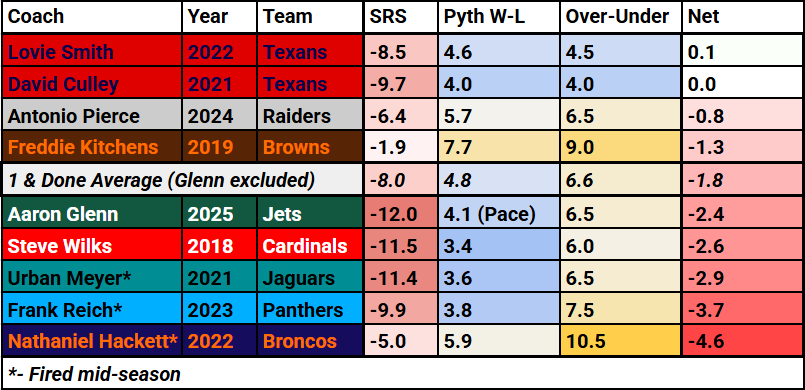
Glenn’s output in 2025 justifies a one-and-done season. The Jets’ -12.0 SRS is worse than each of the eight head coaches to go one-and-done (fired during or after their first season with a team) since 2018: Freddie Kitchens (-1.9), Nathaniel Hackett (-5.0), Antonio Pierce (-6.4), Lovie Smith (-8.5), David Culley (-9.7), Frank Reich (-9.9), Urban Meyer (-11.4), and Steve Wilks (-11.5).
In fairness, the Jets had low expectations entering the year, but even relative to those, Glenn has still performed at a one-and-done level. The Jets are on pace to finish with 4.1 Pythagorean wins (which is based on point differential), 2.4 wins shy of their 6.5 over-under from the preseason (per Pro Football Reference), which is still worse than the average one-and-done coach since 2018. Only Wilks, Meyer, Reich, and Hackett were worse in this category; three of those four coaches were fired mid-season.
Fair excuses can be made for Glenn regarding the Jets’ lack of talent. That’s about all he has going for him, though. There is nothing positive to be said about Glenn individually. His coaching has been flat-out horrendous when evaluating his decisions and actions independent of the talent on the field.
The Jets’ offensive and defensive game plans are stunningly predictable for a professional football team. Each week, it is obvious that opposing coaches know precisely what is coming on both sides of the ball.
The “culture” that Glenn has embedded in his team is archaic. Glenn constantly drones on and on about buzzwords like “toughness” and “grit” instead of prioritizing tactical aspects of the game. He rarely has anything clever to say regarding scheme or strategy. Perhaps his insights behind closed doors are different, but when you think about the league’s brightest coaches, their intellect is obvious when they speak to the media.
Glenn leads a Jets team that is decades behind the times. There is no evidence of a weekly effort to push the envelope and discover innovative, creative methods to outsmart opponents and defeat them through strategy, which is what actually wins games in 2025, not “physicality” and the like. Strategy is especially critical if your team is less talented than most others, which means that Glenn’s lack of talent only puts more of a spotlight on how poor his coaching is, rather than being an excuse.
Glenn consistently shows a lack of awareness as a game manager. There are instances where he is aggressive for the heck of it, and others where he makes conservative decisions when it would be optimal to go for it. It does not seem that his decisions are being informed by analytical models that would give the Jets an advantage. He seems to be managing games based on gut decisions without rhyme or reason.
In press conferences, Glenn constantly contradicts himself. He promised to stick by Justin Fields, only to immediately bench him, and later on, he promised to stick by Steve Wilks, only to immediately fire the defensive coordinator. These are just two of many examples in which Glenn seemingly detracted from his initial plan in a matter of hours.
Glenn’s frequent contradictions suggest that he lacks confidence in his vision, if he even has a concrete long-term plan to begin with. The coach does not give off the impression that there is any sort of “building” going on; just rash, emotional decisions, which are unsurprising from a coach who always gives rash, emotional responses to the media.
He lacks the level head that is necessary in New York. It is obvious when he’s at the podium, and if you’re not the type to care about press conferences, the proof lies in his erratic decision-making.
If Glenn rebounds from this type of start to be successful, he would be the first head coach in NFL history to do it.
Aaron Glenn’s odds of success are already near-zero
When Glenn lost his first seven games as a head coach, he had already dug himself into a deep hole. Of the 17 head coaches to start 0-6 since the 1980 season, just four of them (23.5%) eventually led that same franchise to the playoffs: Dan Campbell, Kyle Shanahan, Zac Taylor, and Jimmy Johnson.
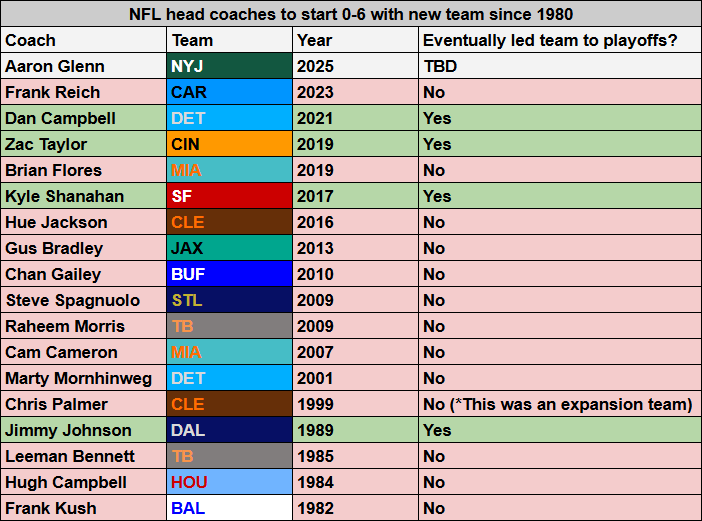
Logically, it would make sense to fire Glenn immediately after starting 0-6, as the odds suggest that starting from scratch with a new head coach would yield better than 23.5% odds of eventually leading the Jets to the playoffs. Obviously, though, the NFL doesn’t work like that.
Thus, it was Glenn’s job to use the rest of the 2025 season to prove why he should be considered a strong candidate to join Campbell, Taylor, Shanahan, and Johnson as the next outlier in a group of head coaches that is mostly comprised of colossal busts.
Glenn hasn’t done that.
Campbell and Shanahan led their teams to much-improved finishes that suggested a turnaround was possible in the future. Glenn’s team has only gotten worse; they just set the all-time NFL record for the worst point differential in December (-107).
Taylor and Johnson’s teams never rebounded after their poor starts, which provides some hope for Glenn. The 2019 Bengals and 1989 Cowboys finished with two wins and one win, respectively.
There’s a key difference between Taylor and Glenn, though: Taylor is an offensive coach.
So are Campbell and Shanahan.
That leaves Glenn with a grim reality: Jimmy Johnson is the only defensive-minded head coach who has ever rebounded from an 0-6 start to lead the same franchise to the playoffs.
Johnson is a Hall-of-Famer with two Super Bowl rings. Are Jets fans really supposed to believe that Glenn is that type of coach after what they’ve witnessed this season? Sure, it’s possible, but one example in NFL history does not make it remotely likely— and it’s downright idiotic to build your future around a remote possibility. It’s also possible that I hit the Powerball today, but I’m not going to purchase courtside playoff tickets next to Ben Stiller and Timothée Chalamet until I do.
Glenn isn’t leading the Jets to success. Plain and simple. That should be the expectation, with a substantial degree of confidence. Once again: If he ends up succeeding, it would be a historic feat.
To each their own, but I would not trust a coach in charge of the second-worst team in Jets history — who appears so lost that he did not know the correct distance of Nick Folk’s potential game-winning field goal attempt in London — to put together a historic turnaround that can only be matched by a Hall-of-Famer.
If owner Woody Johnson has any semblance of foresight, he will cut his losses before it’s too late.
Sticking with Glenn would perpetuate the cycle of misery that has entrapped this franchise for the past 15 years.
Knowing how things go for the Jets, here is how things will likely play out if and when Glenn is still the team’s head coach in 2026.
The cycle of misery that awaits the Aaron Glenn-led Jets
The Jets will draft a franchise quarterback, either Fernando Mendoza or Dante Moore. Let’s just say that it’s Moore for the sake of this article.
Moore walks into a situation where he must play under a poor head coach in Glenn. However, because Glenn is being given free passes due to the Jets’ long-term building approach (as well as Johnson’s hesitancy to meddle, in hopes of squashing his reputation as a meddler), Moore is forced to play two seasons under Glenn’s weak leadership. Unsurprisingly, Moore struggles because Glenn is not a good head coach (nor is he even an offensive coach).
After two seasons, the Jets finally dump Glenn, bringing in an offensive coach to hopefully save Moore in Year 3, but they have to settle for an uninspiring offensive coach due to the unappealing nature of the Jets’ job (similar to the Jets hiring Adam Gase in 2019). However, Moore’s scars are too deep by this point, and the new coach cannot fix him. Moore struggles in 2028, and the Jets trade him to the Atlanta Falcons in 2029.
Under better guidance, Moore turns things around in Atlanta and leads the Falcons to a championship in 2029. Meanwhile, the Jets start over at quarterback in 2029 while sticking with a lame-duck second-year head coach who struggled in his first season. The Jets have another bad season in 2030, causing the coach to be fired, and forcing the second-year quarterback to learn a new offensive system in his second season. It derails his development, he fizzles out, and the cycle continues for all of eternity, or at least until football becomes a two-hand touch sport, and the league folds due to declining interest, leaving the Jets to settle for their lone championship in 1968.
And it’s all because they decided to stick with Glenn in 2026 for no reason other than unearned patience just for the sake of it.
Obviously, that is an exaggerated hypothetical, but… is it really that exaggerated? The Jets have already suffered through the worst-case scenario with each of their last few hopeful franchise quarterbacks. More often than not, the failure can be traced back to their instability within the coaching staff.
The Jets have continuously botched the marriage between quarterback and head coach. Whether it was pairing Sam Darnold with a lame-duck defensive coach in Todd Bowles, pairing Zach Wilson with a rookie defensive head coach in Robert Saleh (although Wilson was probably beyond salvaging even if he played for Kyle Shanahan), or pairing Aaron Rodgers with a lame-duck defensive head coach, the Jets can’t get the two most important positions in football right.
Perhaps there is a world where the Jets keep Glenn and still find success in the future after firing him. After all, when you look at two of the 2025 season’s biggest breakout teams, the Jacksonville Jaguars and the Chicago Bears, both are led by first-year offensive head coaches (Liam Coen and Ben Johnson) who inherited a former first-overall quarterback (Trevor Lawrence and Caleb Williams) who struggled under previous coaching but is now finding his footing under the right leadership.
There is a world where the Jets’ franchise quarterback achieves this arc. It isn’t a guarantee that he fizzles out in New York and then finds success elsewhere.
But when you’re talking about the New York Jets, the worst-case scenario is exactly what you should expect.
You could argue that expecting the worst is a symptom of overly pessimistic superstition, given the franchise’s constant failures. However, their alarming consistency at achieving the worst-case scenario cannot be considered supernatural when the Jets repeatedly make the same mistakes. They commit familiar blunders and receive familiar results. There is no misfortune to be found here—just incompetence.
If the Jets want to break the cycle, they’ll do something proactive for once: Admitting their mistake too early instead of too late.
Aaron Glenn should be fired… even if we all know that he won’t be.