
This essay is part of a series in which writers reflect on Zohran Mamdani’s inauguration as the mayor of New York City.

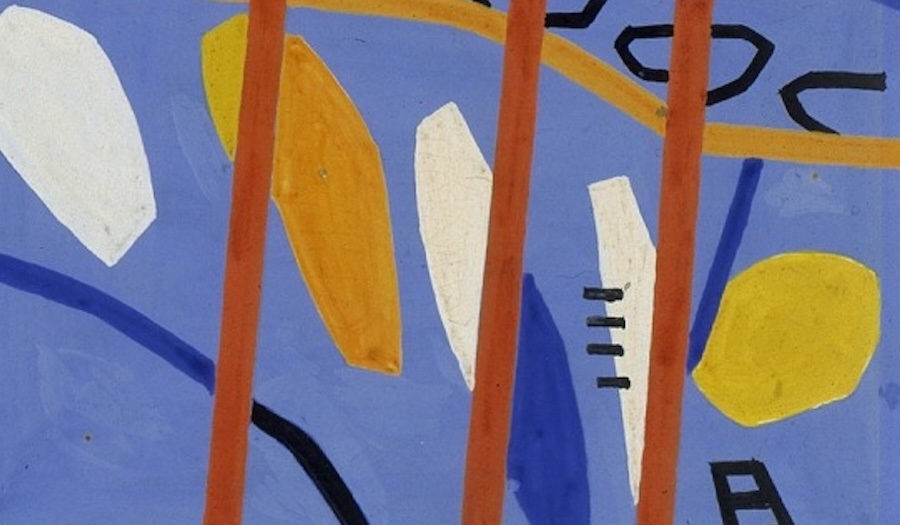
Illustration by Stuart Davis
In less suspenseful years a mayoral election in New York City would be a purely local event, but in precarious 2025 it was a national and even international one as well. The United States is still, in all its potentially catastrophic disarray and decline, the most powerful geopolitical entity on earth. Any little fuse might be lit at any moment by our chaotic and supremely short-sighted government, and much of the world was watching beadily: While the loopy marauders in charge were busy stuffing themselves with burgers and stuffing their properties with hideous kitsch and their giant pockets with looted money, what were we—the residents of America’s preeminent city—planning to say about our own priorities?
Mamdani’s youth, the naturalness of his demeanor, and his unassuming charm give his highly improbable victory an uncanny sheen, as if, in answer to a call, he simply rose in embryonic form up from a great depth to arrive fully realized at the threshold of Gracie Mansion. And following the election, a pervasive sense of relief—even of release—has lifted, or at least suspended, an atmosphere of imminent doom over large sectors of the city, restoring some of its bounce. Not everyone is happy, obviously. No doubt there are lots of clutched pearls and white knuckles around, and it’s true that if he can effect even a proportion of his stated goals, the tenor of New York will be much affected. That’s the point.
There is also the question of whether the Trump White House (assuming it’s still standing) will carry out its muttered threats of punitive funding cuts and military intervention, or who knows what all other horrors. The head-spinningly convivial meeting at the White House between the two lead actors in this drama has allayed those fears provisionally, but Trump and his lieutenants have made excellent use of his whimsical inconsistencies to scare us all out of our wits.
It’s a scummy time, to be sure, resounding with repetitious laments: How to plan? What to plan for? Why are we so helpless? And why oh why do we keep just standing there while other ordinary people are assaulted on the street and hauled off to dungeons? Fascism was ostensibly vanquished when my generation was born and now is again ascendant. We grew up believing that it was largely the anomalous German predilection for authority that accounted for the Nazis’ successful throttling of dissent. But we Americans have always been an unruly bunch, so what’s keeping us so acquiescent? Yes, yes, we’ve been bought off, we’ve been lulled to sleep… True enough, but for the various pacifying comforts we are paying a great price. Robbed, duped, trapped—silenced and humiliated by our own failures of moral and mental clarity—we feel like marine birds caught in an oil slick; the shame of submission is potent.
In addition to the Mamdani attributes that thrilled many voters and alarmed many others—his (inaccurately) perceived inexperience, his age (thirty-four), his religion (Muslim), his birthplace (Uganda), his outlook (idealistic), his parentage (Muslim and Hindu, artistic and intellectual), his only recent US citizenship (2018), and possibly most fearsome, his political identification (socialist)—he also has plenty of virtues almost universally valued. But I doubt that his rationality, intelligence, temperateness, humanism, and ability to inspire confidence, to name a few, would have been enough to buoy him to victory over a powerful and ferocious opposition were it not for the backdrop against which he was running—a backdrop of irrationality, stupidity, rashness, incoherence, infantile destructiveness, and sadism. In short, the radiance of tentative hope shimmering through New York City’s questionable air probably owes as much to what our mayor elect is not as it does to what he is. Against the considerable odds, we New Yorkers have raised to office with our own voices and hands a person who is not insane and not grotesque.
But what will happen? How will it work out? Everybody speculates, nobody knows. The future—which always considers itself a destination—will retrospectively define, according to prevailing biases, what this moment was, and what significance, if any at all, this election will have had. In the meantime, we’ll cross our fingers and hold our breath.