
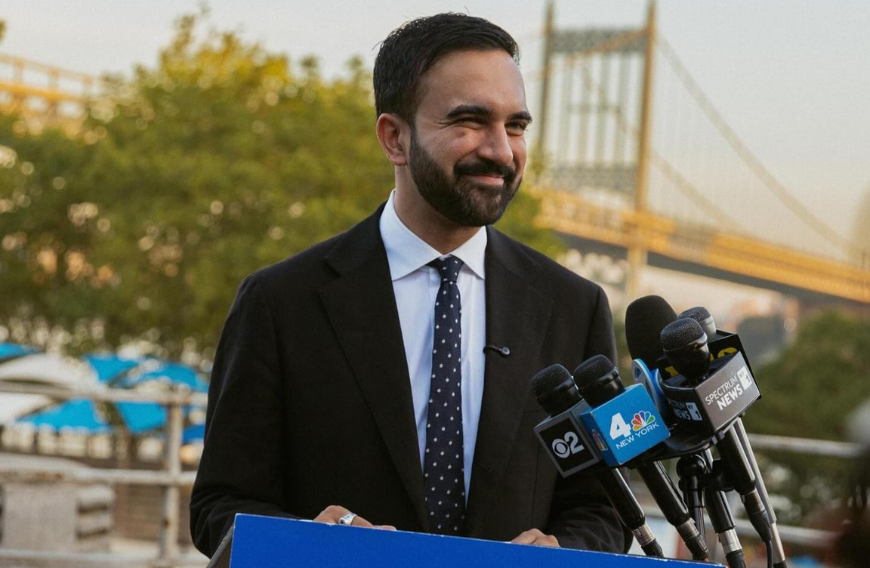
Ever since the ball dropped in Times Square to welcome 2026, New Yorkers have scarcely had time to pause. Just hours into the new year, the city’s political calendar turned a decisive page as Zohran Mamdani was sworn in as mayor in a low-key ceremony tucked beneath City Hall.
The private swearing-in took place on the steps of the historic City Hall subway station, a long-shuttered transit space closed to riders since 1945. New York State Attorney General Letitia James administered the oath as
Mamdani stood alongside his wife, Rama Duwaji, on a staircase inside the landmark station. He chose to be sworn in on two Qurans — one borrowed from the New York Public Library and another that belonged to his grandfather — blending civic duty with personal history.
That restrained opening gave way to a far more expansive public moment later on New Year’s Day. Flipping the script, Mamdani repeated the oath on the steps of City Hall before a crowd that overflowed the plaza and spilled into surrounding streets. Despite biting cold, tens of thousands of supporters filled Lower Manhattan to watch the new mayor formally take office alongside City Comptroller Mark Levine and Public Advocate Jumaane Williams, transforming the inauguration into a charged display of popular enthusiasm as the city embraced both a new year and new leadership.
The public ceremony also drew some of the Democratic Party’s most prominent progressive voices.
READ: ‘He’s got the pulse of people’: A friend reflects on Zohran Mamdani’s rise (November 4, 2025)
Representative Alexandria Ocasio-Cortez and Vermont Senator Bernie Sanders stood alongside the city’s new leadership, using the moment to frame Mamdani’s victory as part of a broader movement with implications far beyond New York. Their speeches sketched out progressive governing priorities for the city while underscoring how the race has already rippled through political circles nationwide.
Sanders, who swore Mamdani into office, struck a defiant note as he addressed the crowd. “The most important lesson that can be learned today is that when working people stand, when they don’t let them [the ultra-wealthy] divide us up, there is nothing that we cannot accomplish,” he said.
s invited guests and reporters gathered within the City Hall grounds, the celebration extended well beyond the gates. The city hosted a seven-block-long public block party, a break from the traditionally ticketed inauguration and a nod to the mass, street-level energy that defined the day.
That emphasis on inclusion carried through the ceremony itself. Mamdani, Williams, and Levine, each used their remarks to stress unity across New York’s communities, speaking in multiple languages — English, Spanish, Hebrew and Greek — and sharing the stage with faith leaders representing Islam, Christianity and Judaism.
After being sworn in, Levine highlighted the symbolism of the moment. “We have three swearings-in. One by a leader using a Quran, one by a leader using a Christian Bible, and one using a Hebrew Bible. I am proud to live in a city where this is possible,” he said.
Mamdani struck a similar note in his address, tying the diversity on display to his broader vision for the city. “We will draw this city closer together. We will replace the frigidity of rugged individualism with the warmth of collectivism. If our campaign demonstrated that the people of New York yearn for solidarity, then let this government foster it,” he said. “We will deliver nothing less as we work each day to make this city belong to more of its people than it did the day before.”
Running through the speeches was a message that had anchored the campaign from the start and was echoed by Mamdani, Levine, Williams, Sanders and Ocasio-Cortez alike: the city’s wealthiest residents and biggest corporations should shoulder a greater share of the tax burden.
READ: Zohran Mamdani elected New York’s first Indian American, Muslim mayor (November 5, 2025)
Sanders made the point explicit as the crowd responded with chants of “Tax the rich.” “Demanding that the wealthy and large corporations start paying their fair share of taxes is not radical. It is exactly the right thing to do,” he said.
For Mamdani, that theme translates into concrete policy goals. A central pledge of his campaign was to raise New York City’s corporate tax rate from 7.25 percent to 11.5 percent, bringing it in line with neighbouring New Jersey, alongside a proposed 2 percent tax increase on individuals earning more than $1 million annually. Any such changes, however, would require approval from the governor before they could take effect.
Housing quickly emerged as the clearest expression of Mamdani’s affordability push. During the campaign, he repeatedly pointed to rent-stabilised apartments — which make up roughly half of the city’s rental housing — and pledged to freeze rents as a way to bring immediate relief to tenants.
“Those in rent-stabilised homes will no longer dread the latest rent hike – because we will freeze the rent,” Mamdani said during his inauguration remarks.
He moved to underline that promise within hours of taking office. At a news conference later the same day, Mamdani rolled out his first set of executive actions, all focused on housing. “On the first day of this new administration, on the day when so many rent payments are due, we will not wait to deliver action,” he said.
Standing inside a rent-stabilized building in Brooklyn, the new mayor announced three executive orders, including the formation of two new city task forces on housing. One will catalogue city-owned land that could be developed for housing, while the other will explore ways to accelerate construction and expand the city’s housing supply.
Mamdani framed those early moves as part of a broader reset for the city. In a speech on his first day in office, he pledged to “reinvent” New York, casting his administration as the start of “a new era” for the nation’s largest city and signalling an aggressive opening to his mayoralty.
READ: Zohran Mamdani sworn in as New York City mayor at midnight (January 1, 2026)
At 34, Mamdani arrives at City Hall as one of the country’s youngest big-city mayors and a rising democratic socialist figure who, just a year ago, was a little-known state assemblyman. His inauguration also marked several firsts in the city’s history: New York’s first Muslim mayor, the first of South Asian descent, the first born in Africa and the first to be sworn into office using the Qur’an.
Mamdani also used the moment to directly address his politics, making clear he had no intention of softening his views now that he was in office. “I was elected as a democratic socialist and I will govern as a democratic socialist. I will not abandon my principles for fear of being called radical,” he said, drawing loud cheers from the crowd gathered at City Hall.
He closed his remarks on a note of urgency rather than celebration. “The work has only just begun,” Mamdani said.
Within hours of the ceremony, the new mayor moved to draw a sharp line between his administration and the last. Mamdani revoked all executive orders issued by Eric Adams after Sept. 26, 2024, the date the former mayor was indicted on federal corruption charges, that were later dropped by the Trump administration.