
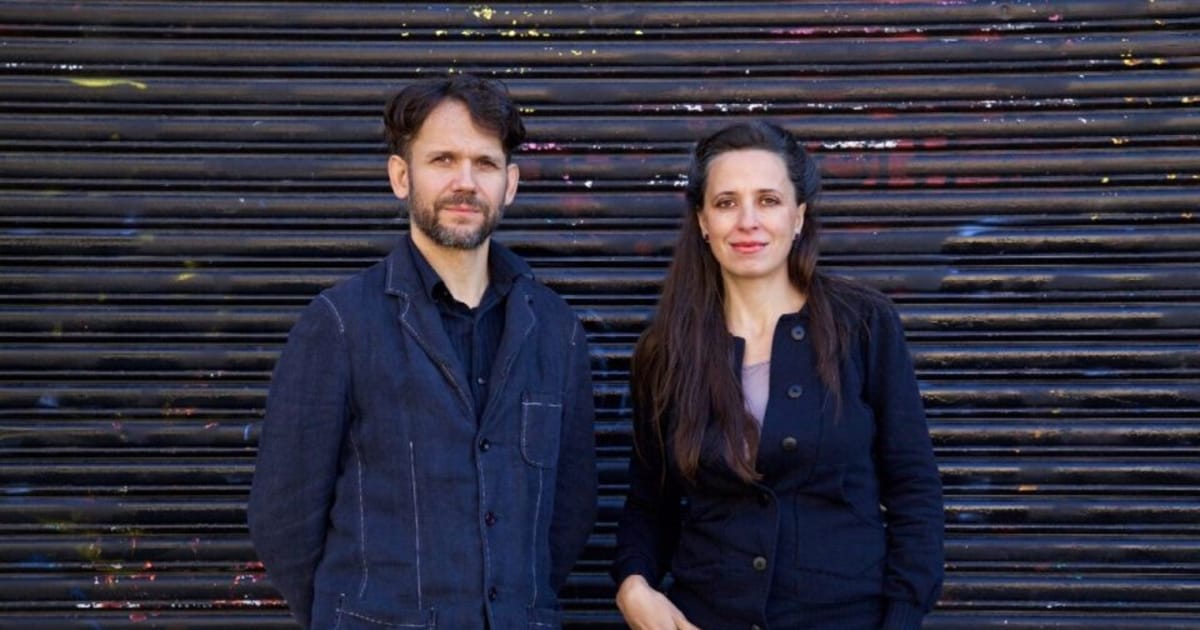
Could you tell us a little bit about your journey that brought you from the Czech Republic all the way to Brooklyn and what that was like 22 years ago?
Milde, Looking for a Home, catalogue front page|Photo: © Kristýna and Marek Milde
Kristyna: “Well, our journey actually started earlier than that, because before we came to New York we had already spent seven years in Germany and Switzerland. But we always felt like we really needed this American experience. We visited several times and we fell in love with the city — and also with the nature here.”
Marek: “Our first out-of-home experience was in Switzerland, where we had a happy life. We spent almost seven years in Switzerland and Germany. And this German environment is a very organized culture — everything works, everything is functional and beautiful.
“However, at some point it may also feel a little stale, a little slow, and limited. And of course, in your early twenties, you want to see what the world really is.
“On our visits to New York we always felt the energy — very excited by the bounty of cultures and by what was happening in the cultural sphere. It was incredible. We were artists before, but each with a separate practice. Living in New York somehow brought our partnership into a creative one. Since 2011, we’ve worked together as a duo. We develop our projects together, and that brought a big change into the way we see and do art.”
Can you touch on how New York has shaped you as artists?
Milde, A la Cart, DUMBO, Brooklyn 2014|Photo: © Kristýna and Marek Milde
Kristyna: “As we mentioned, New York is such a diverse place with a lot of energy. But we were also strangers in a new land. What felt important for us was looking for roots and connections — not only at home, but also back to nature. That’s how we grew up. We both spent a lot of time outdoors with our families, and we keep doing that with our son Adam.
“We keep looking for ways to connect these places that look very divided, but in a sense are deeply connected — and can’t exist without each other.
“Many of our projects use objects that are man-made. For example, in our recent show at Kunsthalle Praha in 2025, we had a real New York yellow taxicab that we planted with a Czech-American forest. We love incorporating nature and the man-made together to create a collision of ideas that spark new perceptions.”
Kristýna and Marek Milde: Volání lesa (The Call of the Forest)|Photo: Vojtěch Veškrna, Kunsthalle Praha
How would you say you integrate your Czech identity into the new New York identity you’ve created for yourselves?
Marek: “You can never deny where you come from. Even after decades here, we’ll always be Czechs. And Brooklyn lets you do that — you can be yourself. We’re both from Prague, so we maintain our Czech bubble at home. But we’re surrounded by hundreds of other bubbles; so many nations live here.
Kristýna and Marek Milde, Homescape, 2014|Photo: © Kristýna and Marek Milde
“I never thought national origin — specifically being Czech — would be a theme in my work. But identity became important. Once you stop being a tourist here, you may feel a little displaced. I was surprised to feel homesick after seven years abroad prior to living in Brooklyn. I never expected homesickness to happen in New York, but it did.
“I realized I needed not only a connection to the city or community, but a wider context. For me, finding roots here in the New World was through nature. When I discovered the beautiful countryside — very strong nature, much stronger than in Europe — I started to feel at home.
“And finding plants I grew up with was comforting. Some plants were brought from Europe during the colonial era and became naturalized here. Encountering them created a feeling of home.”
Kristýna and Marek Milde, Cabinet of Smells, 2015|Photo: © Kristýna and Marek Milde
Kristyna: “Yarrow, thyme, and St John’s wort are all plants that were brought here.”
Marek: “We created a project called Plantarium — a garden made from large Corten Steel pipes planted with European herbs and weeds that now grow all across America. They can be considered invasive, but they are fully naturalized. And interestingly, Native Americans didn’t see them negatively; they immediately used them medicinally.
“These gardens frame nature and offer perspective. We’ve created several such installations.”
Can you give us an example of a few other projects you’ve done in New York?
Lost and Found Gardens of Manhattan|Photo: © Kristýna and Marek Milde
Kristyna: “We had a project at the Westport Art Center called Lost and Found Gardens of Manhattan. Over the years, we gathered household plants — many tropical — and created a garden framed by a flying carpet. We planted them inside the carpet, reframing the home as a tropical forest. We also pointed out how houseplants originate in rainforests where some are almost extinct — yet they thrive in our homes.”
Marek: “Another project was in a public space in Brooklyn, near the Brooklyn Bridge, called A La Carte. It was a community project where we invited local residents who were interested in gardening but had no experience or opportunity.
“This installation was a structure out of supermarket shopping carts filled with soil, where people could grow plants for their favorite dishes. We did this for a season and we thought it would fail because the area was so crowded and busy, but people kept coming and the plants thrived. In the end, we had a nice dinner together.”
Kristyna: “And also part of this project was a display at Smack Mellon Gallery — a farm-to-table installation. We had a blackboard with menus, but instead of prices we listed the number of days it would take to grow each dish. The longest was ratatouille — eggplant takes around 180 days to grow.”
à La Cart|Photo: © Kristýna and Marek Milde
Marek: “Certain dishes took 60 days. The project served to recall people’s sense of what it takes to bring something to the table and the time it takes. And it was great that we didn’t have any vandalism.”
Kristyna: “The only thing was a restaurant guy who was also part of this project kept taking mint from the cart for mojitos.”
What is it like to work together? How do you balance your individual voices versus the shared vision, and does that ever clash?
Kristyna: “I think what’s an advantage of working together is that both of us have different skills. Marek is really great at building — he has great visions and ideas. I’m more the day-to-day person pulling things through. When one of us has an idea, we bounce it off the other. If it passes our critical discussion, the project already has a certain quality.
“There are clashes, but we are both passionate about what we do, and that always helps us come to a conclusion.”
Marek: “Sometimes in the arts, as a creator, you don’t have a problem with what to do, but with what not to do. That dialogue we have together is helpful. As individuals with egos, you have to step back sometimes. We didn’t always work together, but even before collaborating officially, we constantly helped each other.”
Kristyna: “Once we started working together, we were able to focus more on large-scale installations. One installation in 2011 was The Living Room at the Queens Library, created entirely from found objects. The idea came from how we furnished our first student apartment. New York is so dynamic — people move constantly, and they throw things out that you wouldn’t, for example, find in Prague.”
Smack Mellon Gallery|Photo: © Kristýna and Marek Milde
Marek: “Very nice furniture — high quality — in the garbage. You can basically furnish an entire apartment this way. It made us question consumerism: how things are produced and immediately discarded.
“Objects used to have history and were passed through generations. Now consumer goods disappear quickly. So we started to see narratives in common objects.
The installation was functional — visitors used it as a lounge — and then realized it was an art installation about the cycle of things.”
What is the process from start to finish?
Marek: “One of the main things in our practice is collecting resources — ideas, objects, and materials related to a theme we’re interested in. In the initial phase, we usually don’t know where it will go.
“In New York, you find books left neatly on doorsteps with ‘free’ signs. We collected these books for years. They often came as small collections, and we started thinking of them as portraits of the person who discarded them. We kept each set in the exact order we found it.
“We built a bookcase sculpture with a library identification system and invented fictional names for each collection.”
Milde, A la Cart, 2014, Smack Mellon, Galelry, DUMBO|Photo: © Kristýna and Marek Milde
Kristyna: “There was ‘Astronomer from the Upper East Side,’ ‘Fantasy Junkie from Bushwick,’ Bibles, Atlas Shrugged — you name it. It was fascinating to see what the city contains and what stories appear through these small gestures of throwing books away.”
Marek: “That’s the city — a portrait of the people. It’s not about the big buildings here; it’s about the people.”
Kristyna: “Definitely. Foraging in the city and foraging in nature — these are the two activities that spark the beginnings of the discussion, and we see where it will lead us.
“Another project we just finished for Kunsthalle Praha was inspired by riding the subway in New York. We saw all these tree tattoos people had and started to think about how they bring nature with them in the city — kind of like mobile gardens — and how it would look if you put them all together living in the city.
“So we did an open call where people sent us pictures of their trees, and we created an animation of a forest. You could connect the people, the social structure, with the ecosystem of the forest. For us, they are very similar — they connect together to create something much greater.”
How did it feel bringing that exhibition, Call of the Forest, back to Prague — back to your homeland?
Kristyna: “The Kunsthalle is in the middle of the places where we grew up. I grew up in Malá Strana and Marek in Prague 7 and Letná, and this is right in the middle. It was emotional — just dropping off Adam at my mother’s and going to work at Kunsthalle.
“The whole team was incredible; they gave us great support. The response was very positive. For me, it was rewarding to find out that some people went to see the show three times. That was very moving.”
Do you observe a difference in the way your art is received with Czech audiences versus audiences here in America?
Kristyna: “I think it was interesting for the Czech audience to see the American New World through Czech eyes. That’s maybe a kind of translation.”
Marek: “Definitely. In Prague, people were curious to see what comes from America, or what Czech expats do, and what our perspective is.
New York|Photo: Radio Prague International
“Here in New York, people are more interested in the themes we work with. It’s not so much about the fact that we come from Czechia, because in New York everyone is coming from somewhere. National origin isn’t really the theme. People open up to your work if they’re interested in the themes.”
Kristyna: “Americans are not afraid to approach you, ask questions, and be analytical and critical. That helps move the topics forward.”
Do you observe a difference between the Czech artistic community and the artistic community in America, or New York specifically?
Marek: “Primarily the size. In Prague, the group dynamic is very strong, creating a lot of pressure to fit in. Here, you can really find your tribe, and you don’t have to care so much about fitting into a large general group — because you can’t.”
What’s next for you? Do you have any projects or themes you’re curious about exploring?
Kristyna: “One of the projects we are working on right now is a continuation of the project we did at Kunsthalle Praha — the New York taxicab. As I mentioned, there are trees growing out of it, and we would love for this project to continue living.
“We are currently exploring possibilities of placing it permanently somewhere in the Czech Republic — we’re looking at the Krkonoše region. The idea would be for the car to sit in the forest, allowing the trees to grow large-scale and show the power of nature.
Kristýna and Marek Milde: Volání lesa (The Call of the Forest)|Photo: Vojtěch Veškrna, Kunsthalle Praha
“We feel that in the last few years people have been very afraid of the fragility of nature, but we believe nature can revitalize itself and find its roots even in a new environment.
“We’re also working on some private commissions — site-specific installations in upstate New York.
“Being an artist is very complicated. You have to have passion. We were both looking for something else to do, but there is so much in us that it was clear we had to continue.
“If you are not 100 or 200 percent sure, then don’t do it. Consistency helps — developing firm ground and following what inspires you. And of course, you have to be good at documenting your work, writing about it, and promoting it to the public.
“Eighty percent of my time is spent organizing things; if 20 percent is doing the art, it’s a treat. Many people don’t realize how much of a business it really is. But New York is great — and if you have the guts to come, come here.”
And to leave our audience with one last note: what are the feelings and thoughts you really hope to provoke with your artwork?
Kristyna: “The materiality of objects is always very important. It goes against the virtualization of the world. We’re trying to bring people back to being grounded and connected.
“Many environmental projects today are alarming and show the fragility of nature. We try to strengthen the connection to nature instead. If people are aware of and sensitive to the environment, it will guide decisions in the right direction.
“We want to make a positive statement with our work because the world is already shaking, and we need a steady place where we can walk into the future.”