
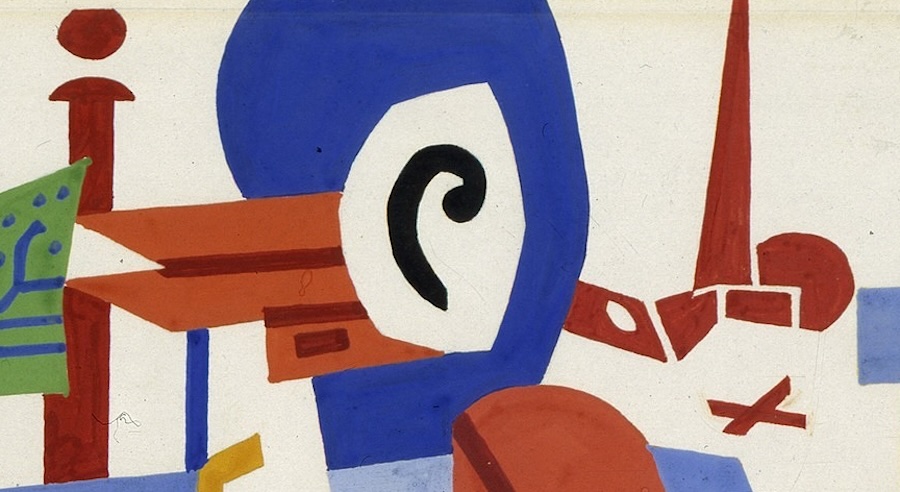

Illustration by Stuart Davis
In his victory speech, Zohran Mamdani vowed to put forward “the most ambitious agenda” New York City had seen since the administration of Fiorello La Guardia, whom he’s unhesitatingly named its greatest mayor. Fans and pundits have frequently wrapped Mamdani in La Guardia’s mythic mantle: La Guardia too was a courageous maverick bent on delivering an honest government devoted to the welfare of the people and a man determined to provide New Yorkers with affordable housing, clean streets, and reliable public transportation.
His accomplishments during his three terms as mayor were legion. Speaking out against cronyism and political hacks, La Guardia appointed highly competent, seasoned commissioners, from both parties, to an utterly bipartisan government. Under his watch fourteen new health centers and nine new child health stations opened, fourteen new piers and two sewage disposal centers were built, the city charter was revamped, the subway system consolidated, and, with the assistance of the New Deal, a huge public works initiative boldly launched, which included hundreds of new parks and playgrounds and more than a dozen swimming pools, hospitals, and schools, plus a public high school for music and art, a new center for the performing arts, and two municipal airports. As a crusader for housing reform, he also established the New York City Housing Authority to provide sanitary, well-ventilated, and modern living spaces for lower- and middle-income families.
“To the victor belongs the responsibility of good government,” La Guardia liked to say. He meant it. So does Zohran Mamdani, whose campaign promises—from universal childcare to safer streets to accessible transit—all provide an optimism that shines through these darkening times. For like La Guardia—a tireless campaigner—Mamdani has been able to incarnate the wishes and dreams of the city’s polyglot citizenry and give voice to its desire for a livable place where all are welcome, respected, and where opportunity exists for each and all.
But in less exalted language, let’s face it: many of the comparisons between Mamdani and La Guardia seem naive or overblown or at least premature. La Guardia had, for one thing, a lot more experience than Mamdani. By the time he entered City Hall, at the age of fifty-one, he’d already been elected seven times to the US House of Representatives. With wit and fury, he’d flayed Prohibition, immigration quotas, monopolies, and corporate greed. “There are other streets and other attitudes in New York besides Wall Street,” he shouted in 1924. “I speak for Avenue A and 116th Street instead of Broad and Wall.” He’d also been elected president of New York City’s Board of Aldermen, where he encountered firsthand the Byzantine and outdated structure of city government—so that he knew, when he became mayor, where the bodies were buried.
What’s more, La Guardia was definitely not a socialist, no matter who wants to enlist him. He was, to say the least, politically mobile, though for most of his life he remained a Republican—albeit an insurgent, progressive one. In 1924 he did run for Congress as a Progressive, and the Socialists put him on their ballot line. This surprised him; he had always stood apart from the Socialist Party and, in fact, during an earlier congressional run, during World War I, he had smeared the Socialist candidate Scott Nearing, a pacifist. La Guardia called Nearing a poet, not a politician, adding for good measure, “One must be color blind to call an American Socialist a red; they’re not red; they’re yellow.”
Then when La Guardia was elected mayor almost a century ago, in 1933, he faced a crisis not of affordability but of survivability: the city was on the verge of bankruptcy. Unemployment was skyrocketing; about six thousand people were selling apples on the streets, and there were shanties along Riverside Drive sheltering the homeless. To help the city—and not just help but inspire it—La Guardia depended on his relationship with President Franklin Delano Roosevelt and the entire Roosevelt administration. Mamdani knows this only too well, having referred to La Guardia after he met with Donald Trump: “You can’t tell the story of La Guardia without telling the story of F.D.R.” Likely, we’ll be telling the story of Mamdani by telling the story of Donald Trump.
Yet, on balance, the engaged and engaging Mamdani does share with La Guardia that special, almost incandescent quality which brings hope to a city mired in disillusion, ineptitude, and despair. “We need imagination at City Hall—imagination for the other fellow,” La Guardia had declared right after his first inauguration. “I have been accused of being an idealist in this matter; I propose to go right on with my idealism,” he continued with passion. “I know that now our ideals can be brought to reality.” That was La Guardia’s mission, and whatever his flaws or failings (we won’t go there now), he knew that putting a foundation under such optimistic confidence is never easy, never accomplished without compromise, never accomplished in full or in some cases even in part. But imaginative idealism, brought to reality and made foundational, is Mamdani’s mission too—and an end well worth fighting for.