
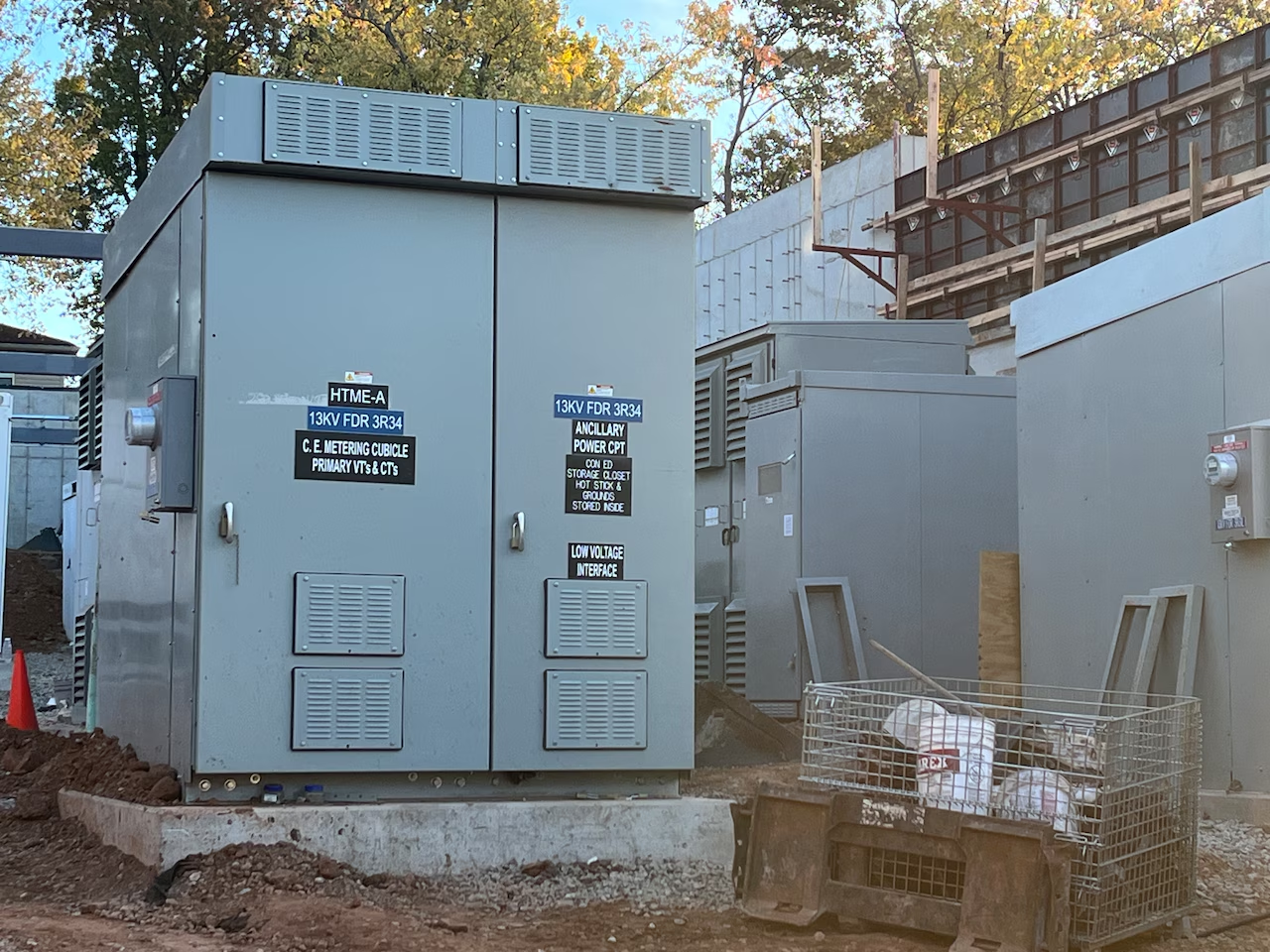
STATEN ISLAND, N.Y. — Applications for 58 battery energy storage systems were approved by the NYC Department of Buildings in 2025 and another 98 are currently under evaluation for placement throughout the five boroughs. According to DOB records, at least 15 of those BESS units are slated for Staten Island, with 10 additional sites under evaluation.
Reviewed by the DOB’s Office of Technical Certification and Research, the projects are in addition to the 11 BESS units already in operation in the borough. Upon reporting this data, the department underscored its extensive review process, which it said abides by FDNY regulations and safety standards.
‘Robust’ safety standards
The release of these numbers comes as a new set of BESS standards adopted by the State Fire Prevention and Building Code Council officially went into effect on Jan. 1, 2026.
“Battery Energy Storage Systems are key to modernizing our grid and optimizing power generation and transmission,” the New York State Energy Research and Development Authority noted in a press release, which detailed the updated requirements. “New York, through the work of its Inter-Agency Fire Safety Working Group, has implemented some of the most robust BESS standards in the nation — strengthening the reliability and resilience of our electricity system and prioritizing the safety of our communities.”
David Sandbank, NYSERDA’s vice president of Distributed Energy Resources, is a former solar developer who was a member of that Inter-Agency Fire Safety Working Group established by Gov. Kathy Hochul in 2023. He sat down for an interview with the Advance/SILive.com to detail how all NYSERDA-supported energy storage projects are contractually required to meet these updated codes and improved safety standards — which now include independent peer reviews and site field inspections.
“We took lot of best practices from the FDNY and what they’re doing in NYC and more broadly adopted them across the state,” Sandbank noted.
According to NYSERDA’s website, New York state’s BESS safety standards are reinforced by “stringent oversight and independent, third-party review.”
“New York State’s BESS codes are among the highest standards internationally and are designed to reduce risk while ensuring that in the rare case a fire does happen, it is contained and does not pose a threat to the facility’s host community or first responders,” the website noted. “This model has been successfully used by New York City to ensure compliance and safety across BESS projects throughout the City. If projects do not meet the standards, incentives are withheld, and the project is unlikely to move forward.”
Sandbank said that plans for each BESS are reviewed to make sure the product is being designed according to current codes and standards and noted that all BESS systems currently in operation adhere to the new regulations.
Fire incidents in Warwick, New York
He spoke of back-to-back fire incidents that occurred in Warwick, New York, in 2023 and indicated that the blazes were properly contained.
“Data has shown there were no known injuries and that air, soil and water had no level of contaminants,” he noted. “The incident was also contained within the fence line of the site.”
But on Dec. 19, after the Advance/SILive.com interviewed Sandbank, the same Warwick BESS site suffered a third fire, which took nearly 24 hours to extinguish. NYSERDA declined to comment on that incident, noting that the site is not one of its approved facilities.
A technology that uses a group of batteries to store electrical energy, allowing the energy to be released later when needed, the storage system sites — commonly referred to as BESS — essentially act as backup power sources for homes or the grid, particularly during peak demand or power outages. They are often used in conjunction with renewable energy sources like solar power.
Developers and green energy proponents tout the lithium-ion structures — which started popping up in several NYC neighborhoods in 2022 — as quiet neighbors that are a necessary agent for renewable change. They are designed to remove pressure from the city’s stressed grid, using rechargeable batteries to store electrical energy from various sources, and then releasing that stored energy when needed.
But over the past two years, Staten Island residents and borough officials have voiced concerns about their siting. Community Boards voted against their proximity to bakeries and storefronts and elected officials issued a moratorium on applications filed within residential districts. In one instance, an energy developer retracted plans to place batteries in a Bulls Head church parking lot.
‘Inherently unproven and dangerous’
Borough President Vito Fossella commented on the latest Warwick BESS fire, saying it should serve as a warning to NYC residents.
“For years, we have warned that BESS units are inherently unproven and dangerous, that if they catch fire they burn for days, and when they do they release toxic gases,” Fossella noted in a statement. “We have also warned that these facilities are prone to catch fire under a wide variety of circumstances, including water damage. Unfortunately, our concerns have once again been realized.”
Fossella is now calling for an amendment to both state law and city zoning ordinances to increase setbacks to 250 feet in business and industrial zones and 1,000 feet in residential and mixed-use zones.
“The safety of our residents and neighborhoods must come first,” Fossella concluded.