
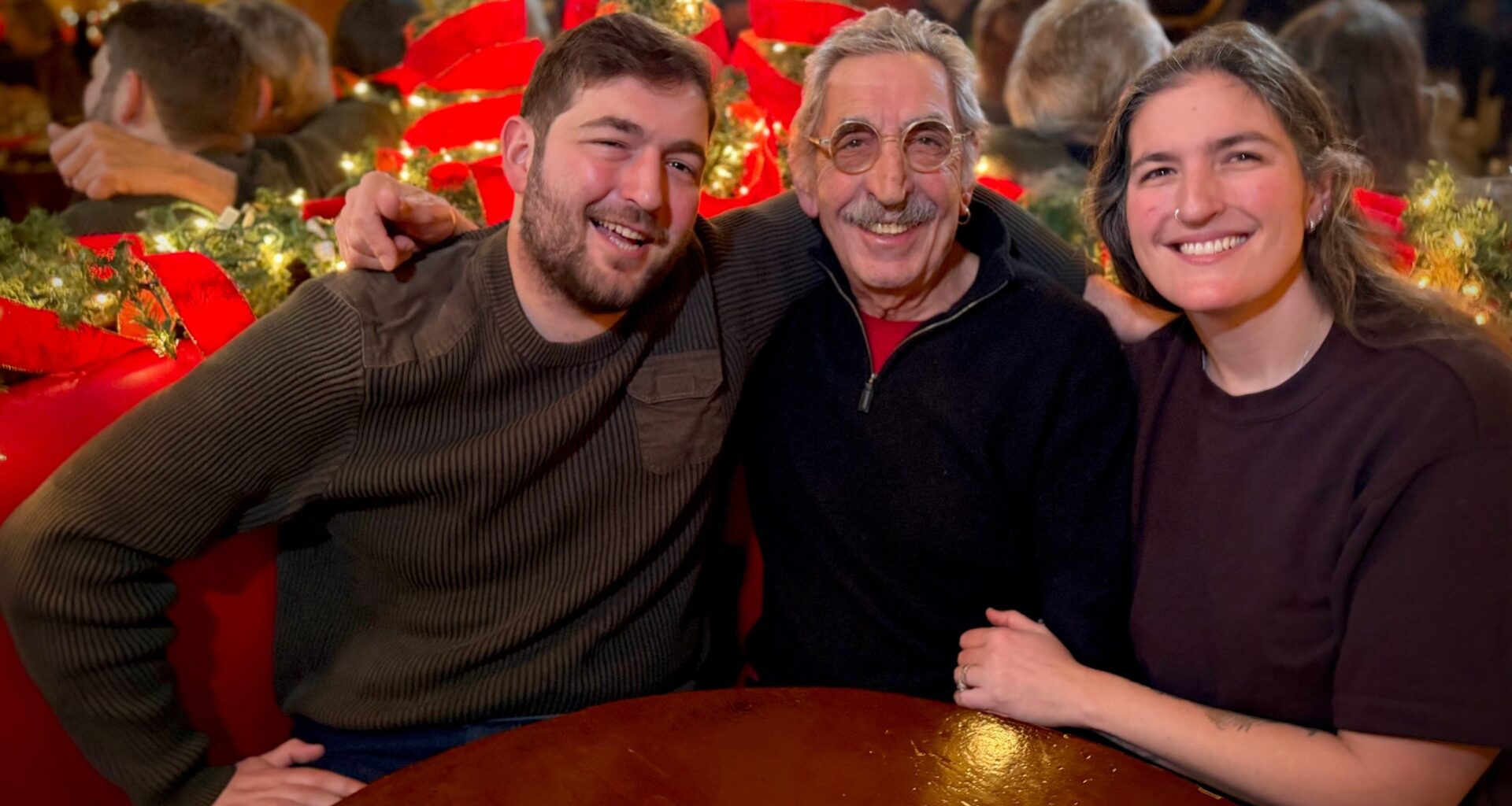
On the final weekend of service at Café Un Deux Trois, Georges Guenancia slid into a corner banquette and did what he’s done for nearly half a century: talked, listened and sized up the room like a man who has spent most of his life reading dining spaces.
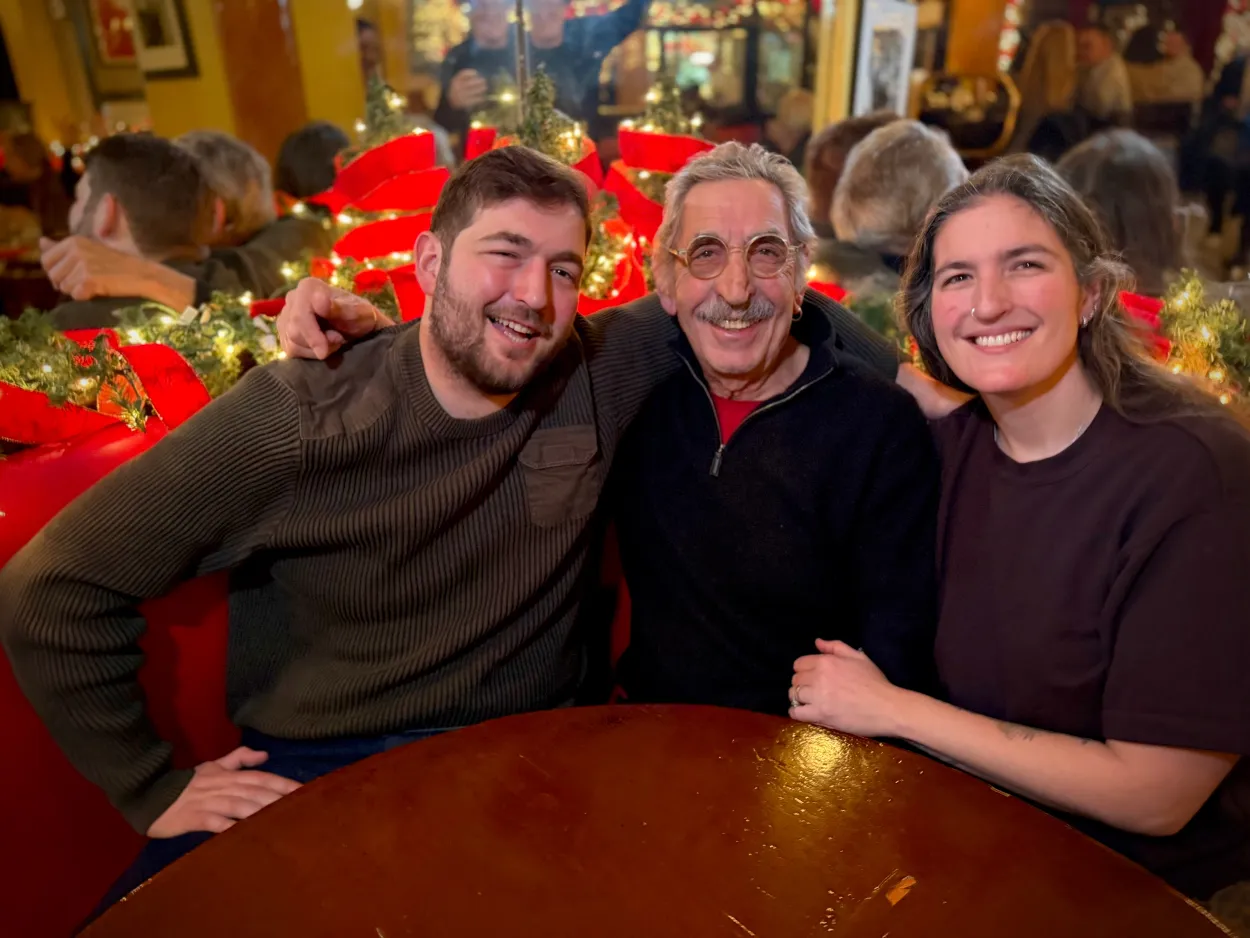 Georges Guenancia with son Charles and daughter Leila at Café Un Deux Trois for their final weekend. Photo: Phil O’Brien
This time, though, he wasn’t alone. Sitting with him were his two children — Charles Guenancia (now the guy behind Cubby’s, the burger spot on 10th Avenue in Hell’s Kitchen) and Leila Colbert (known to plenty of local parents for her work with the PS 51 PTA). They’d come to help tell the story — and, in a way, to help close the loop.
“Take me back to 1977. The year Café Un Deux Trois opened, ” I said. “I’ve only been here 13 years. I’ve heard it was rough.”
Georges didn’t romanticize it. “It was totally dead. Nobody here. Only at lunchtime were there a few people. Nighttime was very bad,” he said with his strong French accent. Even with Broadway nearby, people didn’t linger. “Nobody was coming, walking in Times Square after the show,” he recalled. “All the porn theaters. It was dangerous. So it was not a place to hang out.”
And yet, right there — at 123 W44th Street, in the scruffier Times Square of the late ’70s — he and his partners built something that lasted. The café was founded by two French entrepreneurs, Gérard Blanes and Georges, joined by American partner Michael Moorse (who died in 2021).
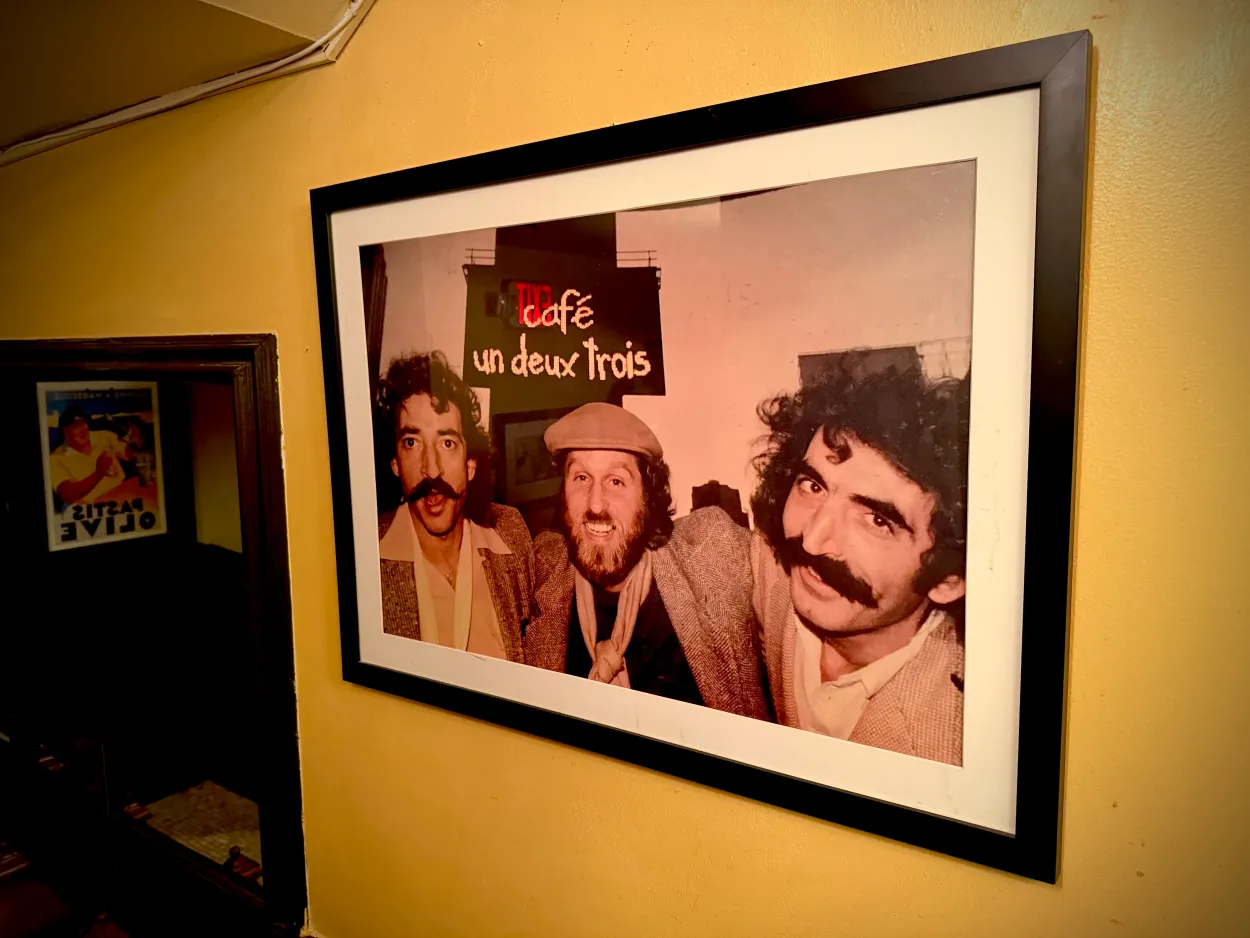 On display in Café Un Deux Trois — a photo of the owners (from left) Gérard Blanes, Michael Moorse and Georges Guenancia. Photo: Phil O’Brien
In Georges’ telling, though, the beginning is less about glamour and more about a friend spotting an opportunity. “A friend of mine told me the place was empty,” he said. “Asked me, if I wanted this… you can do a restaurant.”
Georges said the first couple of years were the toughest — and then, suddenly, the neighborhood shifted. “1979, it changed,” he recalled. Studio 54 had arrived just a few blocks away, and the late-night energy of the city started pulling “downtown people” uptown into the Theater District. “They were coming up for Studio 54,” he said, and with them came a new kind of crowd — the artists and scenesters who made the era feel electric, “like Andy Warhol.” The fabled artist became a regular at the café.
After that, the place quickly became a creative clubhouse, the kind of brasserie where actors, playwrights, stage crew and the occasional political heavyweight mixed with locals and tourists who wanted a slice of old New York. Over the decades, the café’s lore has included famous faces like Al Pacino, Bette Midler and Meryl Streep drifting through the door — part of that glamorous Theater District era when dinner reservations and curtain calls were stitched together.
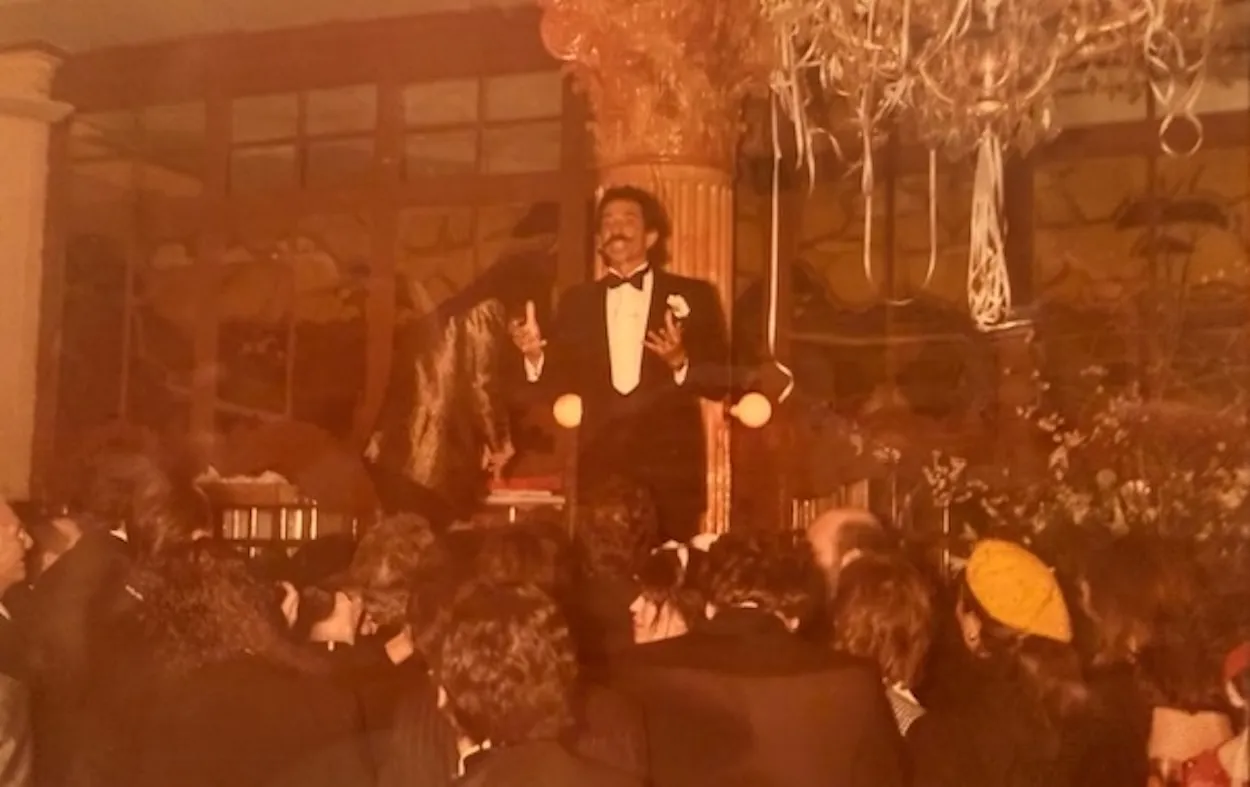 Charles Guenancia in earlier years speaking to a crowd at the restaurant. Photo supplied
Leila and Charles, meanwhile, remember a restaurant that doubled as a second home. Some of their best stories aren’t about celebrities at all — they’re about how the room itself seems to carry memory.
Leila recalled the tale that when her father and partners took over, one wall’s stained glass was hidden. “This wall of stained glass was covered… by sheet rock,” she said, pointing to the area behind the bar.
Charles chimed in that the family even pulled elements from the hotel next door when they could. Georges filled in the practical detail: “The hotel was empty.” Asked which hotel, he answered: “Hotel Gerard.”
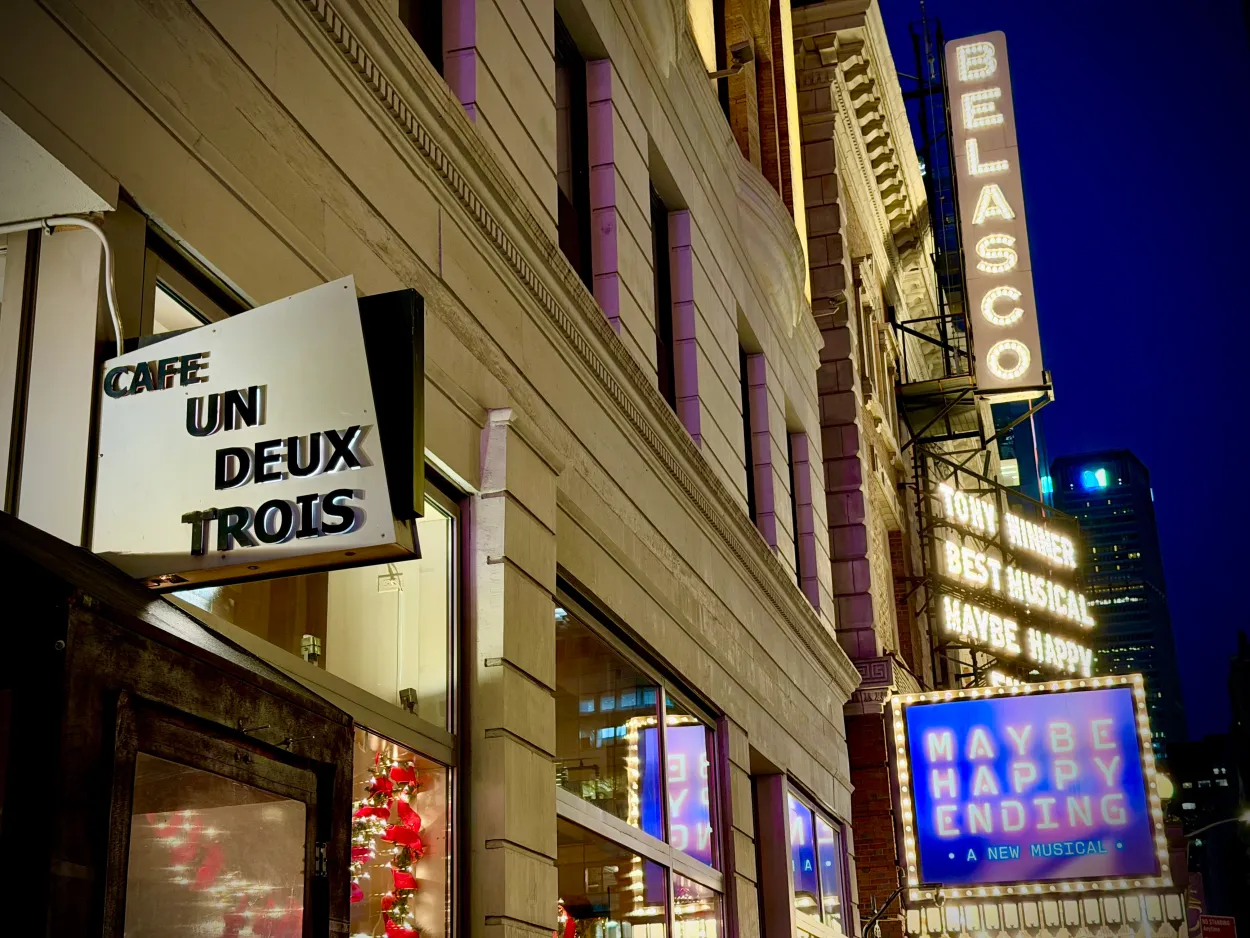 Café Un Deux Trois has been a mainstay of the Theater District since 1977. Photo: Phil O’Brien
Leila, who speaks with the affectionate precision of someone who has told these stories at family gatherings, also remembered looking up at the old ceiling — the “clouds” that longtime diners still talk about. Georges said the room once leaned hard into trompe l’oeil — the classic French “trick of the eye” style of painting, creating sky where there’s just plaster. But time and upkeep have a way of winning. “After 45 years, you have to change the decor,” he said, glancing up at a ceiling that’s now painted plain.
In a way, that sums up the Guenancia approach: keep the romance, but don’t get sentimental about the work. Because the work is exactly why the café is closing.
“Economically and financially,” Georges said, plainly. Then he delivered the line that made the whole decision feel suddenly unavoidable: “There’s no chance to keep a business that loses money every day.”
He described a pattern that will sound familiar to any restaurant owner in Midtown right now: the post-theater rush never came back the way it used to after the pandemic. “Nobody… after eight o’clock,” he said. “It’s curfew. Practically.”
Leila added the daytime version of the same story — offices that used to feed the lunch crowd are now part-time, hybrid and unpredictable. “The office culture in this neighborhood has changed so much,” she said, noting people are only in the office “part of the time.” Georges put it more sharply: “The lunch business doesn’t exist.”
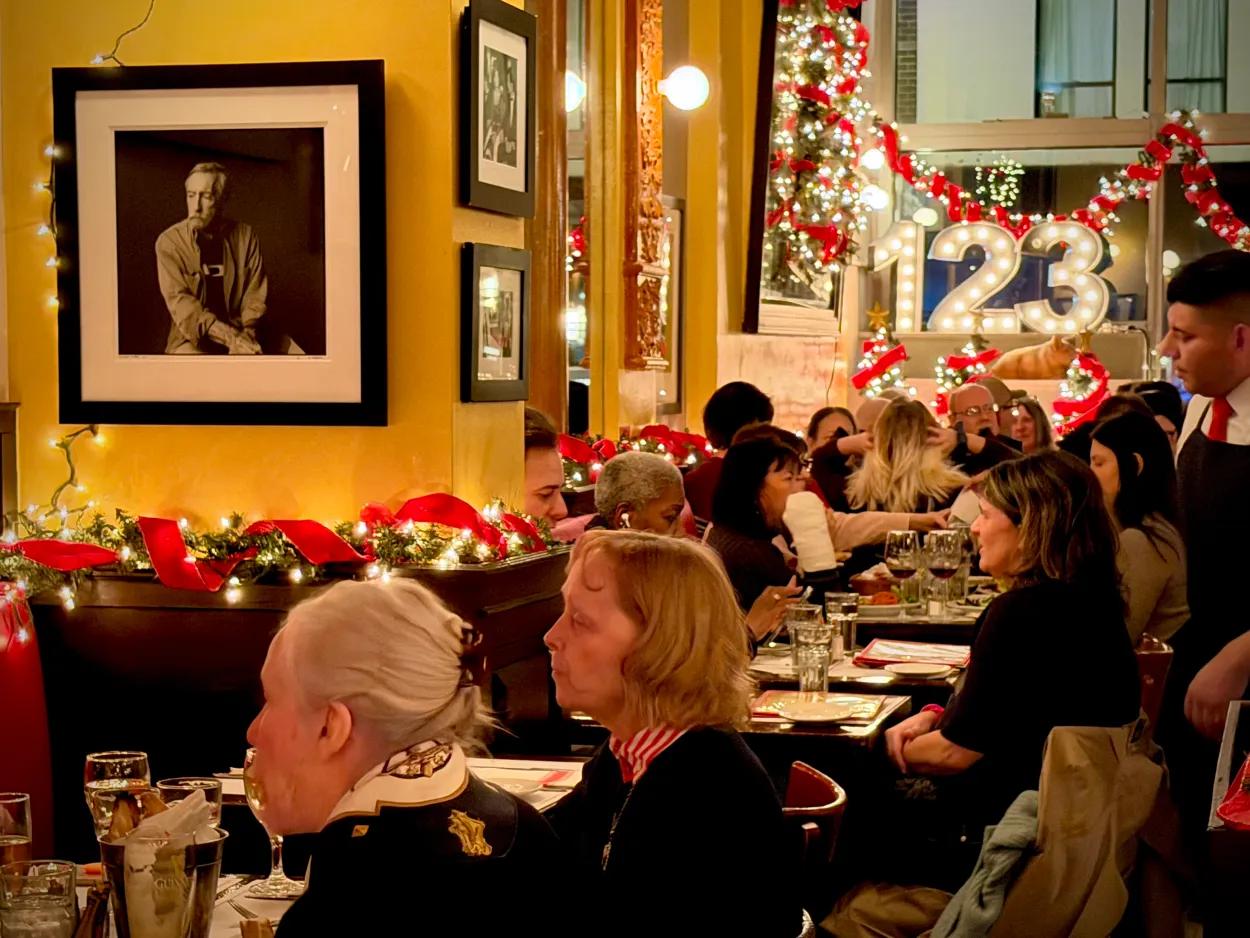 Diners take their places for the final weekend at Café Un Deux Trois. Photo: Phil O’Brien
He rattled off the new reality with a kind of weary clarity: desk lunches, delivery culture, a city increasingly built for “feeding people” quickly instead of lingering at a table. “This is the next generation of restaurant,” he said.
But sitting in that banquette, it’s hard not to feel what’s being lost is exactly the kind of place that resists the “next generation” logic. Café Un Deux Trois was always an in-between space: a restaurant, yes, but also a clubhouse, a staging area, a post-show decompression chamber, a family address.
Leila said it outright. “We moved a lot when I was a kid,” she told me, “and this has been my permanent address my entire life.”
Their milestones are tied to the room. Leila’s parents got married here, Leila got married here, and Charles got engaged here. And some of the family’s most vivid memories are smaller — and sweeter — than the big occasions. “On the day that my brother was born, I came here with my dad, and they had champagne at the bar,” Leila said, describing the restaurant as the place her family instinctively returned to in moments of joy.
Their celebrity stories land not as name-dropping, but as proof of the café’s strange, wonderful cross-section — the way a place like this can serve presidents, and still feel like home to the people who work it.
Leila remembered serving President Jimmy Carter and his wife at our table. “His Secret Service agents sat there,” she said, pointing across the banquette. Charles, laughing, offered his own brush-with-fame moment — the day he told Russell Crowe there was no reservation. “The maitre d’ had to tell me who he was,” he said.
And then there’s the story that seems destined to become the anecdote everyone retells when they talk about this interview: little Charles, sprinting around the dining room like he owned it (because, in a way, he did), approaching a table where two stars were sitting.
“I remember going up to Matthew Broderick and Nathan Lane… and being like, ‘Aren’t you that guy from Mouse Hunt?’” he recalled. The staff response, in the family retelling, was swift and unceremonious: a waiter would pick him up and “throw me into the trash… telling me to leave those two guys alone.”
Leila’s memories are equal parts sweat and sweetness — a reminder that growing up in a restaurant means growing up at full speed. She started at 14 working the door, on Wednesdays, during the “ladies who lunch” matinee crowd. She waitressed through college, managed Sunday nights because “nobody really wanted it,” and worked brutal holiday shifts where the money could carry you for months. She even remembered the old uniform — a vest that trapped heat, made sweat drip down her back, while the room turned three times.
As my questions ran out, I gave the kids the chance to put their questions to their dad, and the answers were perfectly on-brand for each of them.
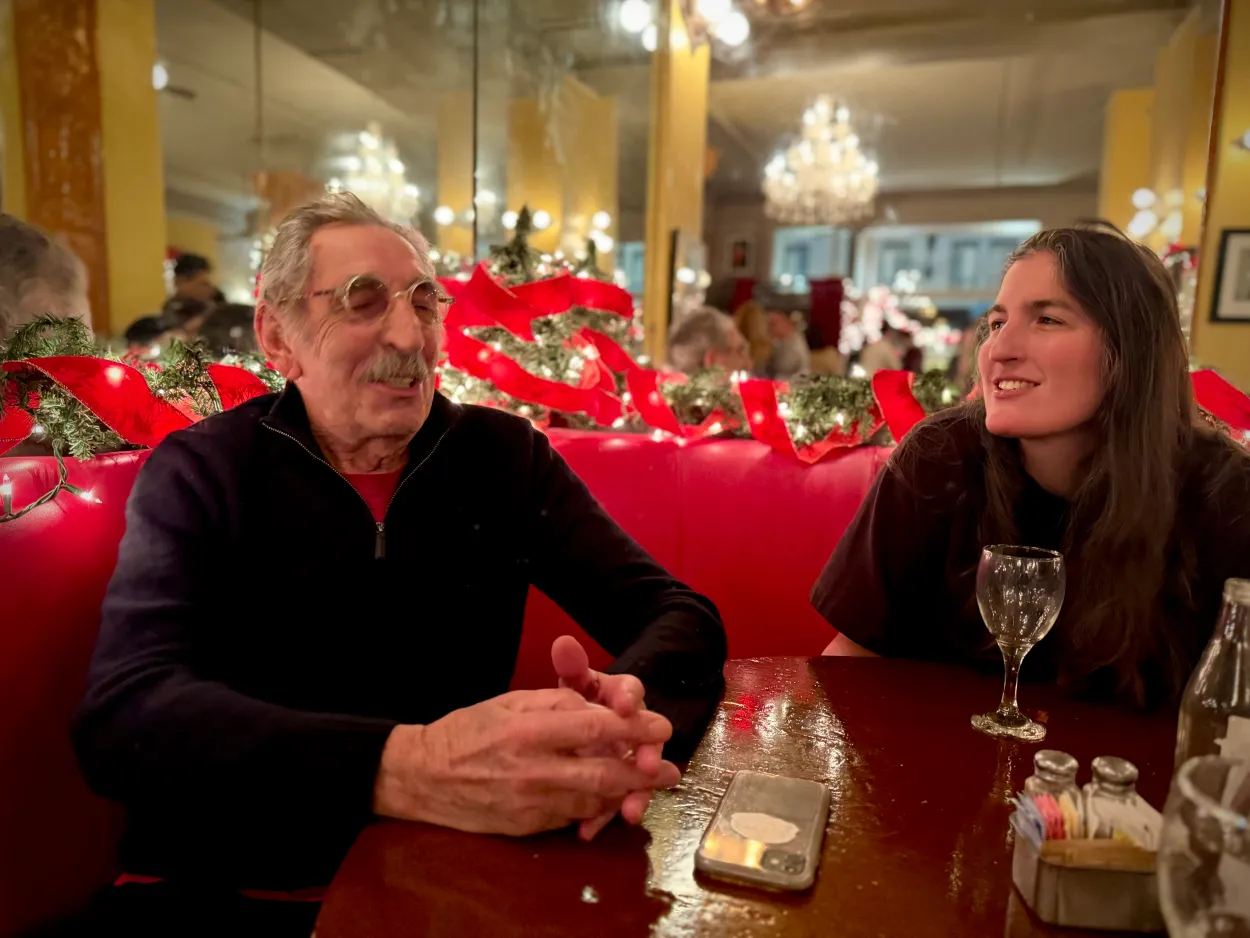 Georges and Leila chat about old times at Café Un Deux Trois. Photo: Phil O’Brien
Leila went for the personal, the funny, the thing only family can ask in public. “Can you clarify?” she said. “Was Frank Zappa ever here? Or was it you…?”
For the record: the café has lived for years with a running joke that Georges resembles the famous guitarist Zappa enough that strangers have asked for autographs. One story even has it happening on a plane, long after Zappa had died.
Charles, meanwhile, went straight to the food — and to the one dish that, in his mind, belongs to the café’s legacy as much as the room itself. “Where did you get the recipe for the Steak Tartare?” he asked.
Georges answered without hesitation: “A restaurant named the Lyonnais in Paris,” he said, explaining that Gérard was working there — “it was a good recipe.” Then, with the kind of dad-joke energy you only get when the pressure is finally coming off, Georges floated a crossover idea for Cubby’s: “Maybe a special burger at Cubby’s — a raw one.” Georges also offered to keep on serving up the recipe at home.
Asked what he loved most on his own menu, Georges didn’t pause: “Casoulet.” Asked about his favorite table, he was just as decisive: “Lunch table nine.” Leila filled in the daily ritual: “Every day around one o’clock, you could find my dad… having lunch” with at least a couple of friends.
That line matters because it captures what a place like this really is: not just a restaurant, but a schedule, a community, a life built around small repeatable pleasures — the kind you can’t replicate with delivery apps. And it’s also the part Georges sounds ready to finally let go of.
When I asked what changes now, after the restaurant closed for the final time on Sunday evening, he gave an answer that was part joke, part truth. “Babysitting,” he said — “I think I’ll be busy.” The family told me he plans to retire into something closer to a normal life: helping out where he can, spending more time at home, and yes, lending a hand around Cubby’s — but not standing over a grill flipping burgers. The idea is less “new project” and more “new rhythm.”
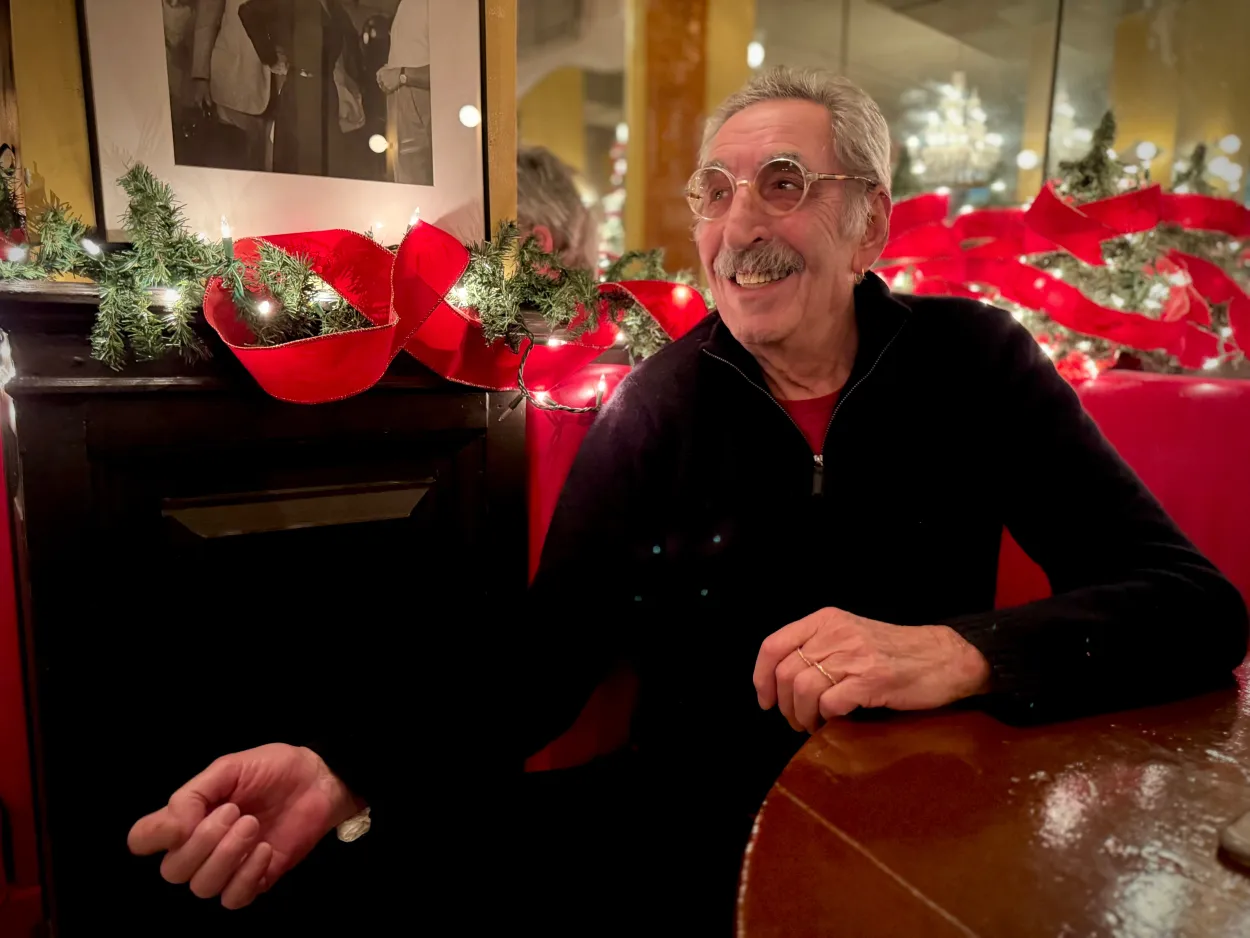 Georges Guenancia is looking forward to babysitting and lending a hand to Charles in his retirement. Photo: Phil O’Brien
I mentioned that I’d seen his wife, Yasmine, on my way in. “She said she was looking forward to having more years with you,” I told him.
Georges’ answer was honest in the way only exhausted people can be. “It’s very tiring this business,” he said. “When you go home, you think about your restaurant… I don’t have the strength to do that anymore.”
Then he circled back to what he’ll miss — the real reward. “Meeting and greeting people,” he said with a beaming smile. “That was beautiful.”
Last night (Sunday), Café Un Deux Trois closed its doors, ending a nearly five-decade run that began in a Times Square most New Yorkers today can barely imagine. But the story doesn’t vanish with the last check dropped on the table.
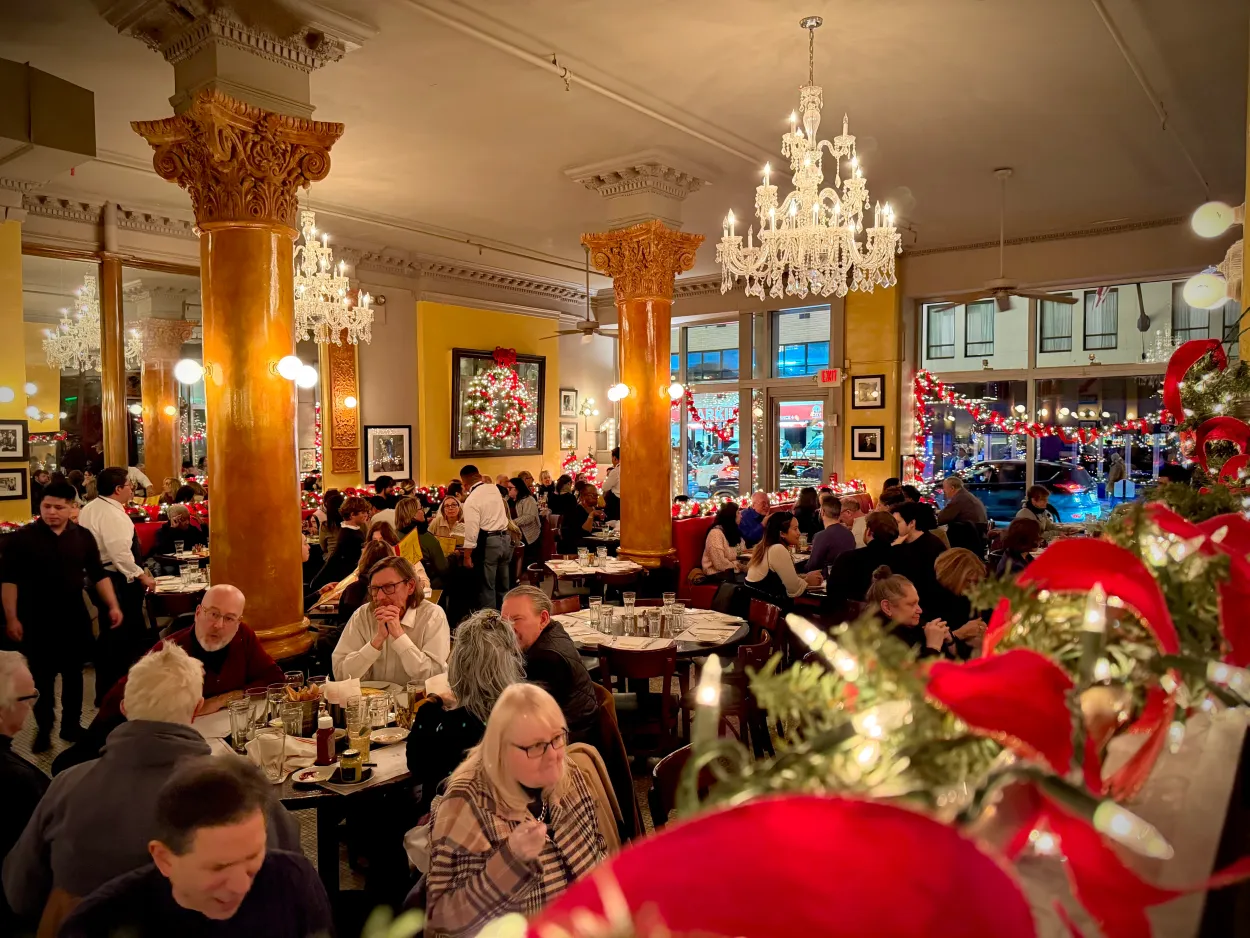 The dining room at Café In Deux Trois filled for one final weekend. Photo: Phil O’Brien
The family lives in Hell’s Kitchen. The next generation is in local schools. They’re part of the neighborhood fabric. And while Times Square loses a dining room that once fed a particular kind of New York night — the lingering, post-show, brasserie version — Hell’s Kitchen still gets the Guenancias in a different form: burgers and shakes on 10th Avenue, and a retired restaurateur who, by his own account, is about to be very busy.