
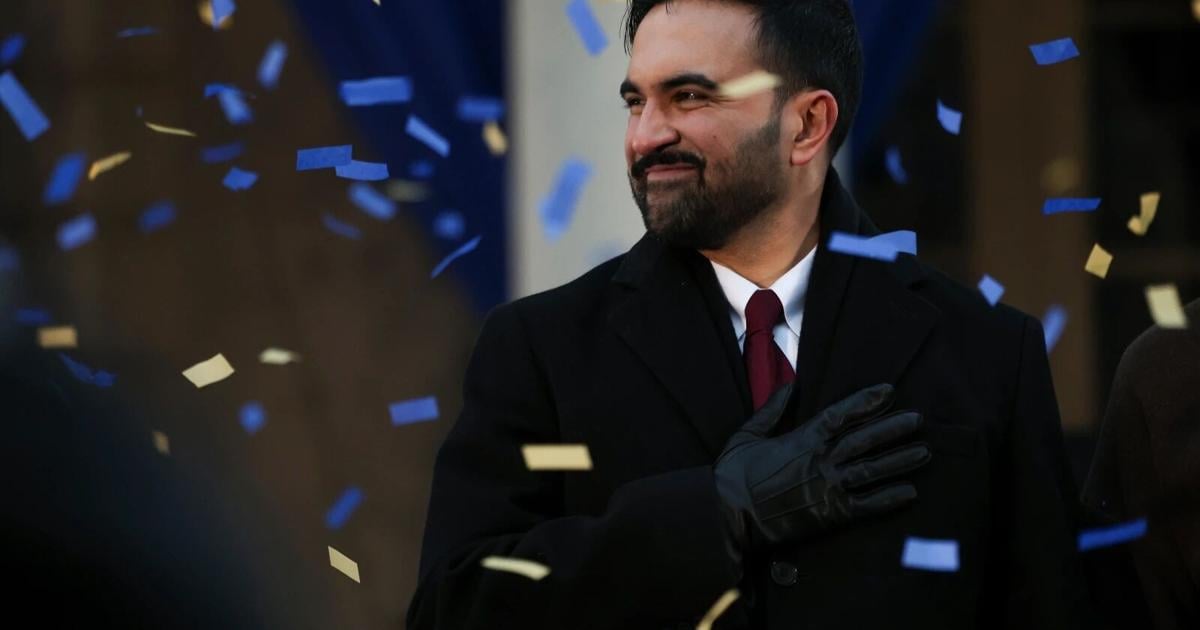
After a controversial campaign trail, New York City Mayor Zohran Mamdani took office on Jan. 1 and on his first day revoked all of the executive orders that his predecessor, Eric Adams, had issued since his indictment on corruption charges on Sept. 26, 2024, which included several designed to protect the Jewish community.
Mamdani, 34, the city’s first Muslim mayor, ran for office as a democratic socialist and, while on the campaign trail in which he promised to make the city more affordable, drew much attention for his critiques of Israel and public support of Palestine.
Under the guise of slashing all executive orders since Sept. 26, 2024, to free the city of any corruption by Adams, Mamdani specified at a Jan. 2 press conference that protecting Jewish New Yorkers will be a focus of his administration and that his axing of executive orders had given him a clean slate to get to work on delivering a “new era” for New Yorkers.
Jewish leaders, however, have not been easily convinced on Mamdani’s motive, who has previously said that he would have Israeli Prime Minister Benjamin Netanyahu arrested in New York City.
“On his very first day as @NYCMayor, Mamdani shows his true face: He scraps the IHRA definition of antisemitism and lifts restrictions on boycotting Israel,” Israel’s Foreign Ministry, @IsraelMFA, wrote on X on Jan. 2. “This isn’t leadership. It’s antisemitic gasoline on an open fire.”
Among the executive orders terminated by Mamdani were No. 60, which barred city entities and personnel from boycotting or divesting from Israel, and No. 61, which directed the New York City Police Department to look into creating zones around houses of worship in which protesting would be prohibited.
William Daroff, CEO of Conference of Presidents of Major American Jewish Organizations, told the Cleveland Jewish News that perhaps the most significant executive order that was slashed was the recognition of the International Holocaust Remembrance Alliance’s definition of antisemitism.
“The IHRA definition of antisemitism is the gold standard of definitions,” Daroff, a former resident of Shaker Heights, Ohio, said. “It’s been accepted by and adopted by literally two-thirds of the United States, hundreds of universities and sports teams, and over 30 countries around the world. What it does is it ensures that there is a commonly accepted definition of antisemitism, because in order to combat antisemitism, you need to be able to define it.”
According to the IHRA, antisemitism is defined as “a certain perception of Jews, which may be expressed as hatred toward Jews” – something that Israel has publicly accused Mamdani of.
“This is a definition that has been previously adopted by New York City, and for the mayor, on his first day as mayor, to rescind that executive order is incredibly troubling and is a sign towards where Mayor Mamdani’s administration will be headed,” Daroff said. “We have a lot of concerns about what’s motivating the mayor’s actions, and the Jewish community in New York City is feeling particularly insecure.”
At a time when Jews across the world, whether in New York City or across the world in Sydney, Australia, are being victimized in acts of antisemitism, Daroff said it’s important for elected officials to “understand that insecurity” and “give us an embrace.” The mayor’s actions on day one of his administration send the opposite signal, he said.
“Mayor Mamdani is definitely the flavor of the month for progressive Americans, and we are certainly concerned there will be copycat Mamdanis that will seek office throughout the country, and that Mamdanism will take off – and a key component of that, beyond free rent and free bus fare, is targeting key Jewish communal agenda items,” Daroff said. “We think it’s important for other elected officials and allies in the Jew community to stand up and say that Mamdanism does not work for them and that the components of that should be condemned by all.”
Although political fears linger amongst the Jewish community, Daroff said that all hope is not lost, as he commends those elected officials who are standing in solidarity with the community at their time of need.
“Political leaders and civic leaders should stand up and express their solidarity with the Jewish community, they should express their concern for the Jewish community, and they should be standing with us,” Daroff told the CJN. “That is what many across the country have been doing, including Cleveland’s own Mayor (Justin) Bibb who has stood strongly with the Jewish community, Gov. Mike Dewine who has stood strongly with the Jewish community, and Ohio’s two senators. That is precisely the sort of action that we demand and that we need.”
Mamdani, who said he wishes to usher New York City into a “new era,” will aim to address housing insecurity and affordability of transportation at the start of his term.
“I was elected as a Democratic socialist and I will govern as a Democratic socialist,” Mamdani said in his inaugural address on Jan. 1. “I will not abandon my principles for fear of being deemed radical.”
While Jewish leaders will continue to keep a close eye on Mamdani’s administration, Daroff offered a word of support for those with concerns.
“The American Jewish community (and the) Ohio Jewish community are unified today in a way that we have not been prior to Oct. 7,” Daroff said. “Certainly, Oct. 7 has focused the community on the issues that are important to us and on the need for us to stand together, and so despite what some politicians or elected officials may say, we as a community are stronger than we were and we will continue to be strong. It is through that unity that we make sure that we don’t just survive as a people, but that we thrive as a people.”