
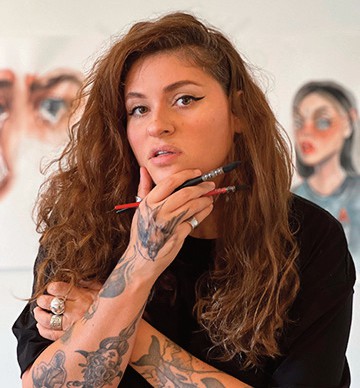

Born in Moscow, Russia, Lilu Goncharova is a visual artist and illustrator with over fifteen years of professional experience. She received formal training at an art college and university in Moscow, while developing her distinctive approach to figurative drawing independently. Her artistic practice centers on people—capturing emotional depth, inner states, and subtle human connections through expressive watercolor portraits.
Throughout her career, Lilu has worked as a freelance artist, illustrating books, creating original characters, and participating in exhibitions. Her artwork has been collected internationally, with pieces sold in Ukraine, Russia, Scotland, Great Britain, Italy, Germany, and across the United States. While human subjects remain central to her work, she also explores animals, landscapes, and conceptual themes. Symbolism plays an important role in her paintings, allowing each piece to communicate layered meaning and personal narrative. She regularly completes custom commissions, approaching each project as a unique visual story.
In 2022, Lilu relocated to New York, where she continues her practice as an illustrator and portrait artist, working primarily in watercolor. In New York, she actively participates in exhibitions that focus on revealing human emotion, resilience, and transformation through figurative art.
Lilu has lived in Queens for over two years and maintains a strong connection to the borough. She frequently creates commissioned portraits and artworks for the Queens community, including paintings of people, homes, and local architecture, reflecting the character, diversity, and everyday beauty of the neighborhood she now calls home.
NB: Other than the amazing diversity, what do you love most about living in Queens (or Queens in general)?
LG: I moved to Queens not that long ago, and it was almost the first place where I began my independent life in New York. Since then, I haven’t been able to part with this borough and choose housing only within its limits. I especially love the architecture and atmosphere of Forest Hills. There are many cozy houses and lots of greenery; it’s a quiet neighborhood full of fireflies in the summer and stunning winter landscapes before Christmas.
NB: What advice do you have for readers who are hoping to develop their artistic practice? Is artistic talent innate and/or can it be taught/developed? How important is daily practice?
LG: My advice: if you want to improve your artistic practice, become obsessed with it. I don’t believe in innate talent; what really matters is drawing every day and creating things you truly love. The most important part is finding what you want to draw: animals, landscapes, people––whatever resonates with you. Practice is essential, and discipline is a huge part of making progress. Most of all, love what you do, and everything will work out.
NB: How important is personal connection and communication (networking) in your industry?
LG: I’m confident that in New York, networking and social connections are an essential part of an artist’s journey. Even though I’m a shy and introverted person, the most important thing is to let the world know that you’re an artist and that you’re ready to share your work. People are genuinely interested in hearing about art––about your experiences and the stories behind how your paintings are created.
NB: What is the best piece of advice you’ve ever received?
LG: The best advice I’ve ever been given is this: no matter how good an artist you are, value your audience––the friends who support you and the clients who come back to you again and again. Without people standing in front of your work, no one will know who you are. No matter how much of a genius you may be, if you don’t have admirers of your art, chances are your work will never be seen.
NB: What are your favorite restaurants, cafes, theaters, bookstores, exhibits, museums, galleries, communities, and venues in Queens? Favorite places to exhibit your work?
LG: As I mentioned, I love Forest Hills. It has a main street, Austin Street, with lots of great food options: delicious Asian cuisine, Mexican food (Tacombi), a coffee shop with amazing cakes at Martha’s Bakery, and excellent vegetarian ramen at Kyuramen (yes, I’ve been a vegetarian for six years and I love diverse vegetarian food). I also really enjoy the Greek taverna Agora Taverna. I like having dinners in the Steinway area as well and often go to the movies near there; I even held a small exhibition in that neighborhood once, and I’m very fond of it. I also love the LIC waterfront––I often grab a coffee and enjoy the views of Manhattan.
I’ve exhibited many of my works in galleries in Williamsburg and in different parts of Manhattan. As an ambitious and highly driven artist, I’m happy that one of my paintings is currently hanging in Chelsea. It’s a very gallery-focused, highly artistic part of the city. I would love to exhibit my work in Queens as well, but there haven’t been many opportunities yet––I hope they appear in the future.
NB: What do you wish more people knew about being an artist and illustrator? What is something you wish you knew before you became an artist and illustrator?
LG: Honestly, I want to explain that being an artist is an incredible amount of work—multiplied by effort, time, trial and error, and knowledge. People often think, “She’s just doing what she loves, that’s not really a job.” But in reality, my work is built on patience and discipline. I spend countless hours drawing methodically. And being an artist isn’t just about drawing. I look for commissions, order frames, ship paintings, take part in exhibitions and various events, and manage my social media—there’s a huge amount of work behind all of that. Behind every successful artist are tons of mistakes, attempts, sleepless nights, victories, discipline, tears, and ambition. This is something that’s important to understand—and something I wish I had known before I became an artist.
NB: If you could choose only one illustration or piece of art to represent Queens, what would it be and why?
LG: That’s an interesting question, because Queens has a lot of murals and beautiful street art! Let’s focus on the mural dedicated to the Ramones— as far as I know, they lived in Queens.
NB: What is a typical day like for you?
LG: As I mentioned earlier, my day involves a large amount of work. I’m most productive in the first two to three hours after waking up, so I try to do most of my tasks before breakfast: making coffee, putting on a series, and working on commissions or shipping paintings. Later in the day, I contact galleries and update my portfolio. In the evening, I paint for exhibitions or practice new watercolor techniques. Dinner is usually spent with friends, often while continuing to promote my art.
NB: Can you tell us more about how your “artistic practice centers on people—capturing emotional depth, inner states, and subtle human connections through expressive watercolor portraits”?
LG: My art has always been about people and their stories, their problems. You know the Russian saying: “Happiness is the same for everyone. Grief is unique to each person.” So, I decided to draw different human emotions. I loved drawing eyes and facial expressions—people with broken hearts or those who are tired, people who long for their friends or have just been crying, people who have experienced depression or are unsure about their choices. These were very different portraits.
Now my art has become more abstract. I draw distorted forms and strange effects; I’m inspired by warped photographs and broken reflections. I draw more hands, legs, silhouettes, unusual poses—but these works are still very emotional, still about people and their inner states.
NB: How do you know when your work (or piece, or any type of art) is “done”?
LG: You know, this is something that comes with experience. At university they used to tell me: “Do you know what taste is? It’s a sense of measure.” And: “Remember, the best is the enemy of the good.”
When you first start drawing, you constantly ask yourself: “Should I add something to this painting?” But when you become a more experienced, established, educated artist, you ask a different question: “Should I leave this painting exactly as it is now?” I think it’s like a switch. At the end of the process, something inside you simply turns off the light, and you understand that it’s time to stop.
NB: Can you tell us more about how you “commission portraits and artworks for the Queens community, including paintings of people, homes, and local architecture, reflecting the character, diversity, and everyday beauty of the neighborhood”?
LG: Actually, everything happens very simply. I’m part of many Facebook groups in my neighborhood, and from time to time I just talk there about my paintings. And while commissions for portraits of people are easy to understand—they make great gifts for holidays and birthdays—I was surprised by the number of house commissions. In the Queens community, people truly love their homes and often ask me to paint them. I love working for people. I love painting their pets, their beautiful cozy houses, their loved ones. It feels to me like this is something that multiplies happiness.
—Nicollette Barsamian
The Local-Express interview series was originated on July 3, 2013 by Nicollette Barsamian.