

TARRYTOWN, N.Y. — I spent a good chunk of Tuesday’s off day working on this column, which included information on the fallout from Adam Fox missing the cut for the U.S. Olympic team.
I wrote that New York Rangers coach Mike Sullivan, team president Chris Drury and assistant coach David Quinn — all members of the American staff in some capacity — went to bat for Fox but were overruled by U.S. general manager Bill Guerin, according to a league source who was granted anonymity so they could speak freely about a sensitive issue. Fox heard the news directly from Guerin following last week’s 6-3 loss to the Washington Capitals, I was told, receiving the call shortly before the Rangers took off for the Winter Classic in Miami. Soon after, he had individual conversations with Sullivan and Drury, who, the source said, had kept him informed throughout the process. Another source who was briefed on the situation indicated the bulk of Fox’s ire was directed at Guerin, while admitting it’s hard not to wonder how the snub will affect his relationship with New York brass.
A few hours later, it all became an afterthought.
We had been anticipating news on goalie Igor Shesterkin, who sustained a lower-body injury during Monday’s 3-2 overtime loss to the Utah Mammoth and was unable to put weight on his left leg in a deflating scene at Madison Square Garden. It turns out he’s being placed on injured reserve, which beats the alternative of long-term IR, but a league source cautioned that we shouldn’t jump to any conclusions about a short absence. More time will be required to determine a potential return date.
What came out of nowhere was a text indicating Fox was the one being placed on LTIR with a lower-body injury. I responded by asking if that was a typo.
I noticed when Fox didn’t take the ice for the first shift of Monday’s OT but figured he was gassed and we’d see him on the next one. It never made it that far, with Utah defenseman Sean Durzi scoring the winner 1:06 in.
There was no obvious collision or incident, but from what I can gather, Fox felt something on a shift that ended with 59 seconds left in regulation. By Tuesday morning, the condition had worsened.
The surprising LTIR move puts the 27-year-old defenseman on the shelf for a minimum of 10 games and 24 days, making his earliest possible return date Jan. 31 in Pittsburgh. That’s the second-to-last game before the Olympic break, and while the injury isn’t considered season-threatening, there’s at least a chance we won’t see Fox again until late February or March if they play it conservatively. It almost surely rules him out as a potential injury replacement for Team USA.
As for the Rangers, I already wrote that missing Shesterkin for any length of time should serve as a nudge for Drury to go into sell mode. Fox’s injury only amplifies that message.
Even at full strength — something we haven’t seen very often this season — this team has clearly hit a wall. The Rangers entered Tuesday last in the Eastern Conference in points percentage (.523) and goals per game (2.59), with only two regulation wins in their last 15 games.
There are no Band-Aids or quick fixes for a roster that’s already proven to be too slow (as we saw again versus the Mammoth), too reliant on its goaltending (which just took a major hit) and severely lacking offensive punch (which suffers in a big way without Fox, especially on the power play). They were clinging to hope for a second-half rally, but that has been dashed now that they’re without their two best players for an undetermined amount of time.
Delaying the inevitable would threaten to set the Rangers back even further. Owner James Dolan went on WFAN Radio on Monday and preached patience while affirming his confidence in Drury, essentially giving the GM the green light to proceed as he sees fit. It’s time to take Dolan at his word and use the March 6 trade deadline to restock a bare cupboard with young players and draft picks.
Trocheck ‘not naive’ about his place on Team USA
In a video that was released by USA Hockey last week, Guerin was filmed calling each player who made the squad for the upcoming Olympics in Milan.
About four minutes in, Rangers center Vincent Trocheck can be heard on the other line saying, “Whatever you need, you know that.”
The inference was fairly obvious: The 32-year-old is willing to do any grunt work required to bring value to a team that had plenty of competition for the final few forward spots.
Trocheck is self-aware enough to recognize that some serious talent was left off the U.S. roster and sounded sympathetic to their plight while discussing his inclusion following Sunday’s practice.
“I’m not naive to the fact that I may not be the Auston Matthews, Jack Eichel, Jack Hughes type where I’m gonna dazzle with my skill and put up 100 points every year,” he told The Athletic from his locker at the MSG Training Center. “There were obviously some guys that were left off the list that have that in their game, and from a stats perspective, may have more points than (me). But I think the one thing that I was kind of falling back on and really hoping to make the team for was the intangibles that I bring.”
Guerin has repeatedly stressed the importance of building a complementary team rather than just a collection of all-stars, with Trocheck embodying that sentiment. He can’t match the production of Jason Robertson (24 goals and 25 assists through 42 games played) or Cole Caufield (20 goals and 20 assists through 42 games), who were both deserving in their own right. But Sullivan has referred to Trocheck as a “glue guy” who may be better suited as a checking fourth-liner or plug-and-play extra.
“I think that I play with an edge and a competitiveness that can help win hockey games — and meaningful hockey games,” Trocheck said. “At these types of tournaments, special teams go a long way. Being able to be on the penalty kill and do those types of things, I think, is part of the reason that I made the team.”
Another element that may be overlooked while picking names off the NHL leaderboard is cohesiveness.
Guerin, Sullivan and the U.S. leadership group believe the team they sent to last year’s 4 Nations Face-Off clicked on and off the ice, capturing a feeling of camaraderie that they wanted to tinker with as little as possible. That aided Trocheck’s case, as well as Rangers captain J.T. Miller.
“That’s something that a lot of the European teams have an advantage with, is that they get to play together so much more often, I feel like, and they have a ton of chemistry,” Trocheck said. “I think the teams are starting to realize that is a factor. If you’re able to keep guys comfortable and familiar with guys that they play with, in a short tournament like this where you have to get together and get ready for the games (quickly), I think that goes a certain distance.”
Perreault focused on ‘subtleties’
When it comes to the progress of top prospect Gabe Perreault, Sullivan is focused on what he described as “subtleties.”
He and the Rangers coaching staff firmly believe in the 20-year-old forward’s playmaking ability, but they’re closely monitoring how he looks away from the puck, on defense and in physical situations.
“One of his biggest strengths is his hockey IQ, and part of that process is figuring out how he could have success in those subtle circumstances that we’re talking about,” Sullivan explained Monday. “He’s an undersized guy. What strategies can he utilize to win wall battles on a breakout, on a rim, or puck battles in the corners? He’s not going to win pucks with physically overpowering people. He’s got to use his brain, his quickness, his stick skills. There’s an experiential learning process that he’s going through with respect to that. So I think Gabe is figuring it out, literally, with every game that he plays, and I think his hockey IQ is what’s going to allow him to do that.”
The Rangers initially valued allowing Perreault to work through those growing pains with AHL Hartford, where he’s appeared in 20 games so far this season, but the scoring deficiencies and mounting injuries of the NHL club necessitated two separate recalls. Sullivan thought he looked “overwhelmed” during his first stint in November, but he’s given the 5-foot-11, 180-pounder a longer runway since returning to New York in mid-December.
Perreault has appeared in eight of the last nine games, with mixed results. He carried a three-game point streak into Christmas break but looked a step behind against the speedy Mammoth.
He said the game is “starting to slow down,” but there’s a long way to go to reach the potential the Rangers see in their 2023 first-round pick. The key will be learning to navigate tight NHL ice and create enough space to let his offensive creativity take hold, which will require repetition and recognition. As Perreault put it, “You don’t really know what it’s like until you’re in it.”
“It’s kind of a mix of all those things: being more comfortable, more confident, knowing how to use your body and putting yourself in the right spot so you don’t get beat,” he added. “I’ve done that at every level. I’ve never been the biggest guy, so I was always kind of finding little ways to put myself in the right spot. I’m starting to figure that out.”
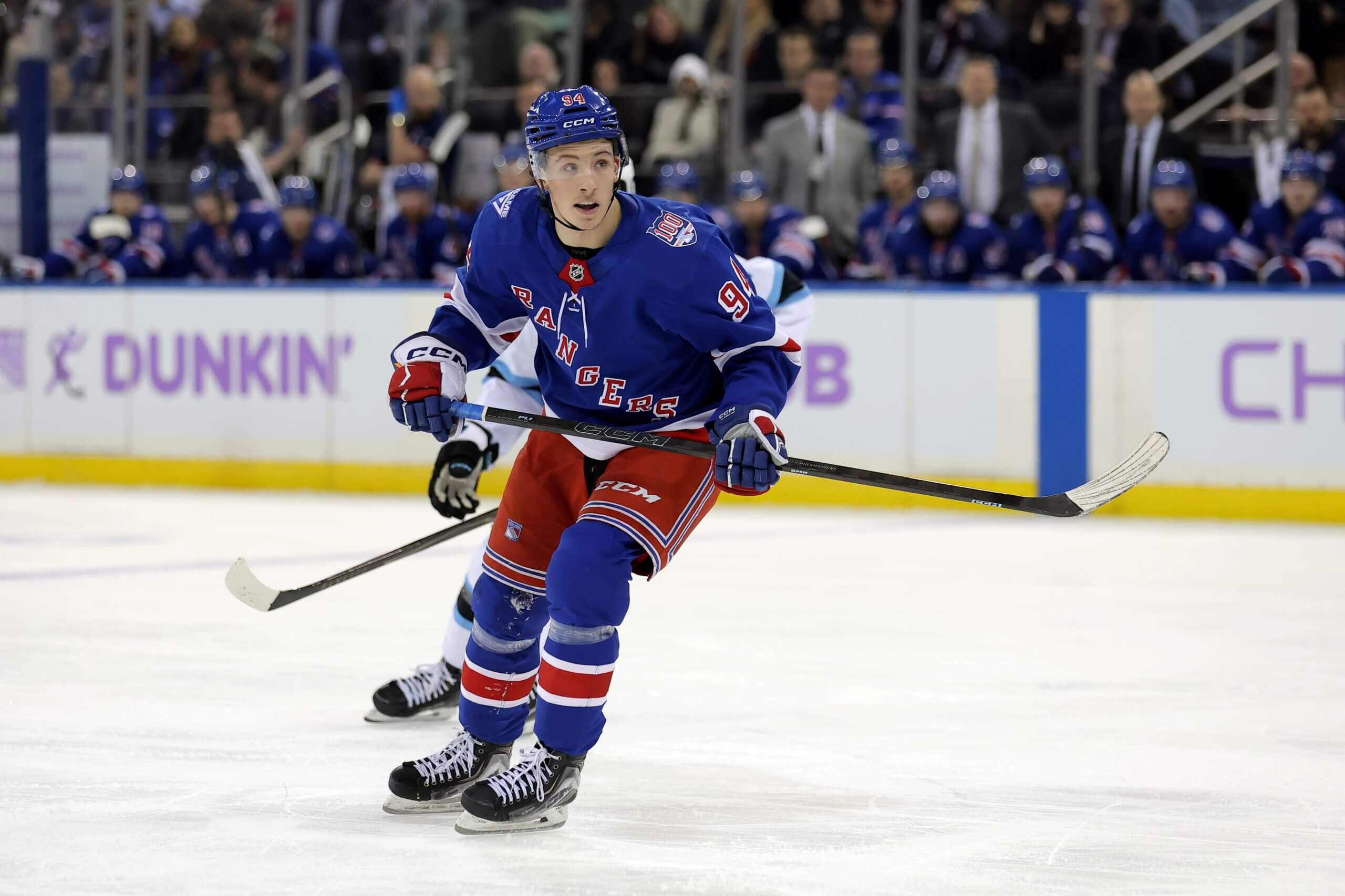
Gabe Perreault is slowly acclimating to the NHL with good results alongside Vincent Trocheck and Alexis Lafrenière. (Brad Penner / Imagn Images)
He’s recently been skating on a line with Trocheck and Alexis Lafrenière, with that trio producing a 61.27 percent expected goals-for rate, according to Natural Stat Trick. They hold a 13-4 advantage in high-danger scoring chances, but have yet to convert any into goals.
Perreault chalked some of that up to not “getting too lucky with our bounces,” which he believes will turn soon. He’s enjoyed playing with Lafrenière, with whom he relishes the chance to speak French, and lauded Trocheck as his locker-room mentor.
“Since I got here, he’s always kind of taking me under his wing and making sure I’m all good and talking to me a bunch,” he said. “Lucky enough, I’ve been playing with him, and I feel comfortable with him. He’s been really great since the start.”
Rempe ‘still has some limitations’
Early in Monday’s contest, Rangers forward Matt Rempe laid a big hit on Mammoth forward Kevin Stenlund and was immediately swarmed by Daniil But. A scrum ensued, but doctors have cautioned Rempe to avoid dropping the gloves as he continues to recover from left-thumb surgery.
It sounds like the 6-foot-9, 261-pounder may be restricted beyond just fighting.
“He still has some limitations,” Sullivan admitted following Sunday’s practice. “He’s still in the process of getting completely healthy.”
Rempe’s underlying numbers have been solid in 10 games since his return, with a 55.72 percent xGF that ranks fourth among Rangers forwards since Dec. 15. But he’s gone without a point in that span and hasn’t logged more than 9:16 time on ice in any contest. The 23-year-old was at 9:27 TOI or higher in every game before his injury, with the recent dip either a sign of Sullivan’s ongoing concern for the thumb or diminishing faith in his bottom six.
It’s probably a combination of the two, which calls into question whether Rempe should have taken more time to heal. It also speaks to the lack of depth and underwhelming alternatives throughout the organization.