
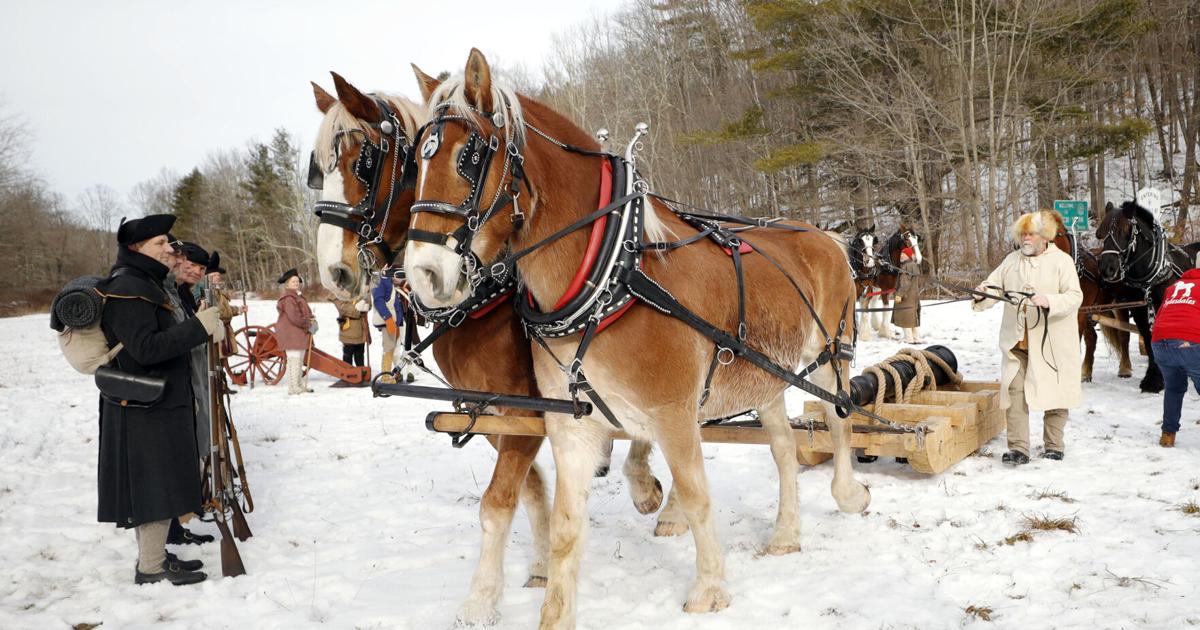
The crack of a cannon rolled across a snow-covered field on Saturday, as draft horses hauled replica artillery across the Massachusetts-New York line.
About a hundred people watched as a sliver of a 250-year-old journey to deliver captured artillery to Revolutionary War front was reenacted before them, and listened as speakers discussed the still relevant lessons of that treacherous journey.
“It was then, and remains now, an unfinished revolution,” said Daniel Mackay, New York’s deputy commissioner for historic preservation, as eight draft horses stood ready to pull replica cannons across the border. “The success of this event is convening for a larger realization of what that event means in contemporary times.”
A procession of Revolutionary War reenactors, fifes and drums and draft horses hauling sleds of replica cannons arrives at the Great Barrington Town Hall during the 250th anniversary celebration of Colonel Henry Knox’s Noble Train of Artillery that traveled from Fort Ticonderoga to Boston in the winter of 1775-1776.
STEPHANIE ZOLLSHAN — THE BERKSHIRE EAGLE
The event in question marked the semiquincentennial anniversary of Henry Knox’s “noble train of artillery,” the 56-day trek that delivered 60 tons of artillery from Fort Ticonderoga to the Boston area, ultimately helping to drive out British forces.
Each draft horse weighed about 1,800 pounds and the teams pulled wooden sleds built by New York state vocational students to the Massachusetts-New York border. There, the sleds were unhitched from the New York team and attached to Massachusetts horses, a recreation of how communities passed Knox’s burden from one to the next.
Revolutionary War reenactors then loaded a cannon. A reenactor told the crowd the replica was far smaller than the massive pieces Knox’s men hauled, some of which were 11 feet long and weighed 5,000 pounds each.
The cannon fired three times, and the final volley formed a vortex that sent a halo of smoke careening over the field. The crowd gasped, then erupted in applause.
In commemoration of the 250th anniversary of Henry Knox’s march to deliver artillery from Fort Ticonderoga to Boston in the winter of 1775-1776, local groups gather on the Hillsdale/Alford line to celebrate the feat with a reenactment of the march — firing rounds from a cannon and transferring the symbolic 60 tons of cannons from New York horse teams to Massachusetts teams at the border.
STEPHANIE ZOLLSHAN — THE BERKSHIRE EAGLE
A line of reenactors fired their muskets, then the four Massachusetts horses were loaded into trailers to be driven to Great Barrington, where the day’s events continued. There, participants marched from the Historical Society to the Mahaiwe Performing Arts Center where representatives from Western Mass. communities along what is believed to have been Knox’s route — Alford, North Egremont, Great Barrington, Monterey, Sandisfield, Otis, Russell and Blandford — continued to commemorate the event.
But before that happened, a series of speakers made their own remarks at the New York state line, where many invoked Knox’s unlikely triumph as inspiration for the challenges facing the country today.
State Sen. Paul Mark said the Knox expedition was born of a moment when people in the colonies felt their lives were increasingly being directed by a distant, overbearing power. He told the crowd the break with Britain wasn’t driven by a desire for war or even independence at first, rather by resentment toward being told how to live.
“In Massachusetts, we don’t like it when people who think they know a lot tell us what to do,” Mark said, drawing laughter. “No one sought war. No one was seeking to be a different country. All they were seeking was liberty, freedom, the independence to have a life worth living.”
Event organizers and local officials from New York and Massachusetts gave remarks at the 250th anniversary of Henry Knox’s march to deliver artillery from Fort Ticonderoga to Boston in the winter of 1775-1776. Every 50 years, local groups commemorate the feat with a reenactment of the march, transferring the symbolic 60 tons of cannons from New York teams to Massachusetts teams at the border on the Hillsdale/Alford line.
STEPHANIE ZOLLSHAN — THE BERKSHIRE EAGLE
So despite the brutal winter that blanketed the region in snow and ice 250 years ago, the expedition worked because the men believed that acting together made the obstacles surmountable, said New York State Sen. Michelle Hinchey.
“History has taught us the same lesson, that America moves forward when we work together, when trust outweighs fear, and when people — we the people — decide that our future is one worth fighting for,” she said.
An ‘unlikely’ hero
Knox was 25 years old when the events unfolded, a Boston bookseller who volunteered to retrieve artillery seized from Fort Ticonderoga and transport it about 300 miles to Gen. George Washington’s Continental Army.
A procession of Revolutionary War reenactors, a fife and drum corps and draft horses hauling sleds of replica cannons arrive at the Great Barrington Town Hall during the 250th anniversary celebration of Colonel Henry Knox’s Noble Train of Artillery that traveled from Fort Ticonderoga to Boston in the winter of 1775-1776.
STEPHANIE ZOLLSHAN — THE BERKSHIRE EAGLE
Knox and his crew had to haul 59 cannons across frozen lakes, rivers and roads. The expedition launched on Dec. 5, 1775, and headed south past Albany to Kinderhook, N.Y., where it turned east toward western Massachusetts.
Traversing the Berkshire Hills was the most challenging part of the journey, and Knox kept a journal. He described the slopes and ascents of the region in his writings, noting it was “almost a miracle that people with heavy loads should be able to get up & down such hills as are here with any thing of heavy loads.”
Knox and his crew ultimately succeeded in their goal, and by March 1776 Washington deployed the artillery to bombard British positions, forcing their evacuation in what proved to be an important early victory in the Revolutionary War.
‘When we are united’
New York Secretary of State Walter Mosley highlighted how communities rallied to Knox’s cause, commending residents of the region for opening their homes and contributing their resources to the expedition. Their actions showed that “when we are united for a common purpose, even in the most daunting task, we can accomplish anything.”
He argued that the same kind of collective effort that carried Knox’s cannons through winter mountains is still visible in local civic life today.
In commemoration of the 250th anniversary of Henry Knox’s march to deliver artillery from Fort Ticonderoga to Boston in the winter of 1775-1776, local groups gather on the Hillsdale/Alford line to celebrate the feat with a reenactment of the march — transferring the symbolic 60 tons of cannons from New York horse teams to Massachusetts teams at the border.
STEPHANIE ZOLLSHAN — THE BERKSHIRE EAGLE
“The spirit of community is not merely a relic of our past. It is alive and vibrant today, even in the midst of obvious opposition,” Mosley said.
State Rep. Leigh Davis spoke of Knox as an “accidental hero” whose story resonates with anyone called to serve.
“It’s about feeling that you have something to live for and have a purpose and you have a goal,” she said. “And Henry Knox had that goal. He was an unlikely hero. He was an accidental hero in the Revolution. He had a task, and he carried through that task, 300 miles.”
Mackay, speaking to The Eagle, framed the commemoration within broader struggles for equality and justice, connecting the Revolutionary era to contemporary fights for rights.
In commemoration of the 250th anniversary of Henry Knox’s march to deliver artillery from Fort Ticonderoga to Boston in the winter of 1775-1776, local groups gather on the Hillsdale/Alford line to celebrate the feat with a reenactment of the march — transferring the symbolic 60 tons of cannons from New York horse teams to Massachusetts teams at the border.
STEPHANIE ZOLLSHAN — THE BERKSHIRE EAGLE
“Women’s suffrage is part of this history. The fight for LGBTQ rights is part of this historic moment, the fight for racial equality, the effort to end enslavement and fight for abolition,” he said.
New York State Parks, Recreation and Historic Preservation Commissioner Kathy Moser, who heads the state’s 250 commission, said the story of the Knox expedition is a reminder that history is often moved forward not just by those who achieve notoriety, but by everyday people who step up when they’re needed.
“While it may not be as well known as Washington crossing the Delaware or Paul Revere’s nighttime ride, the Knox noble train is a story of ordinary individuals accomplishing extraordinary feats,” Moser said.