
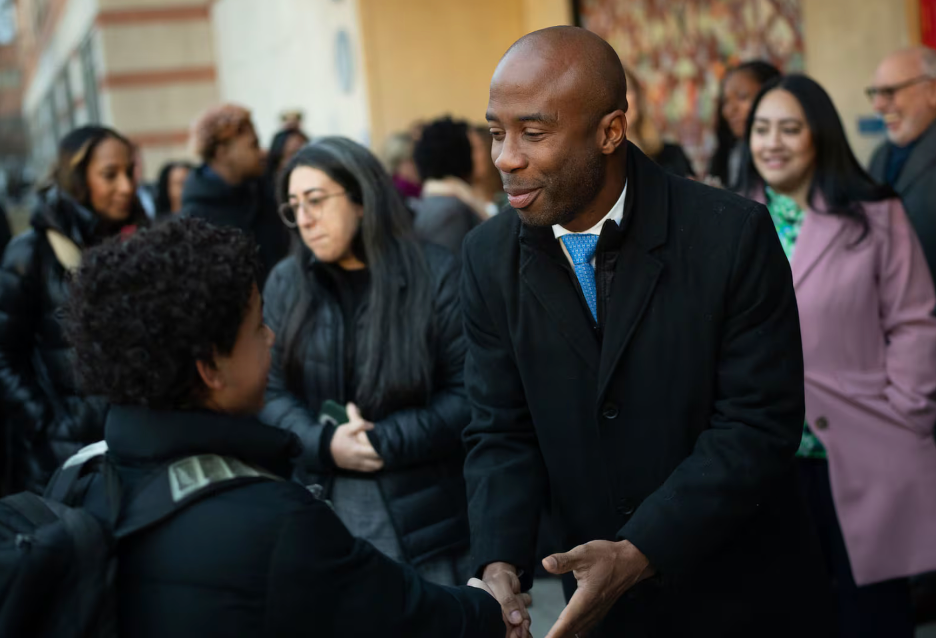
Kamar Samuels, a former elementary school teacher from the Bronx, has taken the helm of the nation’s largest public school system as New York City’s new schools chancellor under Mayor Zohran Mamdani’s administration.
With more than 20 years of experience as a teacher, principal and superintendent within the New York City school system, Samuels enters the role at a critical moment. Mayor Mamdani has tasked him with addressing long-standing challenges, including declining enrollment, absenteeism and educational inequities.
Speaking Sunday on CBS News New York’s The Point with Marcia Kramer, Samuels candidly assessed the current state of NYC Public Schools, giving the system an overall grade of “C,” while expressing optimism about its potential for improvement.
“I believe schools should be safe, rigorous, and truly integrated,” Samuels said. “If schools are not truly integrated, then throughout our system, we won’t really enjoy the greatness that New York City has.” He emphasized that socioeconomic and racial integration will be central to his policy agenda.
One of Samuels’ major priorities is transforming how the Department of Education engages parents and families.
“In all of my jobs across the system, the lead thing that I did was listen to parents, and I want to take that into this role,” he explained. “Parents and families want to know they are part of the decision-making process in schools, and when I was in Brooklyn, we did that.”
Addressing the possibility of school closures, Samuels acknowledged that some schools are currently under-enrolled but stopped short of committing to closures.
“I wouldn’t say I’m going to close schools yet,” he said. “But we’re going to look at structural moves, which includes mergers and all of that, to see what opportunities exist—not just to create diverse schools, but also to meet our class-size mandate.”
Tackling declining enrollment remains a top priority, with Samuels pledging to bring high-quality education to every neighborhood across the city.
He stressed that closing academic gaps must begin with reading proficiency.
“The first thing we have to do is make sure every student is on track in reading,” he said. “That’s why we exist, and right now we don’t necessarily have that in every single neighborhood.”
Samuels expressed strong support for the NYC Reads initiative launched in 2023 and said he plans to expand the program.
“We need to double down on that and then start thinking about math,” he noted. “If our students are not literate and not performing well, they won’t be ready for the jobs that exist—much less the jobs that don’t yet.”
He also highlighted the importance of parental feedback, using basic math skills as an example.
“When a parent says their fourth grader is struggling with multiplication tables, that matters,” he said. “Knowing your times tables is very important. When you get to algebra, you won’t be able to factor on your fingers.”
Samuels cautioned against over-reliance on conceptual teaching methods alone.
“Conceptual understanding is important, but it’s also important for kids to have automaticity,” he added.
Chronic absenteeism is another growing concern for city schools, affecting students across all demographics. Samuels noted that attendance rates remain lower than pre-pandemic levels.
To reverse the trend, he believes lessons must be both rigorous and engaging.
“If our work is not rigorous and not engaging, students won’t be excited to come to school,” he said. “You know who got this right? Video game developers. They keep kids in what we call the zone of proximal development, so they want to keep going. Schools should have the same approach.”
He also placed responsibility on parents, particularly in lower grades, to ensure consistent attendance.
“With more parents working from home, it’s easier to say, ‘Don’t go to school today,’” he said. “But we have to work directly with parents and students to change that mindset.”
Mayor Mamdani announced Samuels’ appointment just hours before officially assuming office on New Year’s Eve. Samuels replaces Melissa Aviles-Ramos, who served as chancellor for 14 and a half months under the previous Adams administration.
As he steps into his new role, Samuels says collaboration with families, educators and communities will be key to transforming New York City’s public education system.