
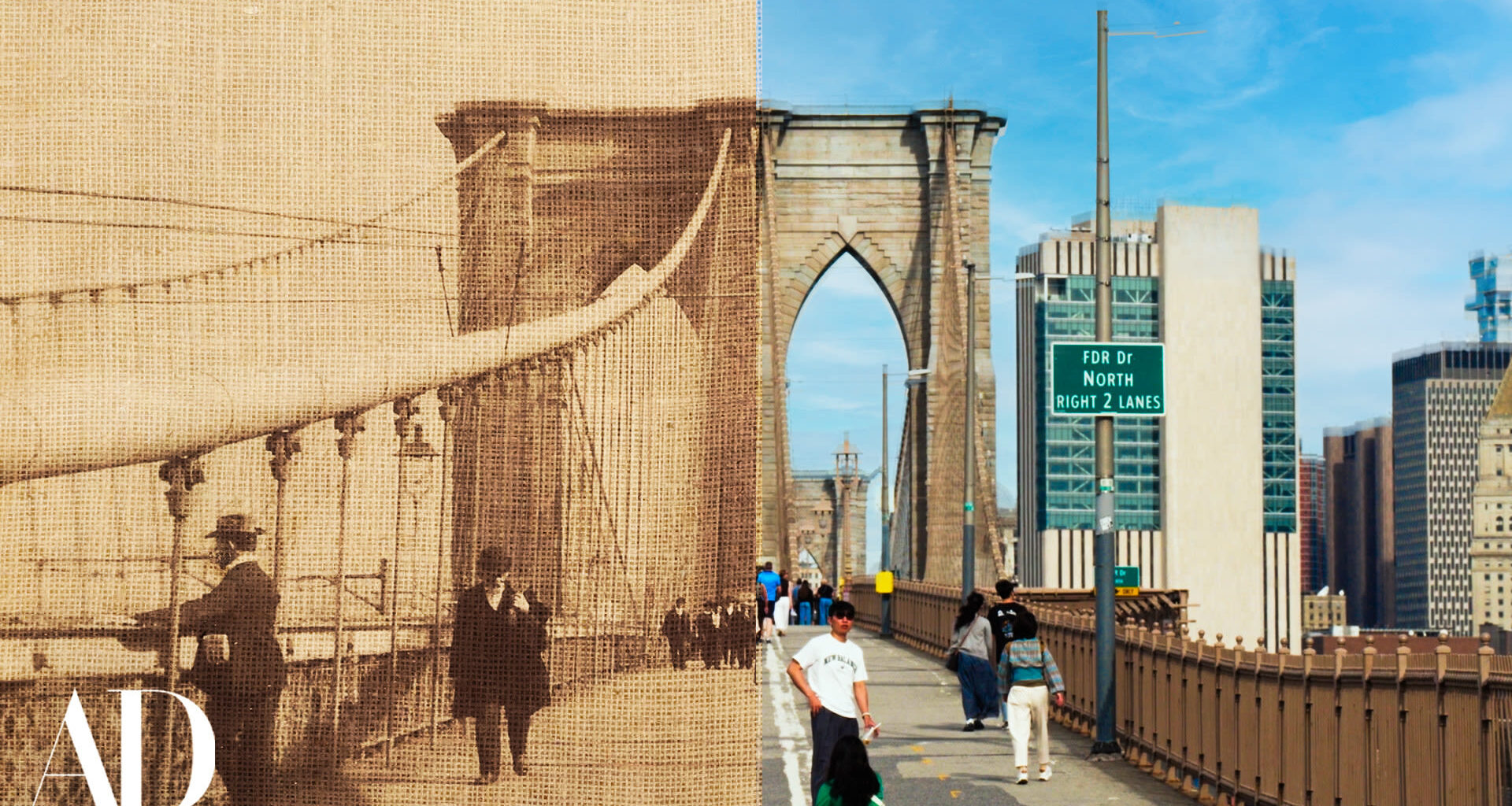
When the Brooklyn Bridge was first opened in 1883,
it was the longest suspension bridge in the world,
it was the tallest building in the Western Hemisphere,
and it was the first bridge illuminated by electric light.
It was truly an engineering marvel,
and overnight it earned the nickname
the Eighth Wonder of the World.
But what is maybe most remarkable
is how the bridge was built to withstand the test of time.
Over 140 years later, New York’s population has exploded,
cars reshaped transit,
and landmarks like Penn Station vanished.
Yet the Brooklyn Bridge still stands
as a global symbol of the city.
The truth is, the Brooklyn Bridge
is not the same as when it opened.
It has evolved with New York City.
Today we’re gonna look at all the ways
the bridge has changed since it was first built,
and discover how every person who crosses it
becomes a part of that story.
I’m Dominique Jean-Louis.
I’m the chief historian of the Center for Brooklyn History
at the Brooklyn Public Library,
and today we’re doing a walking tour
of the Brooklyn Bridge in New York City.
[upbeat music]
When the bridge first opened in 1883,
it was immediately hailed as a huge success.
Before the bridge was built,
the only way to get from Brooklyn or Queens to Manhattan
was on a ferry boat.
These ferries were inefficient for large numbers of people,
expensive to ride.
They were limited to good weather.
Sometimes the river would freeze.
You couldn’t cross the ferry when the river was frozen.
So the idea of the Brooklyn Bridge was really born
as a solution to this problem of the ferries.
But the reality of building the bridge
was fraught with issues.
The bridge was built
with this innovative caisson technology.
It allowed the big tower foundations
to be dug under the river into the bedrock,
and it was revolutionary at the time.
They didn’t really understand
how underwater pressure worked back then,
so many workers ended up dying
from what was called the bends.
The designer of the bridge, John Roebling,
was injured during construction
and ended up passing away from his injuries.
His son took over
and he developed the bends while building the bridge.
And his wife, Emily Roebling,
had to take over finishing the project.
Despite these tragic realities, the bridge was completed,
and the first crossing by Emily Warren Roebling
became an iconic moment in New York City history.
Even though when the bridge opened
there was huge celebrations on both the Brooklyn
and Manhattan sides of the bridge,
people would soon come to distrust the idea
that the bridge was solid enough.
On May 30th, 1883, there was a stampede on the bridge.
Pedestrians got afraid
thinking that the bridge was going to collapse,
and a trampling ensued.
12 people died, 35 were injured,
and there was a building distrust
that the bridge would really stay solid.
So in order to make the public
feel a little bit more comfortable
with the idea of this bridge spanning the East River,
they decided to put on a spectacle.
So they took circus pioneer P. T. Barnum
and had him parade 21 elephants
across the Brooklyn Bridge, 17 camels.
And it really showed to the public
that if the bridge could withstand
the weight of these circus animals,
certainly it could withstand the weight
of pedestrians crossing the bridge.
Because of this, New Yorkers learned to trust a structure
as massive as the Brooklyn Bridge.
As the public became more used to the idea
of crossing the bridge on a pedestrian footpath,
it really taught people how to trust bridges more generally.
More bridges would be built spanning the East River
over the years,
and because of the Brooklyn Bridge,
people were more comfortable
with the idea of bridges being safe.
[mellow music]
Once people were back on board,
the first phase of the bridge’s life really began.
So even before the bridge was built,
Brooklyn was really the first commuter town
in the United States.
People still worked on the island of Manhattan
and then returned home to Brooklyn across the river.
But once the bridge was built,
it really accelerated this idea
of commuting into New York City,
and it made Brooklyn a more attractive place to live
because you could have the benefits of working in Manhattan
and living in a more suburban, rural place like Brooklyn.
So one of the unintended consequences
of the bridge being built
is that more people started to migrate to Brooklyn,
which was its own city at the time.
When the bridge was first built,
it had nine trolley lines to take people back and forth.
And so the bridge really became a thoroughfare
for everyday commuters.
Trolleys weren’t the only way to get across.
You also had horses and buggies
going across in dedicated lanes.
And of course, we have the iconic pedestrian promenade.
It was also cheaper to get across the East River
on the bridge than on the ferries.
It was only 1 cent to cross as a pedestrian,
5 cents if you were riding a horse,
10 cents for a horse and carriage.
And of course, if you were taking your livestock across,
5 cents per cow, 2 cents per sheep or pig.
You could take your bicycle across for 3 cents.
A lot of people don’t realize at this time
that Brooklyn was still pretty rural.
Most people made their living by farming,
and that was important
because Manhattan was full of bankers and shopkeepers.
It wasn’t really growing anything at the time.
The produce that was fueling the growth of New York City
was really coming from Brooklyn.
So from the beginning, the bridge needed to adapt
to a lot of different modes of transportation.
So whether you were commuting to work,
whether you were a farmer bringing their wares
to go sell in the markets in Manhattan,
whether you were taking a promenade
for pleasure across the bridge,
this bridge really changed the relationship
between Brooklyn and the island of Manhattan.
[upbeat music]
So the bridge came about at a time when the population
in New York City was really starting to explode.
Brooklyn and New York City
were two different cities at that point.
But because there’s now a bridge
connecting these two cities,
it really strengthens the relationship.
So about 20 years after the bridge is built,
Brooklyn becomes part of greater New York,
and they unify into one city.
The population is growing in both places,
and it continues growing from there.
When the bridge was built,
there were only about a million people
living in New York City,
and since then, it’s grown to nearly 9 million.
So as the population continued to grow,
more bridges were needed.
We got the Williamsburg Bridge, the Manhattan Bridge,
the Queensboro Bridge.
So even though there were only about a million people
living in the city when the bridge was built,
the designers knew that the city would continue to grow.
So they almost kind of predicted
this explosion in population
and tried to future-proof the bridge for further growth.
It was actually built to be about four to six times stronger
than was needed at the time,
making it possible for the bridge to still function today.
[upbeat music]
So the original designers of the bridge
got a lot right about future-proofing it.
They separated pedestrian traffic from the trains
and from the horses and buggies,
and they even had enough trolley lines
to support commuters going back and forth.
But what no one could predict
was just how important cars would become.
In 1900, there were only about 8,000 personal vehicles
in the United States,
and by 1920, that number had risen to about 10 million.
By the 1940s, cars were ubiquitous in American life,
even in an urban metropolis like New York City.
The last trolley car
ran across the bridge from Brooklyn to Manhattan in 1950.
After that, the train tracks were removed
to make way for cars to be able to cross the bridge.
The pedestrian promenade, of course, still remained,
combining pedestrian and bicycle traffic.
Though the bridge could withstand
the weight of 21 elephants crossing,
they really hadn’t thought
about things like the weight of semi-trucks.
To put that into perspective,
an adult elephant weighs around three to seven tons,
but a fully loaded semi-truck
will weigh somewhere in the ballpark of 40 tons.
Because of all that weight,
semi-trucks are still not allowed on the Brooklyn Bridge.
That also makes the walking experience
a little bit more enjoyable.
So because cars could now cross the bridge,
more kinds of people
could commute from Brooklyn to Manhattan.
Highways were open by this time,
and people could move from further reaches of Brooklyn
and even Long Island
all the way to New York City quickly and easily.
As cars started letting people
move further out into Brooklyn,
the waterfront areas became more and more empty.
All these warehouses that used to have hundreds of workers
were now sitting fallow at the edges of the bridge,
which made way in the 1960s and ’70s for artists to come in
and eventually for those areas to become really lucrative
and attractive for wealthier residents.
So when you’re in waterfront neighborhoods today,
you can really see that transition in the architectures.
Buildings that used to be commercial warehouses
are now for shopping.
They’re now restaurants.
Now Brooklyn’s waterfront and neighborhoods like Dumbo
are full of luxury condos, high-end shopping.
We see a real transition in how the waterfront is used.
But meanwhile, on the Manhattan side of the bridge,
car culture in New York City was really ramping up.
[mellow music]
We’re standing underneath the on-ramps
to the Brooklyn Bridge on the Manhattan side.
Here you can see the original
19th century anchorage to the bridge,
and you can also see these modern supports for the on-ramps.
In the 1960s, the FDR Drive
was built along the edge of Manhattan
as a part of a re-imagining
of the city’s infrastructure by Robert Moses.
And at that time, even more on-ramps were added
to this side of the bridge.
This area where we’re standing now,
known as the Brooklyn Banks, was one of the results of that.
You can also see it has these unique sloped hills or banks,
which were perfect for skateboarding.
So this area unintentionally became a haven
for this booming new trend of skateboarding.
So even this dark, neglected underbelly
of the Brooklyn Bridge
has now become a famous, celebrated space,
even famous enough to be featured in multiple iterations
of video games like Tony Hawk’s Pro Skater.
The Brooklyn Banks is just another example
of how every part of the Brooklyn Bridge
has become a cultural touchstone.
Whether it’s graffiti artists
scaling the top of the towers to tag the bridge,
or admirers and commuters
sharing the space on the promenade,
even here in this sort of forgotten structural area,
community and activity is thriving.
Every part of the bridge in some way
is culturally relevant and iconic to someone,
and that iconic status
would only become stronger in the 1980s
when New York City celebrated the centennial of the bridge.
[upbeat music]
In the 1980s, New York was booming.
Wall Street is having an unprecedented bull market.
The Dow Jones Industrial Average
is increasing over 500% from 1982 to 1987.
Real estate developments in full swing.
At this moment when New York
is at the center of the world stage,
the Brooklyn Bridge celebrated its 100-year anniversary.
More than a million people
lined up on either side of the East River
to watch the celebrations.
We had a thousand journalists covering the event.
There were multiple days of TV coverage.
We had parades, flotillas, big firework pyrotechnics.
There were street fairs.
There was artwork especially commissioned for this event.
These celebrations renewed interest
in the bridge across the world
and really cemented the Brooklyn Bridge
as an icon of New York City.
The snapshot of the bridge at that moment
became the enduring image of the bridge
for that generation and generations going forward.
The centennial image of the bridge
really stays in people’s consciousness,
so much so that when they made renovations
on the bridge in 2018,
the color changed of the bridge when they were cleaning it.
It made headlines.
People were so shocked
that the color of the bridge could change,
but in fact, the bridge had changed many times since 1883.
But that wasn’t the only change that happened in this time.
After the centennial,
tourism became an even more important part of the bridge,
so much so the bridge had to change again.
After the centennial, tourism boomed.
People wanted to use the pedestrian footpath
to take pictures.
That became unsafe with bicycles going back and forth.
They sacrificed a lane of vehicular traffic
to move bicycles off the bridge
so the pedestrian footpath would be safer for tourists
to take their pictures.
This is just the most recent example
of how the bridge adapts to how people are using it.
So today, as when it opened,
the Brooklyn Bridge inspires visitors from around the world,
but it also serves as a humble workhorse
for New Yorkers going about their everyday business.
And whatever your reason is,
when you cross the Brooklyn Bridge,
you play a part in its 140-year history
and influence the next chapter of its future.
For more stories like this one,
be sure to check out other episodes of Walking Tour.