
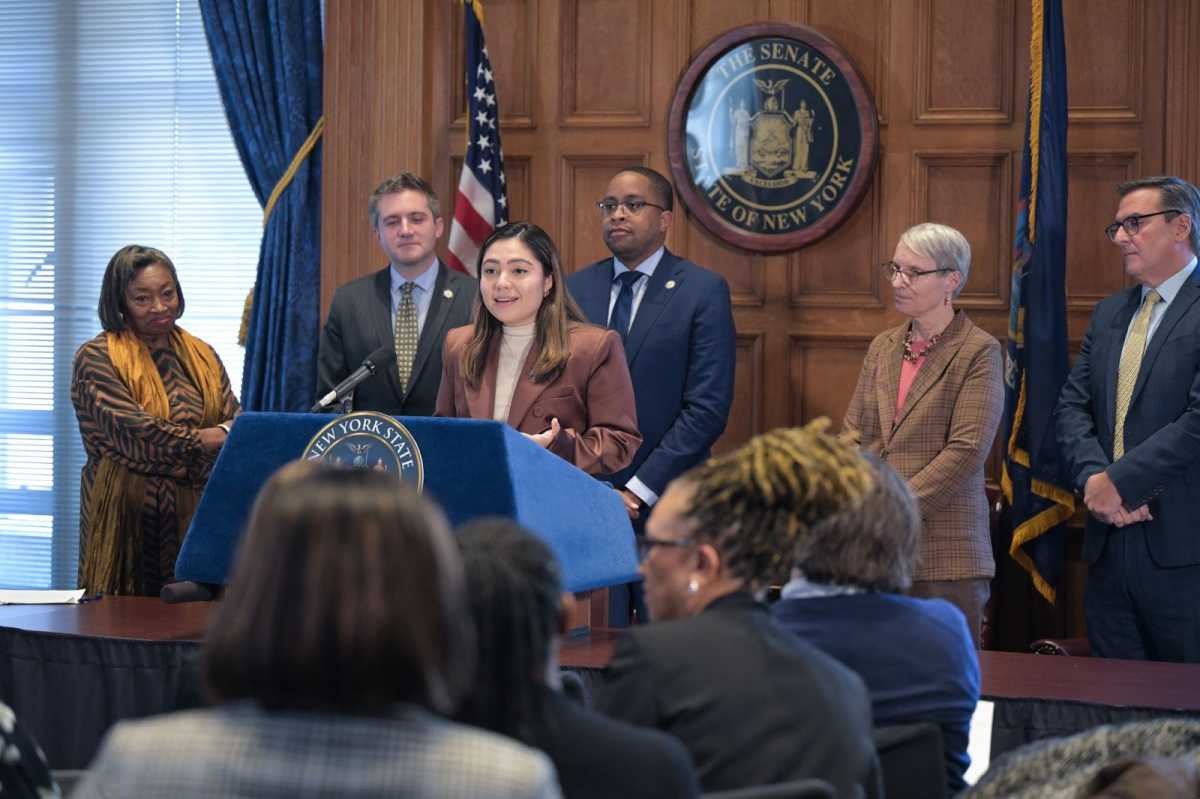
Chair of the Senate Elections Committee, Senator Kristen Gonzalez speaking on the Elections package with Majority Leader Stewart-Cousins, Deputy Leader Gianaris, Senator Myrie, Senator Scoufis, and Senator May.
Photo via NY Senate Media.
The state Senate has passed a legislative package aiming to safeguard election workers and modernize election systems in New York state, including legislation introduced by state Sen. Kristen Gonzalez and Michael Gianaris.
The legislative package also aims to crack down on deceptive practices that suppress voters, including the use of artificial intelligence to spread misinformation during election campaigns. The package also proposes moving New York’s presidential primary to Super Tuesday to elevate the state’s influence in the presidential nomination process.
The legislative package marks a continuation of a recent Senate tradition to pass a series of voting rights bills to kick off the legislative session, a practice that has been dubbed “Democracy Day.”
Gonzalez’s legislation, S.8646A, would prohibit the intimidation or obstruction of election officers, also barring the unlawful dissemination of election officers’ personal information. The bill creates new criminal and civil penalties for harassing election officials as well as creating “new tools” to shield officers from abuse, including access to the state’s Address Confidentiality Program, which has generally been reserved for victims of crimes such as domestic abuse and sexual assault.
S.324, introduced by Gianaris, would ban political spending by foreign-influenced business entities in New York’s state and local elections.
Existing laws already prohibit foreign businesses from spending in New York elections, but Gianaris’ legislation also aims to ban any American business with significant foreign ownership from spending in elections. The bill defines significant foreign ownership as a single foreign investor who controls more than 1% of a company or multiple foreign investors controlling more than 5%.
Meanwhile, Senate Majority Leader Andrea Stewart-Cousins has introduced legislation that would prohibit deceptive practices and the suppression of voters, including the use of AI to spread misinformation. Stewart-Cousin’s legislation would also introduce new penalties for “violations of electoral franchise,” making it a misdemeanor offense to suppress or threaten to suppress another citizen’s voting rights.
The Senate also passed two bills introduced by state Sen. Zellnor Myrie, including one bill that would allow voters to register to vote from a secondary residence, so long as they maintain a continuous connection with an intent to remain. Myrie cited a number of legal challenges brought against the absentee ballots of second homeowners or part-time residents as justification for the legislation, describing such legal challenges as a form of voter suppression.
Republicans have previously expressed opposition to such legislation because it allows full-time New York City residents to participate in Upstate elections, where contests between Democrat and Republican candidates are much closer. In an interview with the New York Times in 2024, Matt Organ, campaign manager for former Republican Congress Member Marc Molinaro, accused Democrats of attempting to “hijack local politics” through the second residencies. Molinaro was narrowly defeated by Democratic nominee Josh Riley in the Upper Hudson Valley in 2024.
Myrie has also introduced legislation that would require the State Board of Elections to create a mandatory, uniform training curriculum for all election commissioners.
Meanwhile, a bill introduced by Syracuse state Sen. Rachel May would establish county-wide portable locations to facilitate early voting. May argued that the measure is a “simple solution” to a lack of access to regular polling sites during early voting.
Finally, Orange County State Sen. James Skoufis has introduced legislation to move New York’s presidential primary date to Super Tuesday, arguing that moving New York’s primary to an earlier date would ensure that the state plays a more consequential role in the primaries.
The Senate passed the legislative package on Monday, Jan. 12, while companion legislation in the Assembly remains in committee.
Stewart-Cousins said in a statement that the legislative package would combat voter suppression, expand early voting, block foreign-influenced money in New York elections and safeguard the independence of the state’s electoral process.
“At a time when democratic norms are under attack across the country, New York is once again leading by example and upholding the principles of representative democracy for all,” Stewart-Cousins said in a statement.
Gonzalez, Chair of the Senate Committee on Elections, said the legislative package would ensure that every New Yorker can participate freely in elections without fear of intimidation or suppression.
“I’m proud that this legislative package strengthens election integrity by expanding accessibility, protecting voters and election workers, and confronting the growing threats of political violence and foreign influence,” Gonzalez said in a statement.
Gianaris, meanwhile, said the package would make democracy stronger in the state by expanding access to elections and ensuring that elections are not subject to “undue interference.”
“We are clearing the obstacles to registration and the inappropriate influence of big money,” Gianaris said.