
It’s not easy to get inside most of Paul Rudolph’s buildings, especially when they keep disappearing. The works of this baroque brutalist, who was active until his death in 1997, have been steadily demolished over the past few decades — his Riverview High School in Sarasota in 2009, the Shoreline Apartments in Buffalo in 2020, his Burroughs-Wellcome Building in North Carolina the following year. Multiple Rudolph houses have been lost in the same period. Others remain at risk; the fate of his still-polarizing Boston Government Service Center is exceptionally unclear. Nature has been cruel as well, washing away his Sanderling Beach Cabanas in Sarasota in a 2024 hurricane.
New York has a few survivors, including his Tracey Towers in the Bronx, which anchor the north end of the Grand Concourse, and his former penthouse at 23 Beekman Place, which is on sale for nearly $16 million (you can see it briefly in The Royal Tenenbaums as Ben Stiller’s residence). Tom Ford owns his Hirsch House in Manhattan (which was formerly owned by Halston — you can see an interior mockup in the Netflix series). But good luck getting inside either of those unless you have a larger wallet or better connections than most of us.
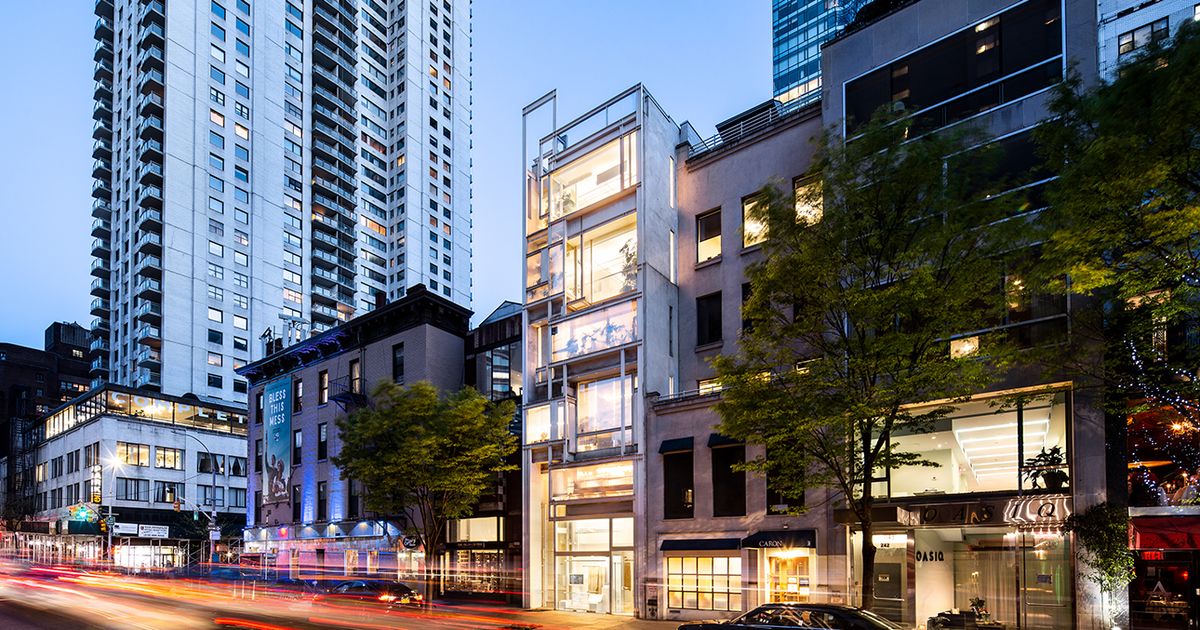
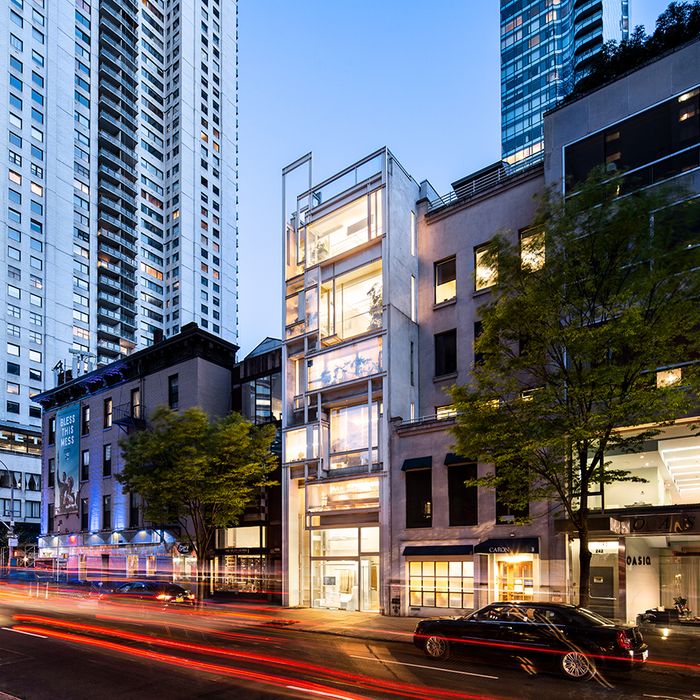
There’s one exception lurking in plain view on East 58th Street. Unlike so many of Rudolph’s commissions, which were not protected, the Modulightor Building is New York’s most recent and youngest interior landmark (the exterior was landmarked in 2023). The building dates from Rudolph’s last decade of work, completed just three years before his death. The architect designed the ground floor to house his lighting company, Modulightor, which he founded with life and business partner Ernst Wagner. It also held his architectural office on the second floor along with two duplex apartments on the top floors, which were rented out to tenants. You could say that after his home on Beekman Place, it was his personal laboratory in the latter decades of life. He may not have lived there, but he was essentially his own client and played with its interiors as he saw fit.
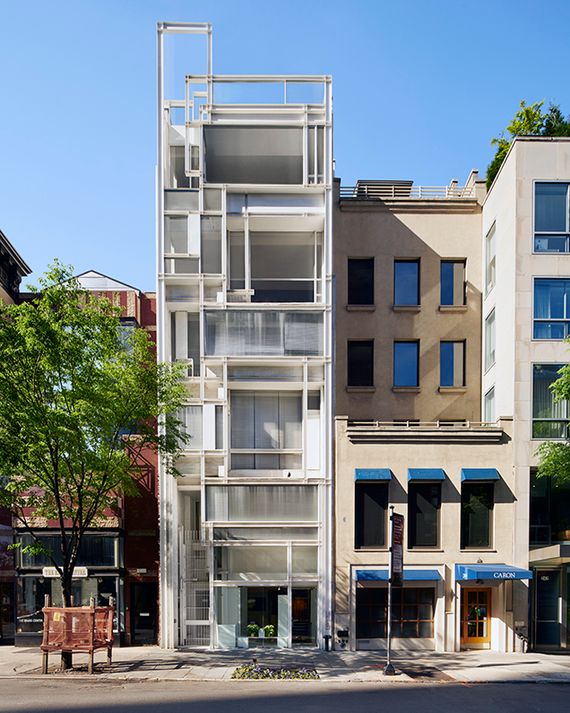
The building’s facade features a lattice of three different sizes of I-beams.
Photo: Annie Schlechter
For the past 25 years or so, since Rudolph’s death, the duplex has been Wagner’s residence, and for much of that time, it has also functioned as a house museum. Wagner died in December 2024 and left the property to the Paul Rudolph Institute for Modern Architecture, which has since expanded its schedule of events and openings. Now, you can visit it twice a month and do basically as you wish within the bounds of cocktail-event propriety — peer around, flip through the books, sit on the furniture, and, as of late, take in some exhibitions. Most recently, it opened “Weaving Annie Albers,” which features reissued Albers designs by Dedar, an Italian textile company.
It might easily have gone the other way. Any townhouse in Manhattan lacking a landmark designation is at constant risk, even those by architects who don’t seem as hexed as Rudolph. Saving Modulightor required decades of dogged efforts to keep it intact and accessible, and it survived one very acrimonious split among Rudolph devotees.
Rudolph wasn’t always a tragic figure. Starting early in his career, in the 1960s, he made a great splash with a cluster of works around Sarasota and then rapidly elsewhere. He became chair of the Yale School of Architecture at 40 and enjoyed a brief interval of success. His projects from the era include the Art & Architecture Building at Yale, which now bears his name, the University of Massachusetts Dartmouth campus, Boston Government Service Center, and a great number of excellent offices, residential towers, churches, and schools.
His fall was about as abrupt as his rise. He left Yale in 1965. While peers such as I.M. Pei and Philip Johnson became international stars with offices that ballooned into megafirms, he became regarded as a brutalist dinosaur, especially as public antipathy toward the style grew. Although Rudolph’s concrete architecture was more complex and soulful than that of many of his imitators, that difference was often overlooked. And unlike Pei or Johnson, he kept his practice small, remaining close to the work, which meant less of it, while his peers ran multiple offices and were only thinly attached to their output.
There has been some overdue recognition. The Metropolitan Museum of Art held the first substantial retrospective of the architect last year, leaning heavily on his artful drawings. There have been a few books this century; one on his Florida houses and another on his later work (both are out of print), and Timothy Rohan’s The Architecture of Paul Rudolph, the first career-spanning biography from 2014. Still, his is not a name that the average person might distinguish from the reindeer.
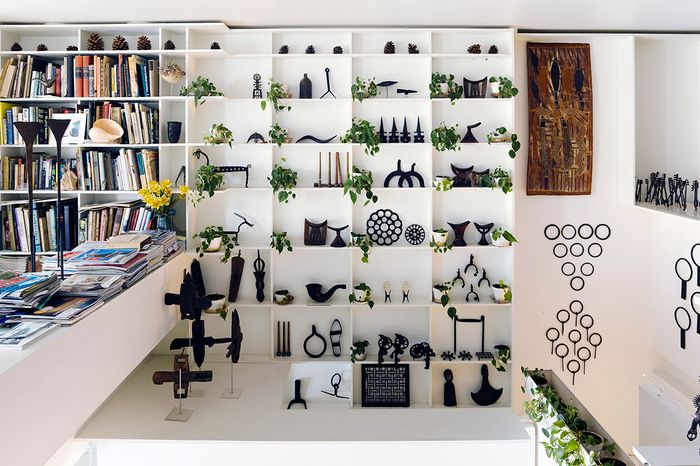
Photo: Annie Schlechter
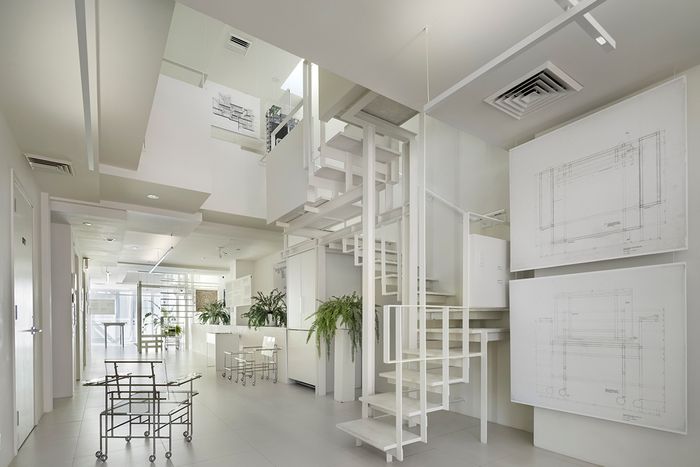
The building’s top two floors have been host to a variety of exhibitions and events, featuring the work of Rudolph and Goldfinger, architectural posters, the photographs of Paul Clemence and more.
Photo: Peter Aaron/OTTO
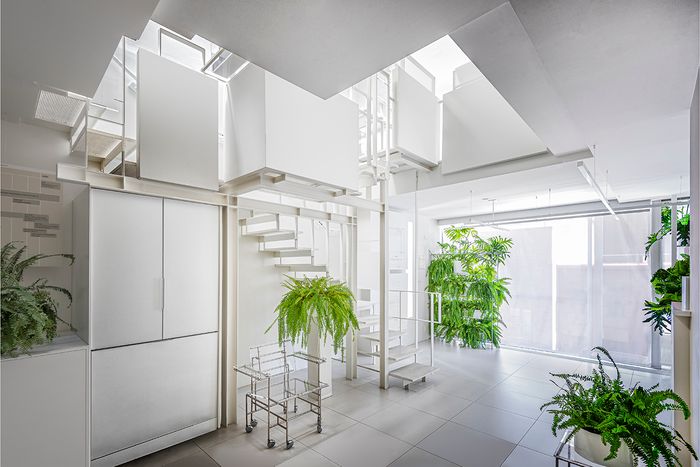
Photo: Anne Broder
Rudolph had always hoped his own residence at Beekman Place would be preserved and open to the public and tried to donate it to the Library of Congress as a study center. But this effort fell through. He willed his portion of the Modulightor building to Wagner, which was lightly reconfigured by former Rudolph employee Donald Luckenill into a single apartment. Wagner moved in along with their possessions.
Wagner began allowing open houses in 2005. Kelvin Dickinson, an architect and now president of the Paul Rudolph Institute of Modern Architecture, attended one of these the following year. He explained, “At that point, there were no websites about him. There were no books in print. When I met Ernst, I sat down on the floor in front of him and I said, ‘Tell me everything.’”
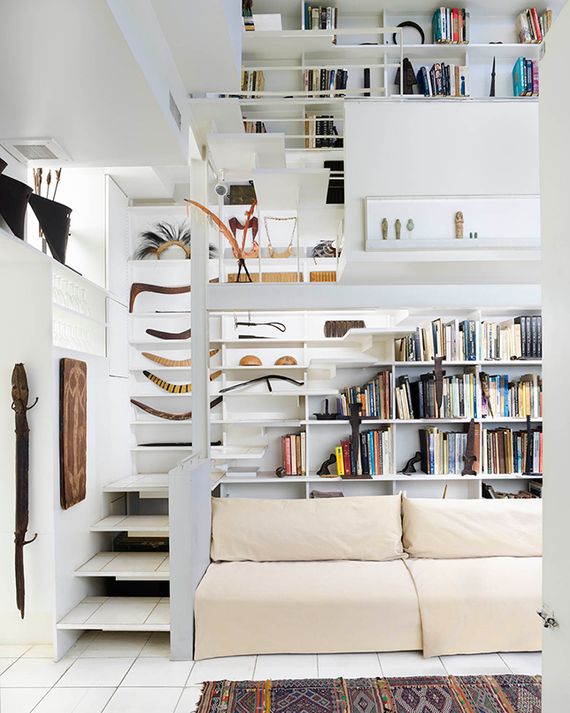
Stair treads become bookshelves in the duplex’s main living area.
Photo: Annie Schlechter
Dickinson soon got permission to come in on weekends to work on cataloguing the possessions remaining there. There were over 30 pairs of Rudolph’s Corbusian glasses in the first box he opened, thousands of slides of unpublished projects, a letter from Walter Gropius, and all of it needed to be organized. Over the nearly 20 years since, he and other volunteers have sifted through this jumble of content, digitizing items, creating a website, and holding events. Wagner continued to hold court, spreading word of Rudolph’s work, and in that time, he became president of the Paul Rudolph Foundation, begun in 2002. Architect Mark Squeo added another two floors to the building between 2010 and 2016, using earlier Rudolph plans for a taller building.
But then a dispute developed in the foundation and Wagner was voted off the board in 2014. Some members believed that Rudolph’s former partner was less than effective at advocating for the preservation of Rudolph’s work. The next year, Wagner, Dickinson, and a number of others founded a new organization based in the Modulightor building, establishing the Paul Rudolph Heritage Foundation in 2015. In 2020, the older foundation filed a lawsuit against the newer one over the rights to Rudolph’s estate, which was settled on confidential terms in 2023. Now both organizations advocate for Rudolph’s work; the newer institute, led by Dickinson, represents the estate, and the foundation focuses on a mission to “further the knowledge, understanding, and preservation of the work of Late Modernist architect & educator Paul Rudolph.” Essentially, there are now two organizations dedicated to preserving Rudolph’s work without the legal tussle of earlier decades.
After the dispute was settled, the open houses at Modulightor doubled to twice a month. The goal was simply to expose as many visitors as possible to Rudolph’s work. As Dickinson explained: “The idea was that if someone sees the interior, they would go, ‘How could you ever tear down a Paul Rudolph space?’”
As a calling card, the Modulightor Building’s façade of irregular I-beams stands out next to its more conventional neighbors. It solves the classic New York rowhouse dilemma of windows being impossible to place anywhere but at the front and back by dedicating nearly all façade space to them. But it’s inside where Rudolph’s design philosophy really shines; instead of the typical open-plan solution, where nearly nothing is going on inside except an expansive floor plate, it’s an Escheresque space full of corners and partial levels that provide vistas up, down, and through the duplex.
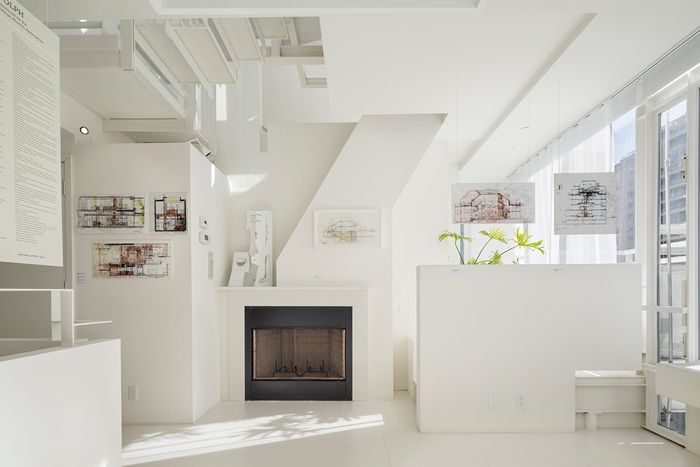
Photo: Peter Aaron/OTTO
It’s in line with a message that Rudolph presented at a 1954 convention of the American Institute of Architects, where he argued that architects must “relearn the art” of designing buildings that “create different kinds of space; the quiet, enclosed, isolated, shaded space; the hustling, bustling space, pungent with vitality; the paved, dignified, vast, sumptuous, even awe-inspiring space; the mysterious space; the transition space which defines, separates, and yet joins juxtaposed spaces of contrasting character.” The Modulightor demonstrates this at every opportunity: Stairway treads become bookcase shelving. Nooks abound. Corners hardly meet. The built-in furniture doesn’t meet the walls or ceilings, and the resulting gaps and recesses make spaces feel much larger than they are. It’s a device he borrowed in part from John Soane more than mildly well.
As Dickinson explained, “Most apartments are a simple rectangular box. As soon as you walk in, you know how big or small the space feels. In Rudolph’s design, he overloads you with corners so that you don’t know where to look. The space feels bigger due to its complexity.” In architecture lingo, Rudolph thought intensely in terms of section — about vertical space — over plan or what is a traditional layout.
The house is also a result of constant tinkering and experimentation. Dickinson explained that when it came to Modulightor, Rudolph “would hold up some plywood or some cardboard and say, ‘I like it,’ and the next day, say, ‘I don’t.’” He would tweak as he went along. It probably helped that the materials he used were the definition of off the shelf, with the basic building block being three-quarter-inch plywood you could buy anywhere. “He used Benjamin Moore white, the cheapest contractor-grade white he could get. I never have a problem if something needs to be repainted. If you’re good at design, you don’t need marble. That’s what I love about his work. It’s so approachable. Just look around. You’ll get it!”
Beyond the design of the house, the stuff of Rudolph’s life is displayed throughout. The Modulightor is not one of those pristine modernist residences that lack any signs that a human might have resided there. On the living-room bookshelves, there is a model of Corbusier’s Open Hand monument in Chandigarh — a gift from the man himself. Nearby, there’s a maquette of an unrealized Picasso sculpture. A terra-cotta panel from Louis Sullivan’s demolished Schiller Theater in Chicago stands in a rear window. There’s even a Richard Serra painting that Rudolph salvaged from the trash in New Haven. But beyond the architectural artifacts and artwork, the duplex is jammed with eclectic objects, from statuary and ceramics from around the world to boomerangs, cigar molds, and shoe forms. There’s also a wall full of Voltron figurines that Rudolph bought in a moment of delight in Mexico City — then hand-painted. The duplex features a few tables that he designed; also, you can try out his surprisingly comfortable Lucite and tubular-steel chairs.
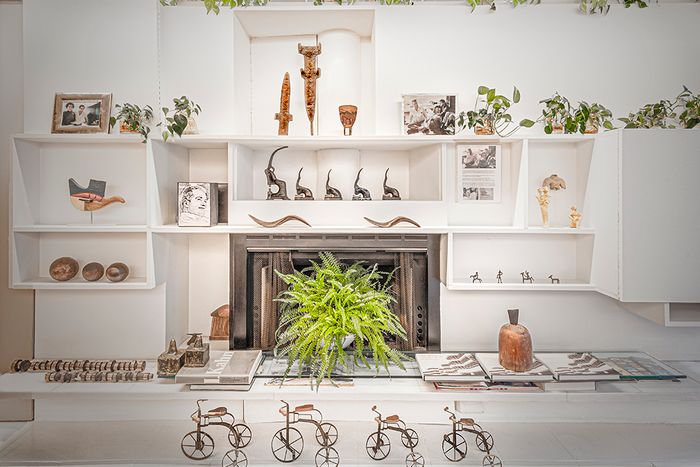
A gift from Le Corbusier, a model of his Open Hand Monument in Chandigarh, sits on the bookcase.
Photo: Anne Broder
Like Rudolph himself, the institute seems to relish tinkering with its purview. Modulightor — house museum, Rudolph archive — has also made room for the work of other notable architects. Dickinson recalled a tip-off years ago that architectural photographer Tom Yee had a massive trove of architectural photos, including images of Rudolph works. But Dickinson was too late to save them — Yee and his wife had just died, and the materials were gone. “It was all probably thrown in the garbage. I realized that I could be one phone call away.”
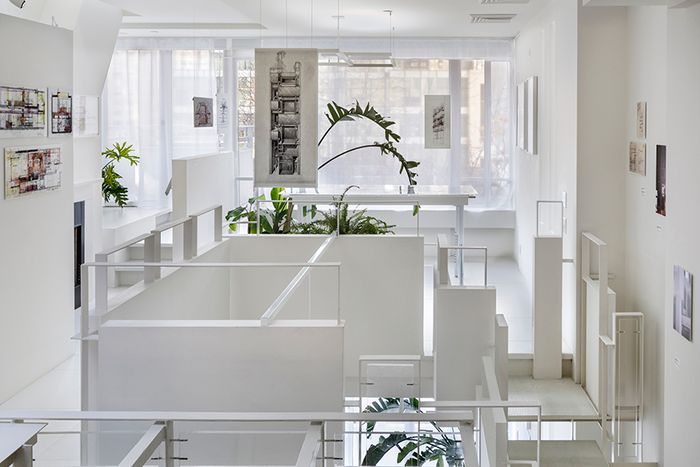
Photo: Peter Aaron/OTTO
So when Dickinson learned that June Goldfinger, widow and design partner of Myron Goldfinger — a Rudolph student at Princeton and another often overlooked modern architect who designed hip ’70s and ’80s residences, from a Roberta Flack apartment to a Hamptons beach house featured in The Wolf of Wall Street — had an exhibit ready, he was curious. He met her and soon offered to take her full archive: 14 garbage cans of drawings. “They’re glamorous 1970s and ’80s interiors with mirrored finishes and walls of glass and giant plants and shag carpets. Just amazing stuff.” You might think that universities would leap at these prospects, but they often want substantial sums of money to accept this material. The Rudolph Institute doesn’t.
They digitized close to 3,600 Goldfinger drawings in a year and a half with the help of about 20 volunteers. They’ve since been doing the same for another mid-century architect, Andrew Geller, whose archive they took on early last year, which included dozens of models of experimental homes and drawings. Dickinson was all too aware of just how endangered such items are. “How much work — just as significant as Rudolph’s — is at risk of being thrown away or lost forever? We have the space — let’s fill it up and then scan everything to share it so the work is not forgotten.”
The archiving, and the exhibits that sometimes result, serve the dual purpose of not just saving the materials but also luring people back to Modulightor. As Dickinson explained, “Most house museums have a lifespan of 30 years. People will go and say, ‘I’ve seen it. I don’t need to go back.’” There are only so many onetime visitors, even for the best-known architects. “That’s why the Frank Lloyd Wright Foundation started selling sneakers,” he added. The institute sustains itself however it can. Volunteers like Dickinson keep the foundation running. There’s a membership program and a $30 admission fee for the open houses. The foundation is also seeking grants, especially to cover the cost of capital improvements it intends to make. It even has air rights to sell, if you’d like to build a tower nearby. Occasional rentals also bring in some cash, along with fashion shoots for brands, from Bottega Veneta to Ivy Getty to Bulgari.
As for its mission of spreading the gospel of Paul, that seemed to be going well on a recent open house visit. The company is usually great, with architects, students, Rudolph homeowners, former Halston models, and all sorts of others turning up. I sighted architect Steven Holl at an exhibit opening and asked him, afterwards, what he thought. He wrote to me that the Modulightor’s “incredible spatial fluidity,” a Rudolph trademark, “must be experienced in person to understand.”
Related