
Free childcare for 2-year-olds. An expanded Second Avenue Subway. Less red tape for new housing. Gov. Kathy Hochul on Tuesday laid out a sweeping agenda to make New York more affordable — and stand up to federal threats — as part of her State of the State address.
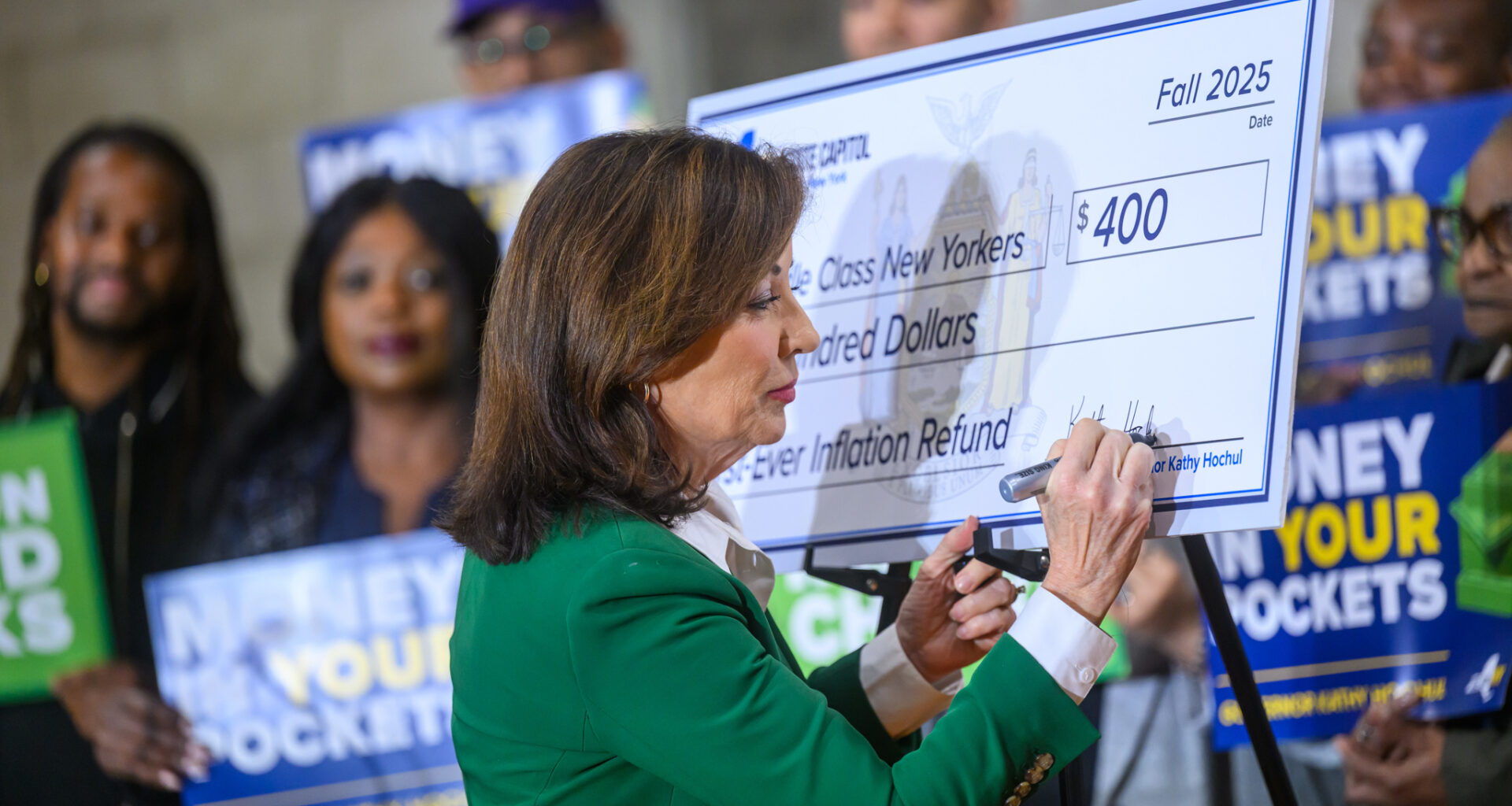
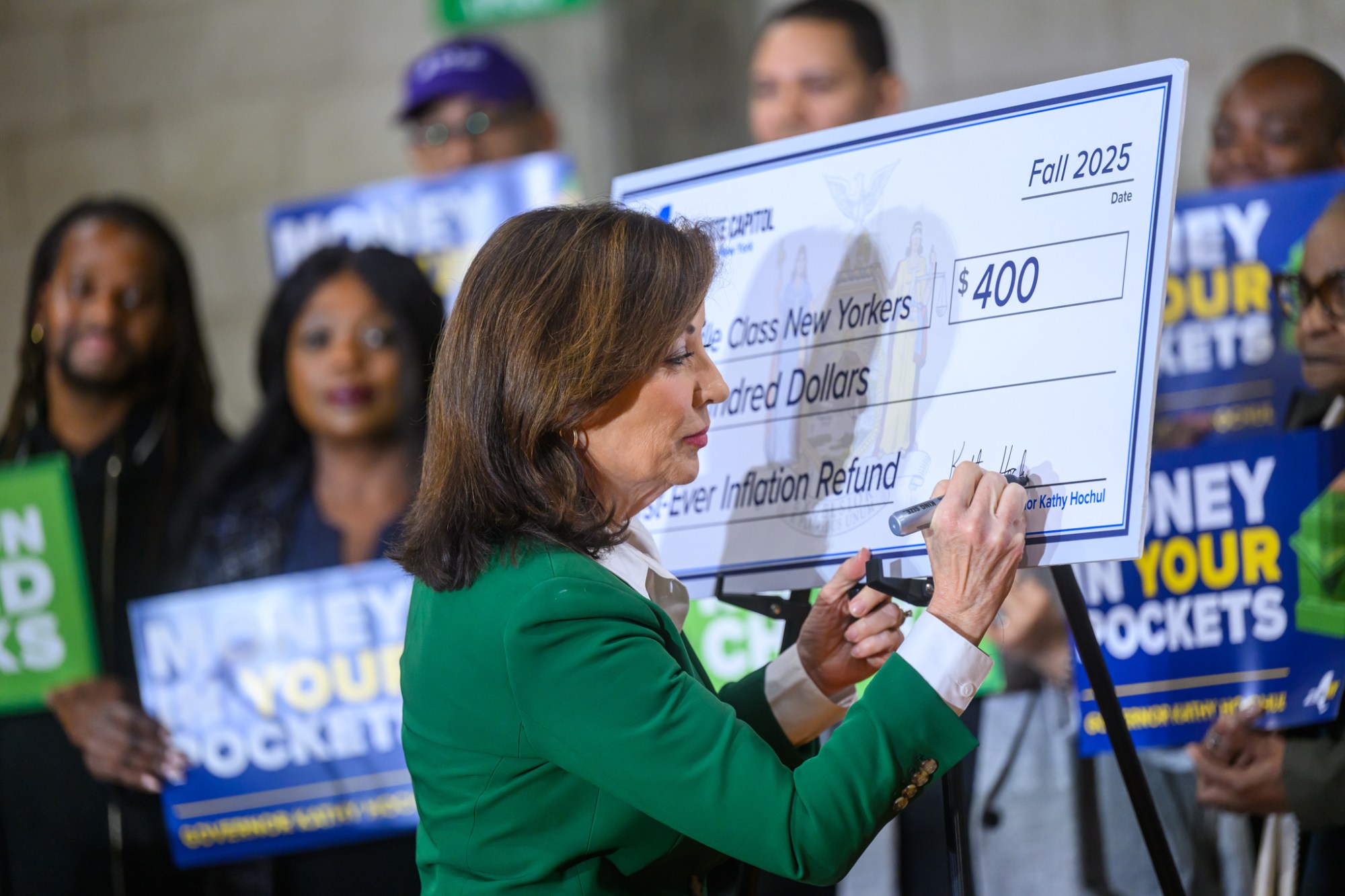 Gov. Kathy Hochul signs a display inflation refund check, May 14, 2025. Photo: Susan Watts/Office of Governor
Gov. Kathy Hochul on Tuesday laid out a sweeping agenda to make New York more affordable — and stand up to federal threats — as part of her State of the State address.
“While Washington takes a machete to our safety net, I’m doubling down on the fight for a more affordable New York,” Hochul said at her speech in Albany.
Her overall focus on New Yorkers’ wallets took a page out of Mayor Zohran Mamdani’s book, with many proposals bolstering his aims. Her commitment to fund two years of free childcare for New York City’s 2-year-olds, for instance, gets Mamdani closer to his campaign promise of free universal childcare. But the governor did not indicate any movement towards making buses free, creating a gap between their priorities.
Most of Hochul’s proposals, whether funding commitments or new legislation, will need cooperation from state lawmakers to become reality. The speech also served as a pitch for her own reelection, as she’s facing a primary challenge by Lt. Gov. Antonio Delgado. Republican Bruce Blakeman, who currently serves as Nassau County executive, is also running for governor.
While Mamdani has long called for a rent freeze for tenants of New York City’s rent-regulated housing, Hochul pushed for a rent freeze for a more limited subset of the city’s renters. She focused on a rent freeze for seniors and disabled New Yorkers, who live in rent-stabilized apartments and Mitchell-Lama housing that takes advantage of certain tax credits to offset rent increases. Families eligible for those programs can now earn up to $75,000, the governor said, up from a previous income maximum of $50,000, so that more people could participate and keep their rent levels the same.
She promised to criminally penalize landlords who systemically harass rent-regulated tenants across multiple buildings — a measure that could advance Mamdani’s promise to crack down on bad landlords, especially repeat offenders.
In order to boost repairs in the city’s rent-regulated housing stock, she proposed amending the J-51 tax incentive that helps finance major upgrades in apartment buildings.
To make it cheaper and quicker to build new housing, the governor proposed changing the state environmental review law to allow certain sizes of development projects in certain neighborhoods to bypass the review.
“They slow down the very projects that help us fight climate change, create housing and strengthen our communities,” Hochul said, referring to the review process. “That’s why, in this budget, I’m proposing a simple, common-sense update: When communities say yes to housing, infrastructure or clean energy, we’re going to let them build.”
Hochul also targeted New York City for new large-scale infrastructure projects, including a plan to fund the expansion of the Second Avenue Subway along 125th Street. She proposed a $50 million renovation to the Jamaica Station of the Long Island Railroad, which hasn’t seen a major upgrade since the AirTrain launched in 2003. And she promised to stand up a new program that would quicken the permitting processes for major projects, including the Interborough Express, a Brooklyn-to-Queens light-rail line.
Hochul set her sights to safety on streets and subways, too.
She said wanted to crack down on speeding in New York City by greenlighting a pilot that would require cars of drivers who repeatedly speed to be equipped with technology that limits speeds. The city previously used this technology on city vehicles and found speeding dropped by 64%.
Hochul wants to add five more outreach teams of MTA police officers and city Department of Homeless Services clinical staff on the subways, bringing the total to 15 teams to expand reach. She also said the MTA will install barriers on the edge of the subway platforms in 85 additional stations this year to bring the total to 200 stations with barriers.
To tackle high utility bills, the governor also wants to tie executive salaries to customer affordability and cracking down on bills that include costs beyond energy services; prevent utilities from shutting off service to tenants whose landlords are behind on bills, as THE CITY previously reported; and limit utility costs to 6% of household budgets. Hochul also announced a goal to build five gigawatts of new nuclear power in the state, up from the current one gigawatt aim — though it’s uncertain how that might fit into her affordability agenda, given the expense of building nuclear facilities.
The governor also used her address to touch on the immigration enforcement blitz rocking many communities in the U.S., and locally.
One of the biggest cheers during her speech came when Hochul said “protecting New Yorkers also means standing up to ICE agents who abuse their power,” referencing a City Council analyst who was detained by immigration officials at a routine check-in on Monday.
“New York will not allow the use of state resources to assist in federal immigration raids on people who have not committed serious crimes,” she said. “Public safety will always come first, but it must be pursued lawfully and with humanity.”
Additional reporting by Katie Honan.
