
Let me preface everything I’m about to write by pointing out that all of these concepts may look good on paper (or your screen), but putting them into practice — and producing the desired results — will be much more difficult. The New York Rangers have hit a wall in the last year and a half, and things could very well get worse before they get better. Such is life when facing the prospect of a rebuild.
That’s considered a dirty word to some, and it’s certainly not a term I expect to hear the Rangers utter any time soon. Even as the powers that be accept that a step back may be necessary for the greater good, my sense is that neither owner James Dolan nor team president Chris Drury has an appetite for a complete teardown.
That may prove to be a mistake, but my job requires reporting what I believe will actually happen. And at this moment, all signs are pointing to a quick retool versus a full-scale rebuild.
So, what could that look like? I’ve asked around about recent turnarounds that were executed in a relatively short period of time and come up with these five guiding principles:
Hit on draft picks (duh)
Do a better job of developing them
Collect assets to flip when opportunities arise
Uncover diamonds in the rough through scouting and analytics
Weaponize cap space
Let’s go through one by one and examine some applicable examples.
1. Hit on draft picks
There’s an argument that the biggest reason the Rangers are in this mess is because they whiffed on so many draft picks from their late-2010s rebuild. They made 42 total selections from 2017-21, including nine first-rounders. Outside of former general manager Jeff Gorton’s final draft in 2020, from which Alexis Lafrenière (No. 1 overall), Braden Schneider (No. 19), Will Cuylle (No. 60) and Matt Rempe (No. 165) remain on the active roster, only three other draftees from that five-year span are currently with the NHL club: Matthew Robertson (No. 49 in 2019), Adam Edström (No. 161 in 2019) and Brennan Othmann (No. 16 in 2021).
Othmann, who has appeared in just seven games with New York this season while struggling to earn organizational trust, is the only remaining first-round pick outside of Lafrenière and Schneider. Lias Andersson (No. 7 in 2017) and Vitali Kravtsov (No. 9 in 2018) were busts, while Filip Chytil (No. 21 in 2017), K’Andre Miller (No. 22 in 2018), Nils Lundkvist (No. 28 in 2018) and Kaapo Kakko (No. 2 in 2019) fell out of favor for various reasons and were shipped out of town.
No team can build a sustainable winner with a hit rate that low.
Colleagues Arpon Basu and Max Bultman recently analyzed how the respective teams they cover, the Montreal Canadiens and Detroit Red Wings, turned their fortunes around, and for both it started with draft successes. The Habs hit on top-five picks Juraj Slafkovský and Ivan Demidov and found Lane Hutson in the second round, while the Wings are built around a trio of top-six picks in Moritz Seider, Lucas Raymond and Simon Edvinsson.
There’s been an element of bad luck for the Rangers, who had a pair of top-two picks in Kakko and Lafrenière fail to hit their ceilings. I haven’t heard of any team that would have made different choices in those premium slots, but you also make your own luck with a good development program. That’s an area where New York has fallen well short.
2. Do better at developing
Drury hasn’t made any top-10 picks since taking over as team president and GM in 2021 — and that very well could change this year — but his scouting and development teams, led by director of player personnel and amateur scouting John Lilley and director of player development Jed Ortmeyer, have barely produced any NHL contributors.
The only Drury draft pick who’s carved out a regular role is rookie center Noah Laba, who turned out to be a nice find in the fourth round of the 2022 draft. But in a damning statement about the Rangers’ pipeline, they had only one player named in Corey Pronman’s new list of top under-23 prospects: 2023 first-round pick Gabe Perreault, who was ranked 120th.
That, above all else, must change if we’re to believe a quick retool is possible.
3. Collect assets to flip
The Washington Capitals are another good example. The rise of middle-tier prospects such as Martin Fehérváry, Connor McMichael and Aliaksei Protas aided their swift turnaround, but president of hockey operations Brian MacLellan was also aggressive — and willing to take risks — in the trade market once he decided to rip the Band-Aid off in 2023.
Starting at that year’s trade deadline, MacLellan sold off Garnet Hathaway, Dmitry Orlov, Marcus Johansson and Lars Eller, netting a first-round pick, two seconds and two thirds. While all of this was going on, he jumped at the opportunity to land talented young defenseman Rasmus Sandin from the Toronto Maple Leafs, using that recently-acquired first-rounder to complete the deal.
Even though the Caps were on their way to the playoffs the next season, they recognized that they weren’t true contenders yet and flipped Evgeny Kuznetsov, Anthony Mantha and Joel Edmundson for a total haul of a second-rounder, two thirds, a fourth and a fifth. That summer, they used that draft capital to kick the retool into overdrive. Washington traded for Jakob Chychrun, Pierre-Luc Dubois, Andrew Mangiapane and Logan Thompson without giving up anything higher than a second-rounder. Some worked out better than others, but by the spring of 2025, they were Metro Division champs and the No. 1 seed in the Eastern Conference.
The formula is pretty straightforward: Capitalize on contending teams’ thirst for veteran help for a couple deadlines, which in turn will arm your organization with enough assets to pounce whenever desirable targets become available. The Quinn Hughes trade made it clear the Rangers don’t have the ammunition to go big-game hunting, but they have an opportunity to restock if they play their cards right. That way, if Brady Tkachuk, Jason Robertson, Robert Thomas or any fill-in-the-blank star hits the market in the next year or two, they’ll be positioned to make a competitive offer.
4. Find diamonds in the rough
A star or two would surely help, but it will be of equal importance to replenish New York’s depleted depth by uncovering a few hidden gems. That onus falls on scouts, led by director of pro scouting Garth Joy, as well as forward-thinking data analysis. The Rangers must identify reclamation projects who can be acquired on the cheap and possess specific skill sets and/or underlying metrics that suggest they can be cultivated into useful players.
Look at the Florida Panthers, who signed Carter Verhaeghe as a little-known free agent in 2020 and spotted the potential in Gustav Forsling when the Carolina Hurricanes placed him on waivers in 2021. A few years later, they were core pieces on Stanley Cup-winning teams.
5. Weaponize cap space
Rebuilding teams aren’t always in position to weaponize their cap space, but the Rangers will be by the time we get to the summer. Once July 1 rolls around, they’re projected to have over $30 million to spend.
Rather than handing out bloated contracts to a diluted free-agent class, most of whom won’t help the roster get younger, Drury can take short-term gambles on undervalued players who may turn into trade assets by next year’s deadline. He can also offer to absorb contracts other teams are looking to get rid of. That could net additional draft and prospect capital, and if he targets the right players, perhaps he’ll stumble into someone who thrives with a change of scenery. (Which would also check the box for Step 4.)
A best-case scenario would be what the Canadiens did with Sean Monahan in 2022, when they took him off the Calgary Flames’ books in exchange for a conditional pick that turned into a first-rounder, then flipped him two trade deadlines later and landed another first from the Winnipeg Jets.
All of these steps will require savvy and creativity, with a healthy dose of skepticism about Drury’s ability to pull it off. His track record of drafting, developing and managing assets features plenty of blemishes, which explains how the franchise has reached this sorry state to begin with. But with all signs pointing to Dolan leaving Drury in charge and giving him the green light to proceed as he sees fit, the best Blueshirts fans can hope for is that the current regime will learn from its mistakes, commit to a new plan and execute an efficient retool strategy by emphasizing the five guiding principles.
Rangers have yet to approach Panarin about NMC
In order to kick-start that process, the Rangers must begin by selling off veterans who aren’t part of the long-term vision. Leading scorer Artemi Panarin is at the top of our list of trade candidates because he’s on an expiring contract and seems unlikely to sign an extension, but it won’t be as simple as just shopping him around. The 34-year-old winger holds a full no-movement clause, meaning New York can’t trade him anywhere unless he signs off on it.
My understanding after speaking to a league source on Tuesday is that the Rangers have yet to approach Panarin to gauge his willingness to waive the NMC or inquire about his preferred destinations. They’ve yet to make any final decisions with the March 6 trade deadline still nearly two months away and are holding off on that conversation for at least a little longer. But make no mistake: The clock is ticking, and it would behoove Drury to be proactive in a situation that will require some delicate maneuvering.
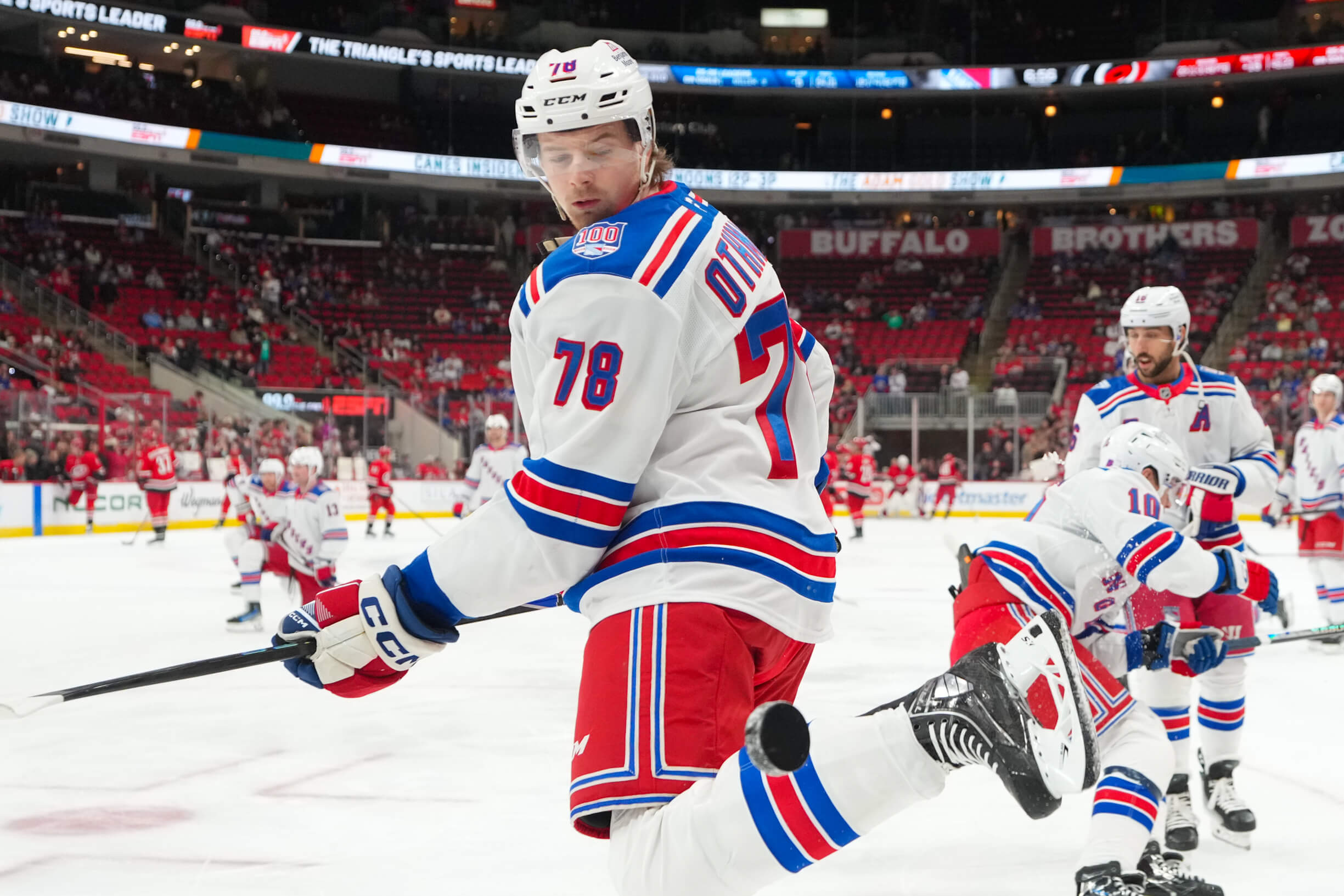
Brennan Othmann’s play has seen an upswing since the new year across the AHL and NHL. (James Guillory / Imagn Images)
Othmann finally turning the corner?
One player we know the Rangers have had trade discussions about is Othmann, who was recalled Sunday and promptly inserted into the lineup for Monday’s 4-2 loss to the Seattle Kraken.
There may have been an element of showcasing behind that decision, but coach Mike Sullivan was adamant about the 23-year-old winger earning his latest look, saying, “His last five or six games have been his very best down there in (AHL) Hartford.” That echoes what I’ve been hearing, with one source saying Othmann has been the Wolf Pack’s best forward “by a mile” to start the new year.
Earlier this season, a scout told The Athletic it looked like Othmann was suffering from “an identity crisis.” He was reeling from the disappointment of getting cut from NHL training camp, then quickly saw his name pop up in trade rumors. All the while, the 6-foot, 192-pounder was trying to prove he could fill the role Sullivan and the Rangers envisioned for him: a physical force in the bottom six who agitates opponents and chips in timely goals.
It led to overthinking and pressing, with Othmann often skating himself into mistakes as a result of trying to do too much.
“If you look at the past teams I’ve been on, it’s always been a top-six player or first line, and play in all situations. Then here, you’ve kind of got to work into that, and you’ve kind of got to earn that a little bit more,” he told The Athletic on Monday. “I don’t know if it’s unlucky, but it’s just, since I’ve been here, there’s been three different coaching staffs. Towards the end of last year, you kind of think you’re building up trust with that coaching staff, and then another new coaching staff comes in.”
Othmann’s first attempt fell flat. He made his season debut on Oct. 26 in Calgary and committed a couple glaring defensive errors, which prompted Sullivan to bench him for the rest of the road trip.
“It sucks,” Othmann said. “I was disappointed in myself.”
It would take nearly a month to get another chance, and when he returned for a five-game NHL stint around Christmas, the results weren’t much better.
Othmann was sent back to Hartford on New Year’s Day, but this time he resolved to play freer. He credited Wolf Pack coach Grant Potulny for reviving his confidence with ample ice time, which led to a five-game point streak with four goals in that span. The points bolstered his case for a third recall, but his purposeful all-around play, which included a nose for forcing turnovers and drawing penalties, also drew positive reviews.
There’s still a long way to go to restore his status as a promising prospect, but there have been glimmers of hope the last couple weeks.
“I’ve been more worried about playing winning hockey and playing the right way, and it’s just kind of been working for me,” said Othmann, who played his best game of the season for the Rangers on Monday and just missed his first NHL goal while hitting the post twice. “You can’t really change the past of how you played or what the decisions were. You can only worry about the now.”