
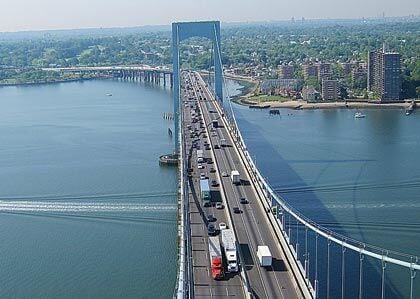
The Throgs Neck Bridge opened to the public on Jan. 11, 1961. So how did the Metropolitan Transportation Authority celebrate on Sunday?
“We had a party for people who work on the bridge,” said Nellie Hankins, an archive assistant with MTA Bridges and Tunnels. There was cake, coffee and bagels.
“But we didn’t sing happy birthday,” Hankins said.
While it opened 32 years after the Bronx-Whitestone Bridge, Hankins said the spans are considered sister bridges.
“The idea is that they’re meant to serve similar members of the driving public,” Hankins told the Chronicle. “The Throgs Neck takes a lot of truck traffic that the Whitestone doesn’t in part because the Whitestone is a much older bridge [opening in 1939]. They really occupy two different ideas of what urban planning was going to look like.”
Their links go back to before the Whitestone was approved to connect Queens, Long Island, New England.
Hankins said Throggs Neck (yes, two Gs) was under consideration back in the 1930s, but was passed up because the area did not have the connecting roadways to places where people wanted to go.
The end of World War II actually set the stage.
“The baby boom is starting and population centers are shifting, with people moving out to Long Island,” she said. “People were using the Bronx-Whitestone Bridge more. The traffic stats more than doubled between 1946 and 1950. And they doubled again between 1950 and 1960.”
The Throggs Neck area still lacked the connective infrastructure; but the Whitestone was being overwhelmed.
“It was clear that the Bronx-Whitestone was getting hit a lot,” Hankins said,
But in 1956, the Interstate Highway Act passed, and things began to move very quickly.
“So now you not only had the money and the willingness to build, you had the willingness from the federal government on down and from the city and state governments up to build connecting highways,” Hankins said.
A Throgs Neck bridge was recommended as part of a 1955 report from the Triborough Bridge and Tunnel Authority and the Port Authority of New York and New Jersey.
Othmar Ammann, who had designed a number of bridges in the tri-state area, was selected. One G was dropped from the name.
“He designed the Bronx-Whitestone, so he was familiar with the area,” Hankins said. And he chose to make his creation toned down, but still pleasing to the eye.
“There weren’t a lot of froufrous,” she said. “He wanted a bridge with clean lines that would stand the test of time.”
Ground was broken in October 1957 with just over two years needed for planning and financing. Less than four years later, the ribbon was cut and the first passenger cars crossed. It cost $91 million in 1961 dollars.
Hankins noted its location above Ft. Schuyler, which now hosts SUNY-Maritime College. She said the ideal geology and geography for a fort and a bridge are very similar.
And since 1983, the Bronx tower has hosted nesting peregrine falcons, who now have a private nesting box. Every new chick is banded.
“We’re proud of that,” Hankins said.