
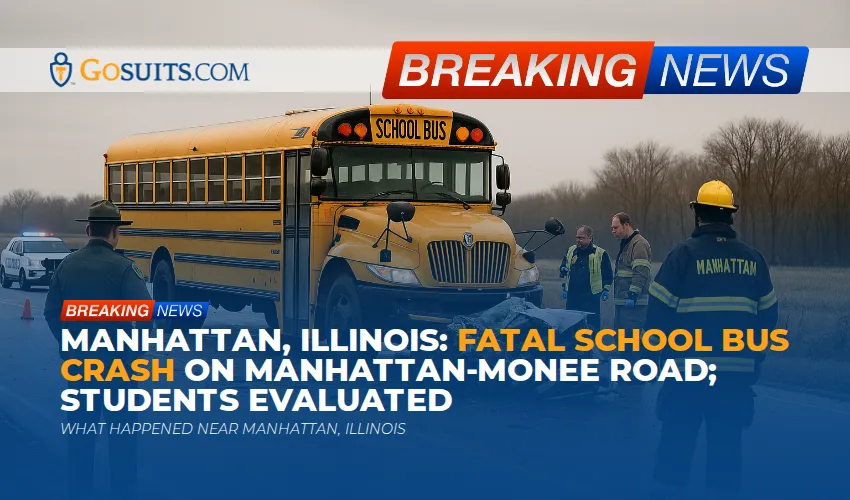
What happened near Manhattan, Illinois
On a Thursday morning southwest of Chicago, a serious crash occurred on Manhattan-Monee Road near Schoolhouse Road, just east of the Village of Manhattan in Will County. According to state police, a car collided with a school bus. The driver of the car was killed. The school bus driver and the ten students on board were transported to a nearby hospital to be medically evaluated. Authorities closed all eastbound and westbound lanes of Manhattan-Monee Road while the investigation was underway. As of late morning that day, the roadway remained shut as law enforcement continued their on-scene work.
Details released publicly so far are limited. Law enforcement has not issued a full causation report, nor have they publicly identified the deceased driver in initial updates. This is typical in the first hours after a catastrophic crash, especially when multiple agencies coordinate scene documentation, vehicle inspections, and witness statements.
Location context along Manhattan-Monee Road
Residents in Manhattan know this stretch of Manhattan-Monee Road well. It serves families commuting to and from local schools, small businesses, and farm properties east of town. It is also a connector toward Monee and, farther west, the I-57 and I-80 corridors that feed daily traffic into and out of the Chicago Southland. Schoolhouse Road itself is a familiar north-south local route, with open fields that can produce strong crosswinds, drifting snow, and glare at sunrise in winter.
On weekday mornings, school buses move through this corridor on timed routes. It is not unusual to see buses stopping for student pickups, with flashing reds and stop arms extended. Even when buses are in through-travel, drivers in Will County understand these vehicles are larger and slower to stop than passenger cars. The mix of rural roadway geometry, occasional limited sightlines near curves or tree rows, and variable winter traction can complicate decisions in the seconds before a crash.
Injuries, hospital evaluations, and immediate response
The early reports indicate that the school bus driver and the students on board were taken to an area hospital for medical evaluations. In similar incidents, receiving facilities triage for hidden injuries like concussions, whiplash, and abdominal trauma that may not show symptoms right away. Children can sometimes seem fine initially and then develop headaches, nausea, or stiffness later that day or the next morning.
Emergency response in Will County typically involves local fire protection districts, paramedics, and law enforcement coordinating under an incident command at the scene. For a school bus crash, protocols often include contacting school district administrators and establishing a reunification plan. If you are part of the local school community, you may have seen temporary staging areas or school notifications while the scene was secured and students were accounted for.
How school bus crashes are investigated in Illinois
Illinois law enforcement commonly follows a structured process after a fatal traffic crash. Investigators document vehicle positions, measure skid marks, chart roadway conditions, and photograph damage. They may also collect data from vehicle event data recorders if available. When a school bus is involved, agencies pay close attention to bus maintenance, driver qualifications, and compliance with required safety equipment.
Depending on jurisdiction, the Illinois State Police may lead or co-lead the investigation, particularly on state or county routes. State Police maintain crash reports and provide guidance on how parties can request them once finalized [1]. For broader Illinois crash trends and context, the Illinois Department of Transportation publishes annual crash facts and statistics that help frame how and where serious collisions occur statewide [2].
How to obtain official records: police reports, autopsy, and death certificates
Police traffic crash report
Once the report is complete, involved parties and next of kin can typically request a copy through the Illinois State Police crash reports portal [1]. If a county or municipal agency was primary at the scene, that department may also have a copy or supplemental report. If you are unsure which agency holds the record, start with the State Police portal and then confirm with local authorities referenced on the receipt or case number provided at the scene.
Coroner and autopsy records
When a traffic fatality occurs in Illinois, the county coroner has statutory responsibilities to investigate the death and, when warranted, perform an autopsy. The Illinois Counties Code outlines coroner powers and duties for such investigations [9]. In Will County, the coroner’s office typically maintains records such as the autopsy report, toxicology, and cause and manner of death determinations. Next of kin may request copies pursuant to applicable rules. While many counties publish request procedures on their official sites, families may also confirm general rights and processes under state law or consult with counsel for help navigating requests.
Death certificates
Death certificates are managed through the Illinois Department of Public Health’s Vital Records program, with local registrars assisting in many cases. IDPH provides guidance on how to obtain death records, eligibility, and required identification [8]. Funeral homes often help initiate this process, but families can also request certified copies directly from the state once the record is finalized.
Freedom of Information Act requests
Some materials can be requested through the Illinois Freedom of Information Act, subject to exemptions for privacy and ongoing investigations. The Illinois Attorney General provides FOIA guidance for the public on how to make a request and what to expect in response timelines [10].
Possible civil liability paths under Illinois law
It is too early to know exactly how this crash unfolded, and we will not speculate. In Illinois, liability in motor vehicle collisions generally turns on negligence: whether a driver failed to use reasonable care under the circumstances. If the facts ultimately show that one or more parties did not act reasonably, the law allows injury victims or next of kin to pursue claims. Importantly, Illinois uses a modified comparative negligence framework. If a claimant is less than 50 percent at fault, their recovery is reduced by their share of fault. If they are 50 percent or more at fault, they are barred from recovery [5].
In a school bus crash, potential defendants can vary depending on what the evidence shows. Possibilities can include the bus driver’s employer, a third-party driver, a vehicle manufacturer if a defect contributed, or a maintenance contractor. Public entities have additional notice requirements and defenses, so documenting the timeline and preserving records is essential. Wrongful death claims in Illinois are governed by the Wrongful Death Act, which allows certain family members to seek damages for the loss of their loved one [6].
In this kind of case, families often have questions about their rights, how damages are calculated, and which insurers are involved. Speaking with seasoned counsel early helps ensure that key deadlines are met and that evidence like dashcam footage, bus GPS logs, and intersection camera video is requested before it is overwritten. If you are weighing your options and want a practical overview tailored to our region, this resource may help: What to do after a car accident in Chicago.
Insurance issues after a school bus crash
When a school bus is involved, multiple insurance layers may apply. There can be the policy for the bus operator or district, the policy for the private vehicle, and potentially underinsured or uninsured motorist coverage. If the car driver who died was not at fault, the estate representative may pursue a claim that includes wrongful death damages. Where student injuries are involved, child claims must account for both immediate medical care and the possibility of delayed symptoms or long-term needs.
Insurance carriers commonly reach out to witnesses and injured individuals quickly to obtain statements. Before speaking with any insurer, it is wise to consult an attorney. What someone says early on can be used against them later, even when intended as a simple recap. Insurance companies often ask broad questions and may request authorizations to comb through medical histories beyond what is relevant. In Illinois, claim timelines, settlement discussions, and medical lien issues can become complex. An initial conversation with car accident lawyers can clarify which records you must share and which requests overreach.
In a community like Manhattan, where neighbors often know the families involved, there is a natural urge to move quickly. That urgency should be balanced with careful documentation and measured communications. If legal help is considered, many residents prefer someone familiar with Will County roads and the broader Chicago Southland environment. Working with Manhattan car accident lawyers who understand local conditions can help align investigation steps with what we see seasonally on these routes.
Winter driving realities in Will County
January mornings can be unforgiving on rural corridors. Black ice, refreeze from melting snow, and low sun angles can combine to create sudden hazards. The Illinois Department of Transportation’s winter driving guidance emphasizes slower speeds, increased following distance, and strategic braking to maintain control in low-traction conditions [7].
Even when precipitation is minimal, overnight frost can cling to bridge decks and shaded stretches near tree lines. Drivers approaching buses, farm equipment, or intersections like Schoolhouse Road should anticipate unexpectedly low grip and longer stopping distances. A safe approach includes scanning far ahead, protecting space around larger vehicles, and ensuring headlights are on during dawn hours.
Data and context: school bus safety and crash trends
School buses remain one of the safest ways for students to travel, thanks to vehicle design, compartmentalization, and strict driver requirements. National Highway Traffic Safety Administration materials explain that while school transportation-related crashes do occur, a relatively small fraction of the people killed in those crashes are occupants of school transportation vehicles. Most victims are occupants of other vehicles and vulnerable road users outside the bus [3].
At the same time, crashes involving buses draw significant investigative attention due to the number of passengers, public interest, and duty-of-care considerations. The Federal Motor Carrier Safety Administration tracks national data on large truck and bus safety that helps inform policy and training priorities [4].
Closer to home, Illinois publishes annual crash facts and statistics that break down fatalities, serious injuries, roadway types, and contributing factors. While the state-level datasets are not a substitute for a specific crash investigation, they are useful for understanding broader patterns on rural county roads, including speed, weather, and time-of-day influences [2].
Preserving evidence and protecting rights in the first 72 hours
For families and community members affected by a crash like this, those first few days matter. Key information can be lost if action is delayed. Without speculating about fault, here are practical steps people often consider after serious collisions in the Chicago Southland:
Document injuries and symptoms. Keep a dated journal of pain, headaches, sleep disruption, or cognitive changes. Children, in particular, may express discomfort indirectly or later. Consider re-evaluation if symptoms evolve.
Secure photos and video. Preserve any photographs of vehicle damage, the crash scene, road surface conditions, and visible injuries. Save phone metadata and back up files to cloud storage.
Identify witnesses. Write down names and contact details for anyone who saw the crash or its aftermath, including school personnel who arrived early. Witness recollections fade quickly.
Request nearby footage. Corner properties, farm driveways, and small businesses sometimes have security cameras facing the road. Politely ask owners to preserve footage and note camera angles and retention times.
Keep medical records organized. Create a folder for discharge instructions, imaging reports, and billing. If treated at multiple facilities, make a timeline.
Be cautious with insurance communications. Before any recorded statement, consult counsel so you understand which questions are appropriate and which are not.
If you live or work in the South Suburbs and often commute along Manhattan-Monee Road, consider reviewing a practical checklist that fits our region’s traffic patterns and weather. In addition to the steps above, this guide provides a helpful day-by-day approach during the first week after a collision: What to do after a car accident in Chicago.
Next steps: why acting soon matters
Serious crashes set a lot of processes in motion quickly. Acting promptly can make a real difference. Here is why timing matters, and what typically needs doing:
Preserve time-sensitive evidence. Intersection cameras, private security footage, and bus telematics may overwrite within days or weeks. Early requests help ensure this material is not lost.
Protect legal timelines. Illinois has strict statutes that limit how long claims can be pursued. Understanding which deadlines apply, especially with public entities, helps avoid losing rights by delay [6].
Coordinate medical care. Prompt follow-up appointments document injuries and connect symptoms to the collision. Gaps in treatment can be used to contest claims later.
Clarify insurance coverage. Sorting out which policies apply, how medical payments coverage works, and whether underinsured motorist coverage is available prevents surprises when bills arrive.
Manage communication. Keeping statements consistent, factual, and limited helps reduce misunderstandings. Written communications are often better than off-the-cuff phone calls.
What is the exact thing to do now? Identify and preserve the records that can vanish quickly, including potential video and electronic data, and organize medical documentation from the start. Why act now? Because critical footage, bus GPS logs, and third-party witness details can be gone in a week, and those pieces often determine reconstruction outcomes. When should this happen? Ideally within 24 to 72 hours, while memories are fresh and data is still retrievable. Where does it matter most? At and around the roadway corridor itself, at nearby properties with cameras, and at any medical facilities that saw patients in the immediate aftermath.
Commentary from Gosuits Manhattan, Illinois Personal Injury Attorney
Our hearts are with everyone affected by this crash east of the Village of Manhattan. For the family of the driver who lost their life, and for the students, bus driver, and first responders who experienced a frightening morning, we extend sincere sympathy. This article is intended for education and general information.
From a civil injury standpoint, a thorough, independent look at what happened on Manhattan-Monee Road is essential. Investigators will examine visibility, road surface conditions, sightlines near Schoolhouse Road, vehicle dynamics, and any electronic data. We commonly see that a single second of misjudgment or an unexpected traction change can have cascading effects when heavy vehicles and school buses are involved. Careful reconstruction helps answer the two hardest questions families ask after a tragedy: how and why.
Insurance companies and corporate defendants often move fast to frame the narrative. Adjusters may request recorded statements before people have even had a follow-up medical visit. They may send broad medical authorizations or imply that early settlement is the simplest path. That approach can take advantage of unfamiliarity with the process and the stress families are under. Knowing what you are required to share and what you are not is vital. Understanding comparative fault rules and potential damages under Illinois law helps level the playing field [5] [6].
It is important to speak with an attorney for a free consultation before giving statements to any insurer. A brief conversation can clarify rights, identify time-sensitive evidence to request, and outline which steps to take first. What someone says to an insurer can be used later in ways that may not be obvious at the time. Even if you choose not to pursue a claim, understanding your options early is a prudent step for your family.
References
Crash Reports – Illinois State Police
Illinois Crash Facts and Statistics – Illinois Department of Transportation
School Bus Safety – National Highway Traffic Safety Administration
Large Truck and Bus Crash Facts – Federal Motor Carrier Safety Administration
735 ILCS 5/2-1116 – Comparative fault – Illinois General Assembly
Illinois Wrongful Death Act – 740 ILCS 180 – Illinois General Assembly
Winter Driving – Illinois Department of Transportation
Death Records – Illinois Department of Public Health
Illinois Coroners and Medical Examiners – 55 ILCS 5/ – Illinois General Assembly
FOIA for the Public – Office of the Illinois Attorney General
School Bus Driver and Vehicle Safety – Illinois Secretary of State
This article is provided solely for general informational and educational purposes. It is not intended as legal advice and should not be relied upon as such, particularly by individuals affected by the incident discussed. Reading this article does not create, nor is it intended to create, an attorney–client relationship.
An attorney–client relationship with our firm can only be established through the execution of a written contingency fee agreement signed by both the client and the law firm. If you are a victim of this incident, you should not interpret the information herein as legal advice. Instead, we strongly encourage you to contact an attorney of your choice to obtain a proper consultation tailored to your specific situation.
Some or all of the information found on this site maybe generated by AI. Images of the scene of the incident are not real images and are created by AI. We do not guarantee the accuracy of the research and infromation found here. You agree to indemnify, defend, and hold Gosuits and the affliated companies harmless for damages or losses caused by you or another party due to any access to or use of the Services on this website or any information contained therein whether authorized or unauthorized. We will not be liable for any information or access caused by unauthorized disclosure of your information by any third party. You agree to notify us in writing immediately if you suspect any unauthorized use of or access of your information from this website by a third party.
We rely on the information found on the net and do not always have first hand knowledge of the matters. If you find any information here inaccurate or offensive contact us and we will have it immediately removed.
By using this website you are agreeing to these terms and conditions along with our terms and conditions on our disclaimer page.
If you would like this article removed, please call 800-972-4355 and ask for Sean Chalaki, who will assist you with your request.